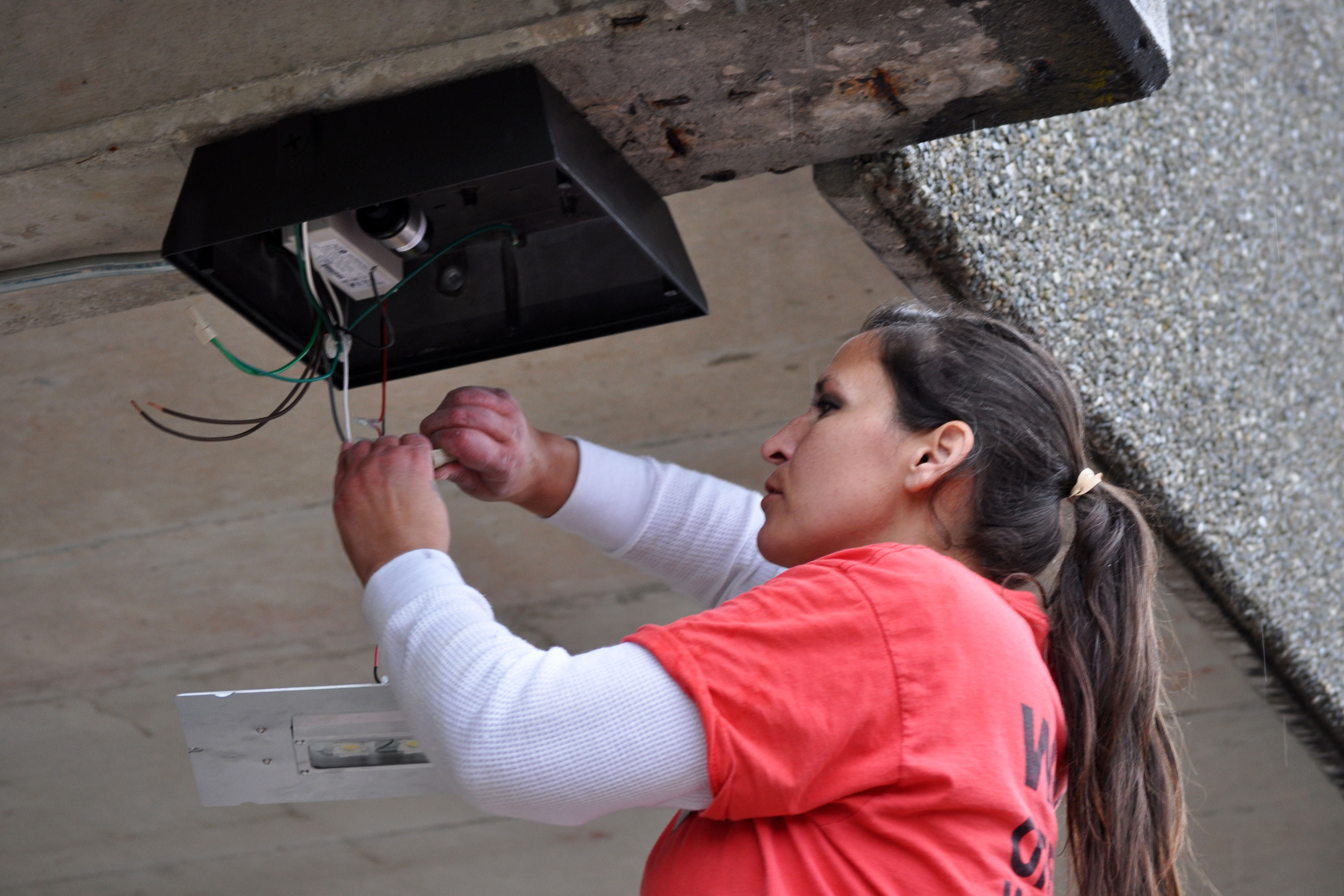
An inmate-electrician at Washington Corrections Center for Women updates a light fixture in the main courtyard. Photo by Jody Becker-Green.
According to Brian Tinney, Assistant Secretary for the Administrative Services Division, Washington State DOC has purchased 1,353 new LED light fixtures in the last 60 days. The LED light fixtures are far more energy efficient than the those they replace, and DOC expects to save 1.1 gigawatts of electricity in the first 50,000 hours following installation. Saving 1.1 gigawatts is the same as saving 1.1 billion watts, almost enough to power the DeLorean in Back to the Future.
SPP’s new director for DOC, Steve Sinclair, played a pivotal role in the new commitment to LED technology. He inspired facility managers to embrace the idea, and created the purchasing plan to make replacement and retrofits easily achievable.
The next LED challenge will be in converting prison perimeter lighting—switching to LED technology so that outdoor evenings are safe and well-lit, but less expensive than they have been.
by Liz Louie, SPP Butterfly Technician
Introduction by Lindsey Hamilton, SPP Butterfly Program Coordinator
Butterfly technician Elizabeth Louie worked with the Taylor’s checkerspot butterfly (TCB) program at Mission Creek Corrections Center for Women (MCCCW) for more than two years. She is now one of the few butterfly husbandry experts in the world. During her time at Mission Creek she made many significant contributions to the program. She streamlined data collection procedures and created an immaculately organized system for tracking daily activities and progress. She always found creative solutions to problems when resources and communication with outside expertise was limited. Lastly, as a senior butterfly technician she ensured high quality butterfly care and effectively trained and inspired incoming technicians. The program will benefit from her good work for years to come. Liz will be missed, but we are so happy for her and wish her the best in all that she pursues in life.
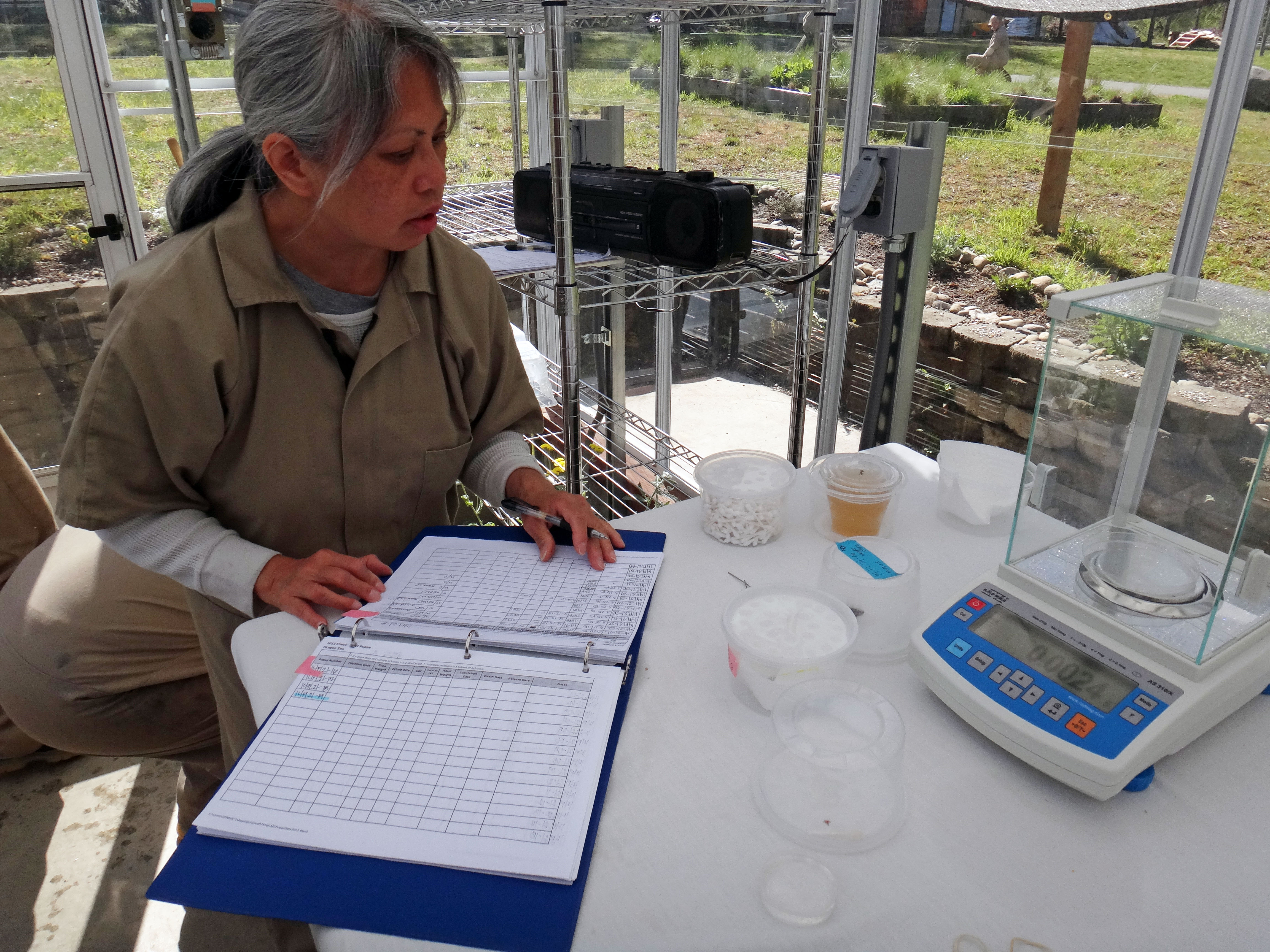
Liz Louie records data on pupae and butterfly weights.
The following is a blog written by Elizabeth Louie, now out of prison in work release:
It has been 26 months and three seasons, with two Sustainability in Prisons Project (SPP) bosses and three Department of Corrections (DOC) bosses, releasing approximately 8,000 caterpillars and 250 butterflies to the wild. I have come to the end of an amazing journey. As I leave Mission Creek and the TCB program, I want to say THANK YOU for the experience.
It seems appropriate that I’m leaving just as the caterpillars are going into diapause. All the hard work caring for larvae, pupae and eclosing butterflies, conducting breeding and collecting eggs is now done. It’s now a transition period. A period of rest before the cycle begins again, similar to the stage I’m in now. Work release, a time of transition and preparation for my final release into the community.
Liz Louie explains the details of butterfly husbandry to the University of Denver’s Institute for Human – Animal Connection. Photo by Judith Gerren
A writer from Sierra Magazine recently asked what I thought about the irony of having a butterfly program in prison; the contrast between the delicate, fragile butterfly and the “harshness” of prison life. For me, butterflies are very resilient animals. Their primary habitat was an artillery range, the aftermath of fire and destruction. Metaphorically, the butterfly symbolizes re-birth, new life and beginnings. So with that said, Mission Creek (prison) makes a lot of sense for a surrogate habitat.
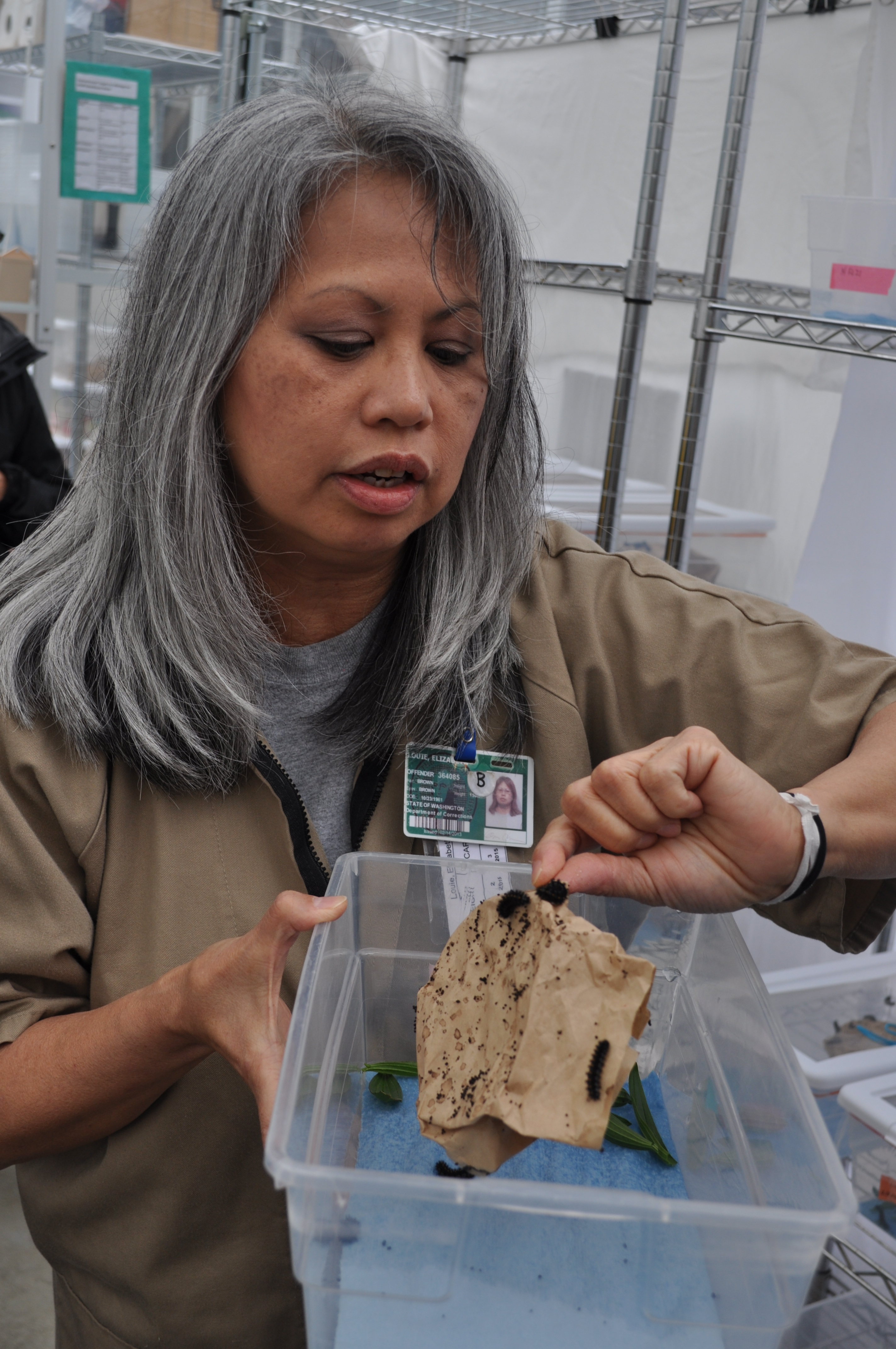
Liz is demonstrating how we care for postdiapause larvae. We keep them in bins with paper bags (“mima mounds”) to climb on after they wake up from their winter slumber. Photo by Jody Becker-Green
In fact, there are other parallels between the butterflies and prison life. The larvae will sometimes go into second diapause (D2) if they feel conditions are not right. Maybe there’s not enough food, so the larvae will go back to sleep. Similar to D2 larvae, women come in and out of prison. They may not have gotten what they needed from prison the first time, or they lack outside support to help them be successful. But for me personally, at my age, its good to know that the final stage is a butterfly. It means the most beautiful stage of my life is yet to come. All the other stages have been in preparation for that final one.
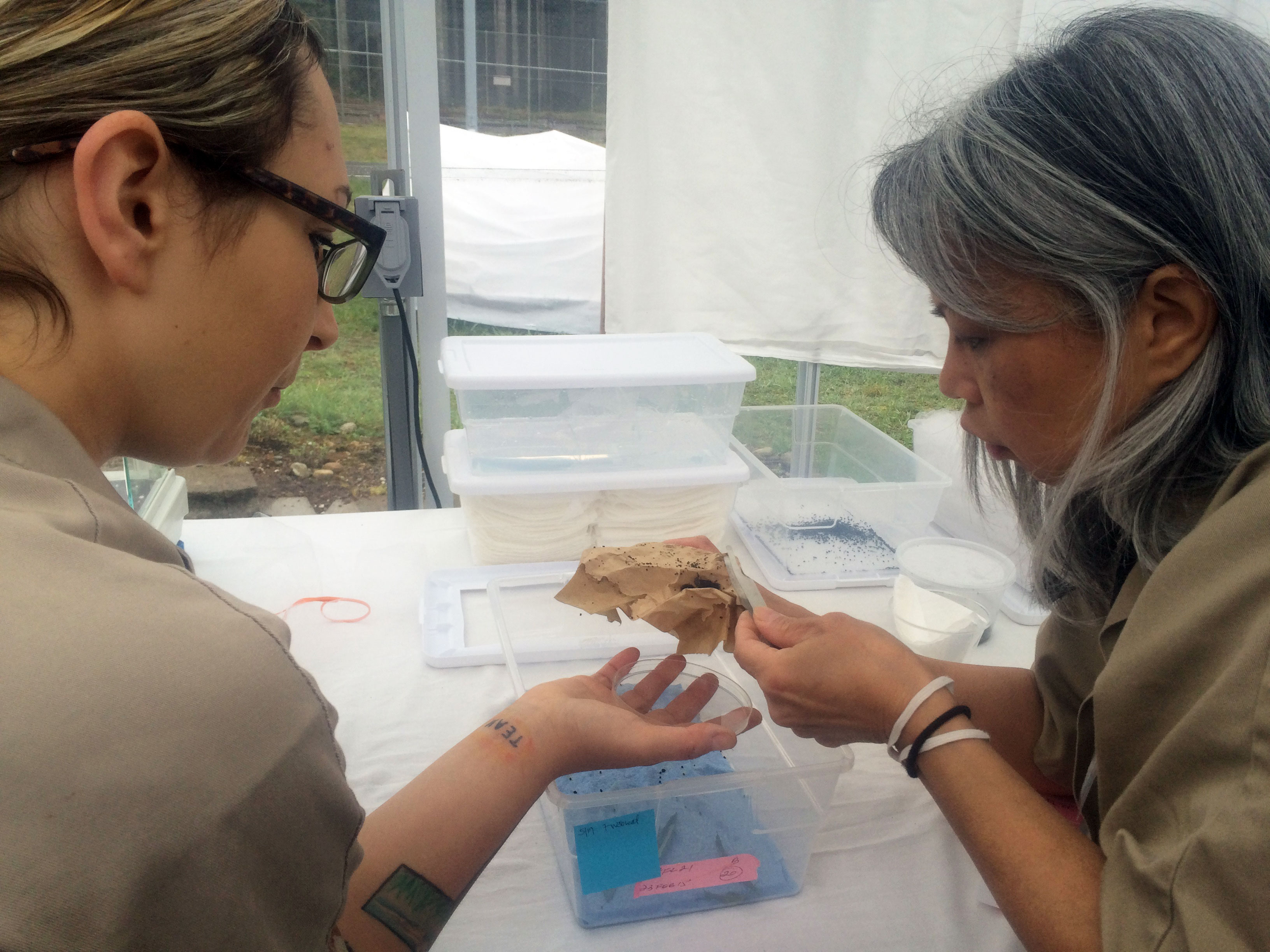
Liz Louie shows inmate Samantha Turner how to remove a new pupae from a “mima mound”. This is a very delicate process.
This will be a time in my life that I won’t soon forget. The people I’ve met and the women I’ve worked with, I take away something from each of them. I’ve learned a lot about myself, both the good, and the things I need to change. I have a greater appreciation for the simple things in life. I walk away a stronger person and look forward to whatever life holds.
Inmate Liz Louie feeds a Taylor’s checkerspot honey water from a Q-tip. Photo by Benj Drummond and Sara Joy Steele.
Introduction by SPP Frog and Turtle Program Coordinator, Sadie Gilliom. Blog by SPP Frog and Turtle Program Inmate Technician, Mr. Anglemyer.
Mr. Anglemyer, the author of the following blog, is one of the inmate technicians for the Sustainability in Prisons Project’s Frog and Turtle Program at Cedar Creek Corrections Center (CCCC). Each technician brings unique skills to the program. We like to provide opportunities for all of the technicians to develop the skills they have in addition to learning new ones. Anglemyer is an aspiring journalist and expressed interest in writing about his experience with the frogs and turtles. The following blog is Anglemyer’s first piece. Although dark at times, I think he provides an interesting and important perspective to consider. It has given me insight into how working with an endangered species can stimulate deeper thoughts and self-reflection and how some aspects of the program may be improved by providing the technicians with more hopeful information for the future of the frogs and our world.
Rearing OSF Tadpoles at CCCC
Taking care of Oregon Spotted Frog [OSF] tadpoles is fairly easy…yet, stressful. It’s easy because the tadpoles pretty much take care of themselves. All we have to do is keep them supplied with food and clean water. The stress factor comes in the form of “unknowns” and “what if’s”. The “unknowns” are only a factor because of our lack of experience. When I say “we” and “our”, I’m speaking of me and my co-worker. We’re both prisoners at Cedar Creek Corrections Center, and neither one of us had ever heard of the Oregon Spotted Frog before we started working with them. The “what if’s” are: What if we make a mistake somehow, and they all die? What if we don’t make a mistake and they all die? What if it is thought that we were neglectful, incompetent, or even malicious?
Mr. Anglemyer holding an Oregon spotted frog. Photo by Sadie Gilliom.
I have no rational reason to have any of these fears. The staff at the prison and the people connected to the program have been helpful and supportive. They give us clear instructions and everything we need to carry them out. Furthermore, these fears are my own. My co-worker does not share them. I’ve always been a bit of a worrywart—it’s been a rough go. Once bitten, twice shy and all that jive. Murphy’s Law (what can go wrong, will go wrong) has been a constant companion in a large part of my life.
On top of all that, taking care of an endangered species engenders deeper and darker thoughts concerning mortality. Not just the existence and mortality of the animals under my charge, but of the entire species, and my own species as well. If the OSF is doomed, aren’t we all doomed? On a long enough timeline everything and everyone is doomed. Frogs, people, even our planet and solar system will one day be gone. If that were not the case, life would be bland and meaningless. Please don’t regard me as some type of banal armchair (or in my case, steel cot) philosopher for expressing these sentiments. I’m fully aware that these thoughts and feelings are not new and original. Since the first caveman contemplated his own navel, people have struggled with these notions. In the past, present, and future people have and will continue to ponder this stuff, until…well, until…there’s no one left to ponder anything (think about Buddhist teachings on impermanence, and Shelley’s poem Ozymandias). All I’m trying to relay is that working so close to a species that is close to the brink of extinction magnifies these feelings.
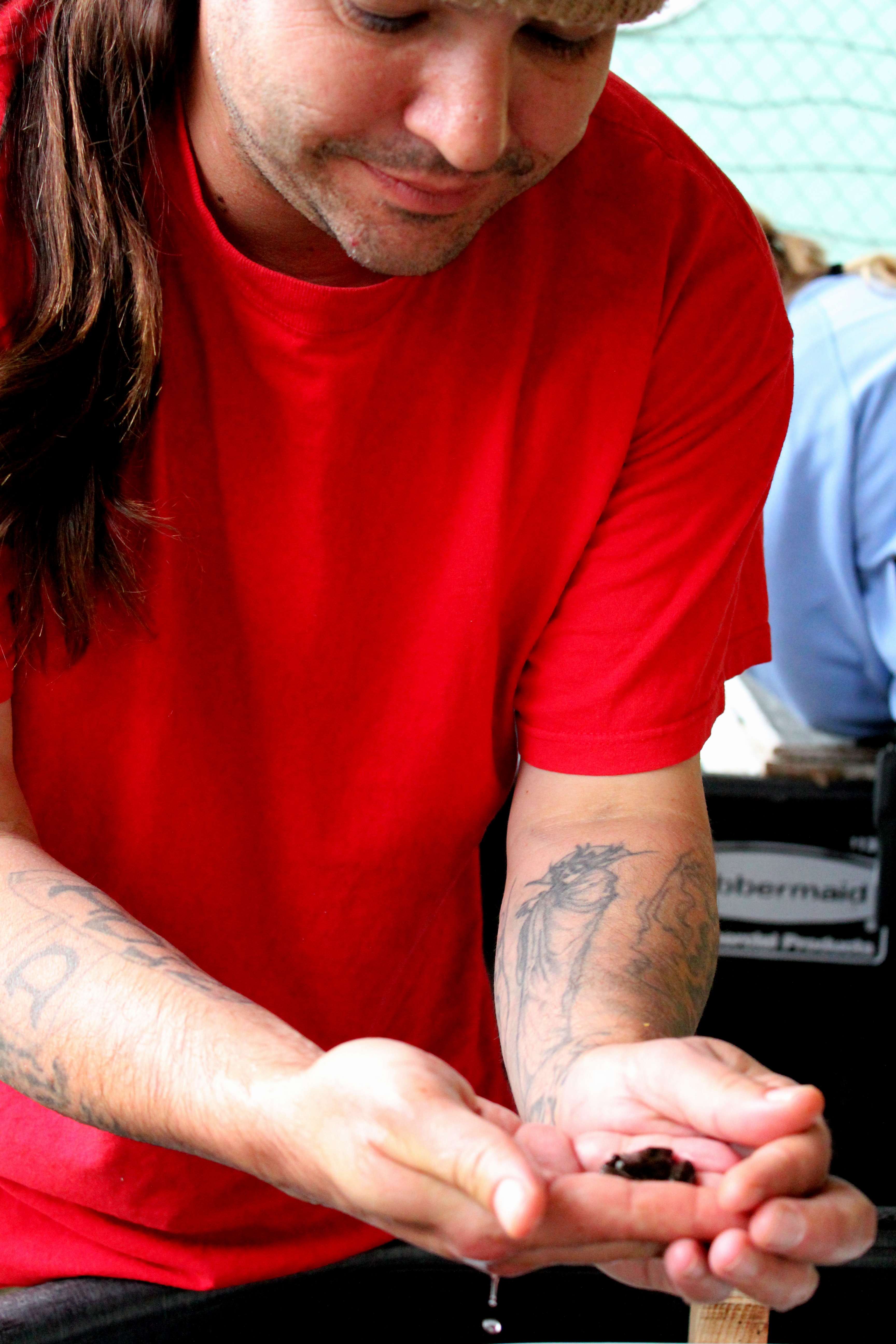
Now enough with the heavy stuff, apart from the above stresses, fears, and existential baggage, working with the Oregon Spotted Frogs is extremely rewarding. It’s the most interesting thing that I’ve taken part in in the last decade—and I’ve only been in prison for half that last decade. In that last half decade, I’ve been relegated to necessary yet menial work; I spent three years mopping a top tier at Coyote Ridge. So working with endangered animals is a new and stimulating change. Watching the tadpoles change into frogs and documenting these changes, studying conservation biology, working with people from an educational, rather than, a correctional setting is a great experience. I’ve been exposed to critters that I would’ve only read about. Caring for them connects me to them in a way that reading about them alone would not. And through this connection to these creatures I’m connected in a larger way to the plight of all the other species that will soon no longer be because of my and my species affinity, no, not affinity, rather addiction to strip malls and track housing.
And the great hope that can be taken from the existence of programs like these in the prison sphere, an area of society that is traditionally punitive and reactionary, is that maybe the pendulum is swinging towards a more compassionate world.
by Joslyn Rose Trivett, SPP Network Manager
Stephen Sinclair has replaced Dan Pacholke as the Assistant Secretary for the Prisons Division with the Washington State Department of Corrections. With the new position, he has graciously accepted serving as Co-Director for the Sustainability in Prisons Project (SPP). Stephen has already shown himself to be a knowledgeable and capable leader for SPP, and we are thrilled to have him on board.
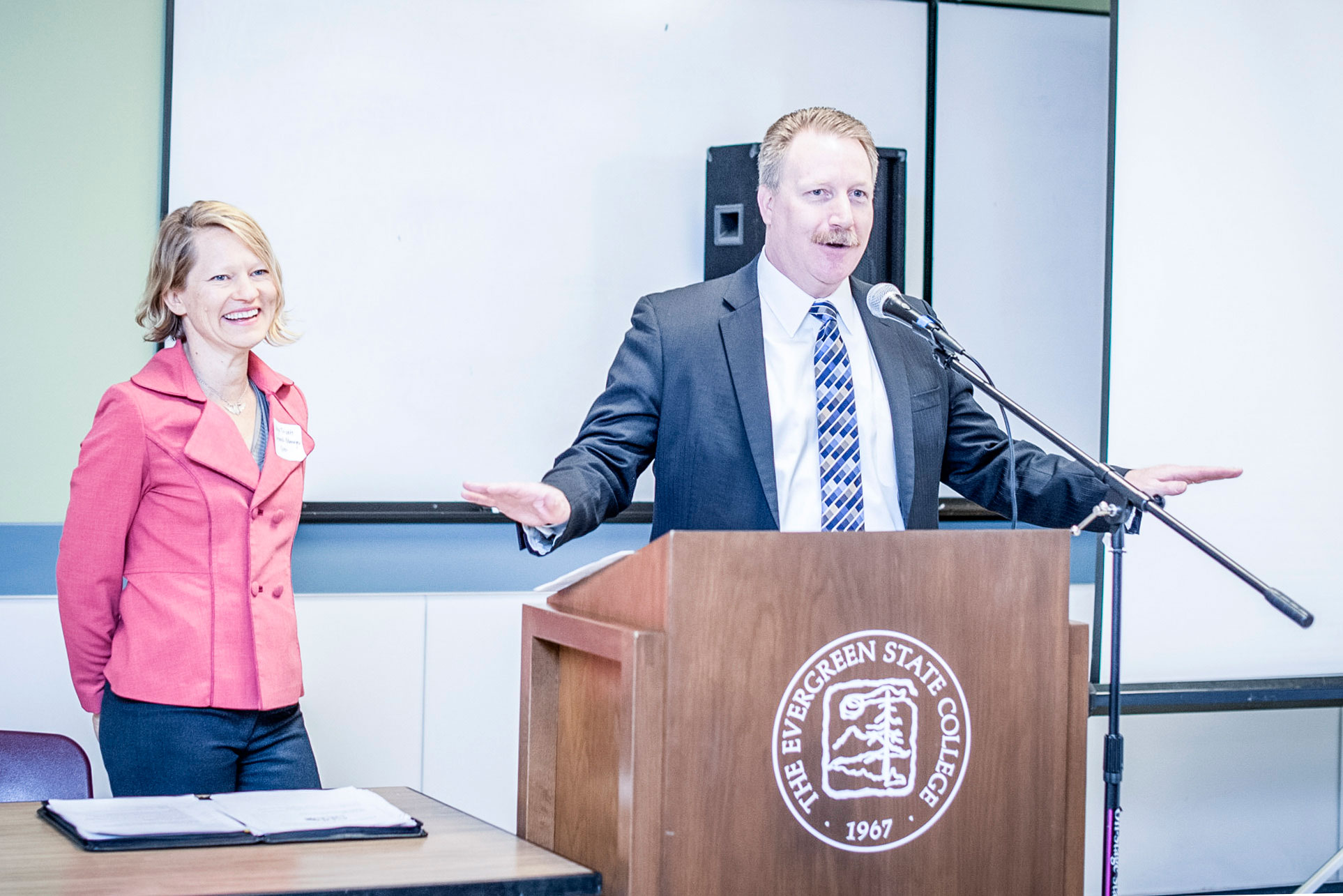
Steve Sinclair and Joslyn Rose Trivett emceed SPP’s Statewide Summit, a two-day meeting in April, 2015. Photo by Karissa Carlson.
Stephen takes over as Co-Director for SPP from his esteemed predecessor, Dan Pacholke. Dan was one the founders of SPP, and his inspiration and creativity have helped make SPP what it is today. We have no doubt that Stephen will continue to rally WDOC’s sustainability culture; he is dedicated to a more humane and sustainable way of running prisons.
We would like to take this opportunity to thank Dan Pacholke for his tireless years of service and dedication to SPP. We are grateful Dan will continue to be involved in SPP, now as a Senior Advisor. We warmly welcome Stephen Sinclair to his new role as Co-Director for SPP. Thank you to you both!
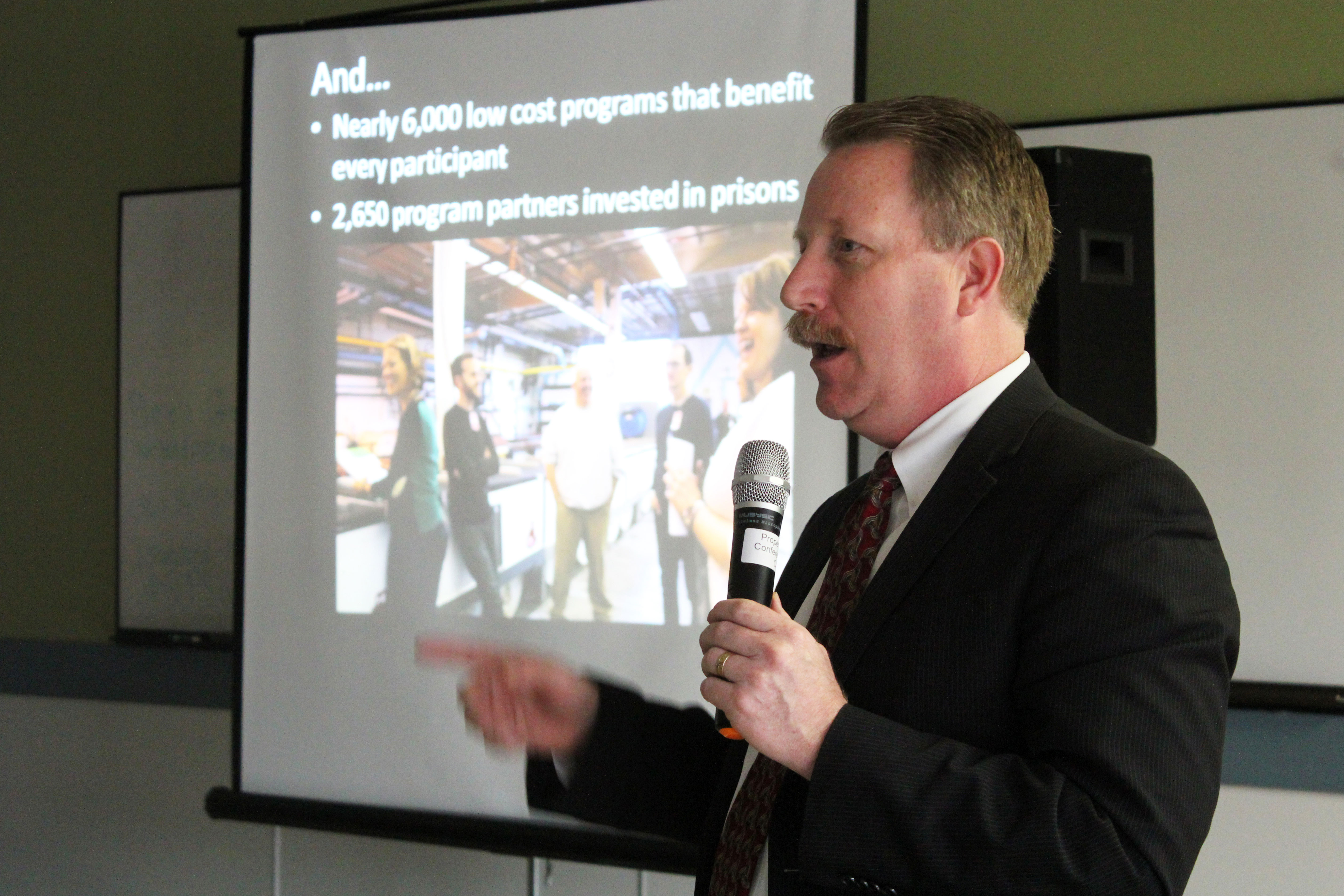
Steve Sinclair presents on SPP’s future to more than 100 DOC, Evergreen, and program partners. Photo by Joslyn Rose Trivett.
Written June 11, 2015
Joey Burgess, SPP Ecological Conservation Nursery Coordinator and Graduate Research Assistant
All photos by Joey Burgess
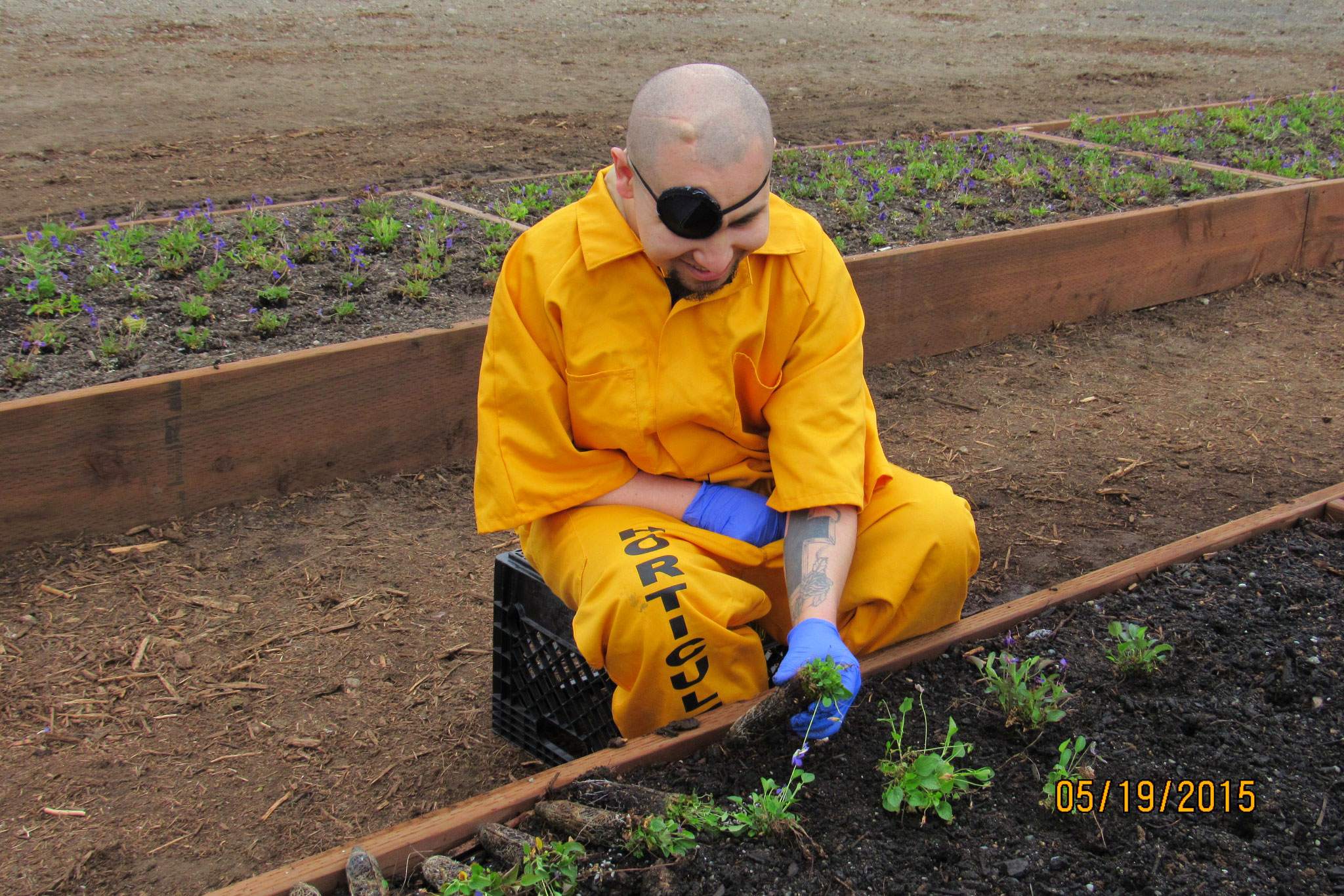
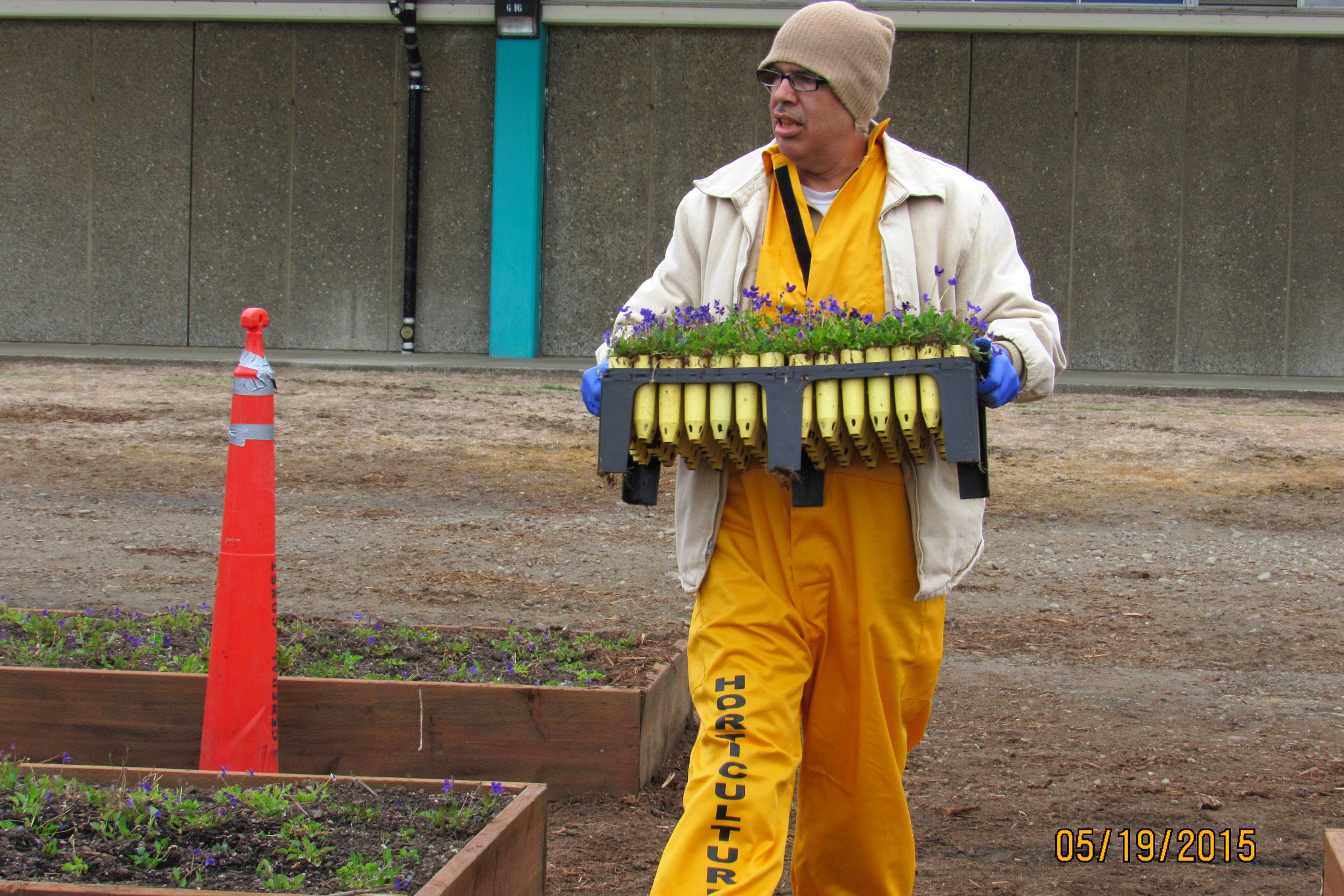
A horticulture student in the Skill Builders Unit at Washington Corrections Center (WCC) tends to native violets in the prison’s new seed beds.
My first two months working with the Sustainability in Prisons Project (SPP) was characterized by collaboration and progression, both of which I consider keystone concepts for sustainability. At Washington Corrections Center, a men’s prison near Shelton, WA, we partner with Centralia College, Washington State Department of Corrections (WDOC) staff, and inmates with cognitive impairments to raise Viola adunca (early blue violets) for seed. The project holds novelties for everyone involved and it has flourished thanks to flexibility and open minds.
A horticulture student carries a rack of early blue violets that are ready to be planted.
Because of precautionary protocols, making infrastructure changes within the walls of a correction facility is not a speedy process. However SPP, WDOC, & Centralia College have truly united and the effect has been excellent. After only three months the violets are flowering, and we have already started harvesting seed. Our success is not limited to the health of the violets; it is also evident in the mental health and progression of the inmates.
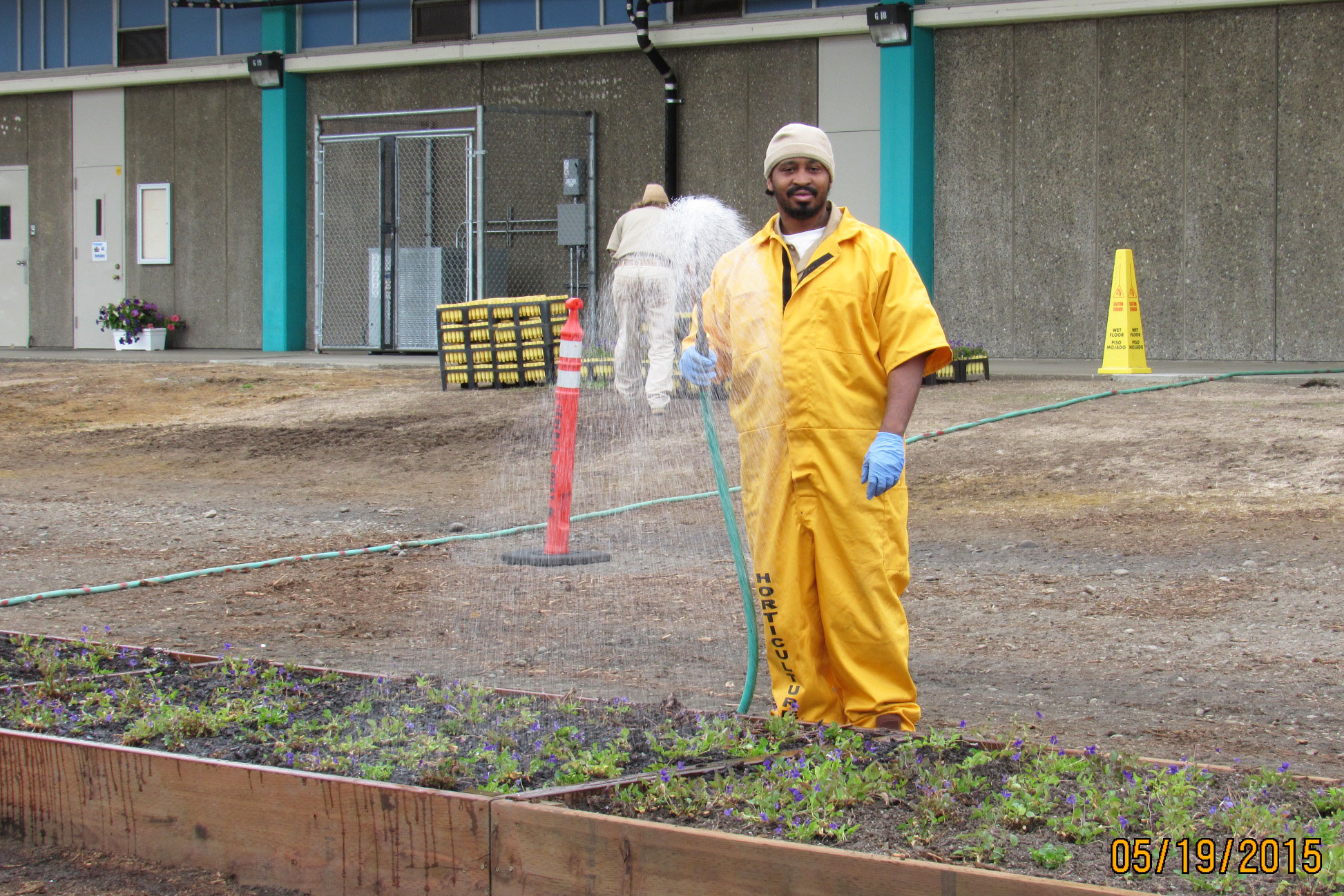
Another member of the class-and-crew hand waters violets.
An interest in horticulture is an inmate’s ticket to the project, but dedication keeps him there. Whether it’s planting, watering, cultivating, or harvesting, we focus on one skill at a time. We encourage each person to find a connection to the work. This holistic approach has created an atmosphere of personal and community development. Inmates are brimming with questions about the broad scheme of SPP, and how they can find similar work upon release. Also, it has been surprisingly common for WDOC officers and administrators who are not involved in the project to ask how they can help, even going out of their way to arrange for our 9,000+ violets to be watered over hot weekends.
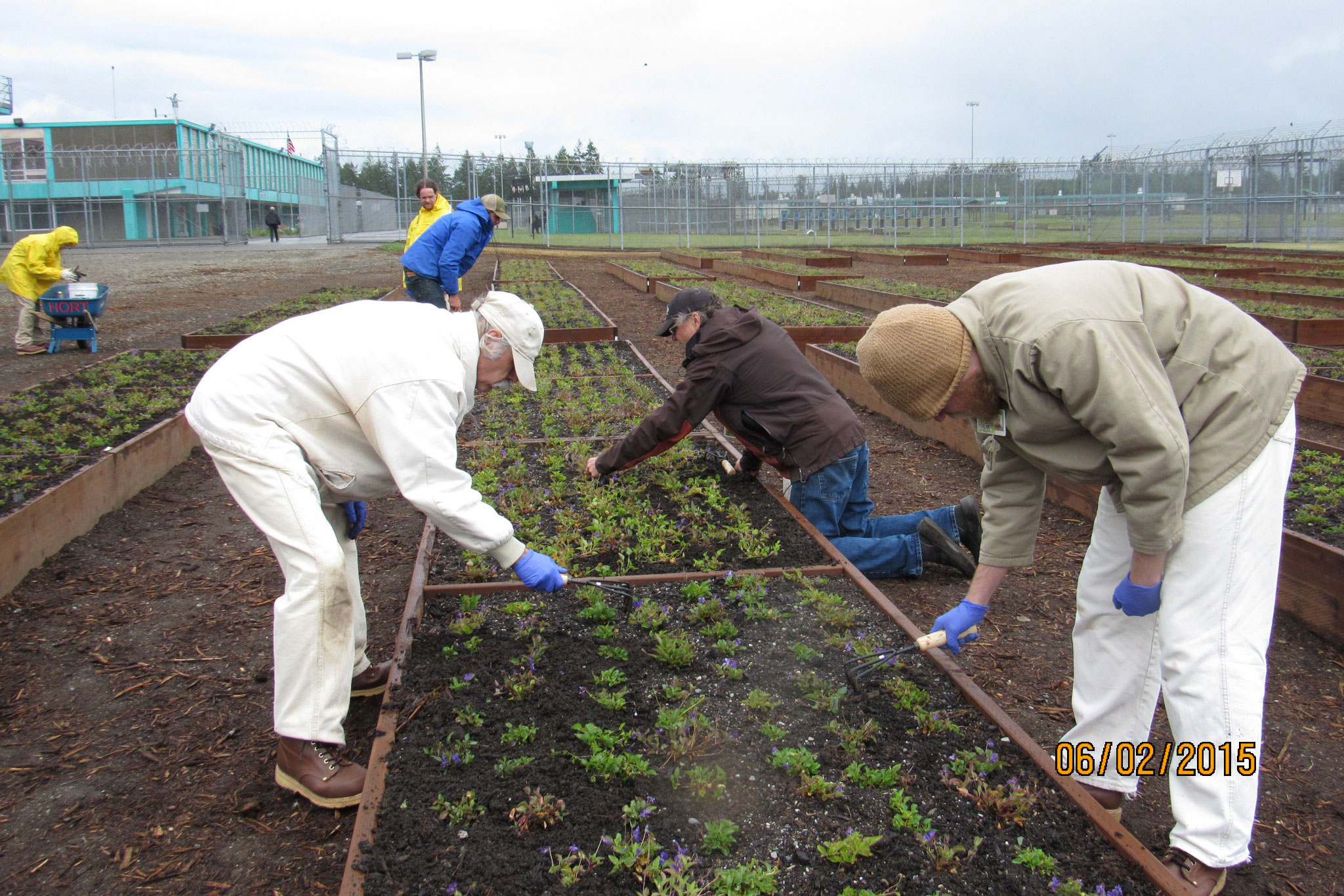
SPP partners weed and care for the violets as a team.
Although in its infancy, the Viola adunca project has created an unlikely community. The original goals were to raise violets for seed and provide inmates with valuable skills. However the project has become a platform for more than that: proof that under a common goal, even stark boundaries can be blurred.
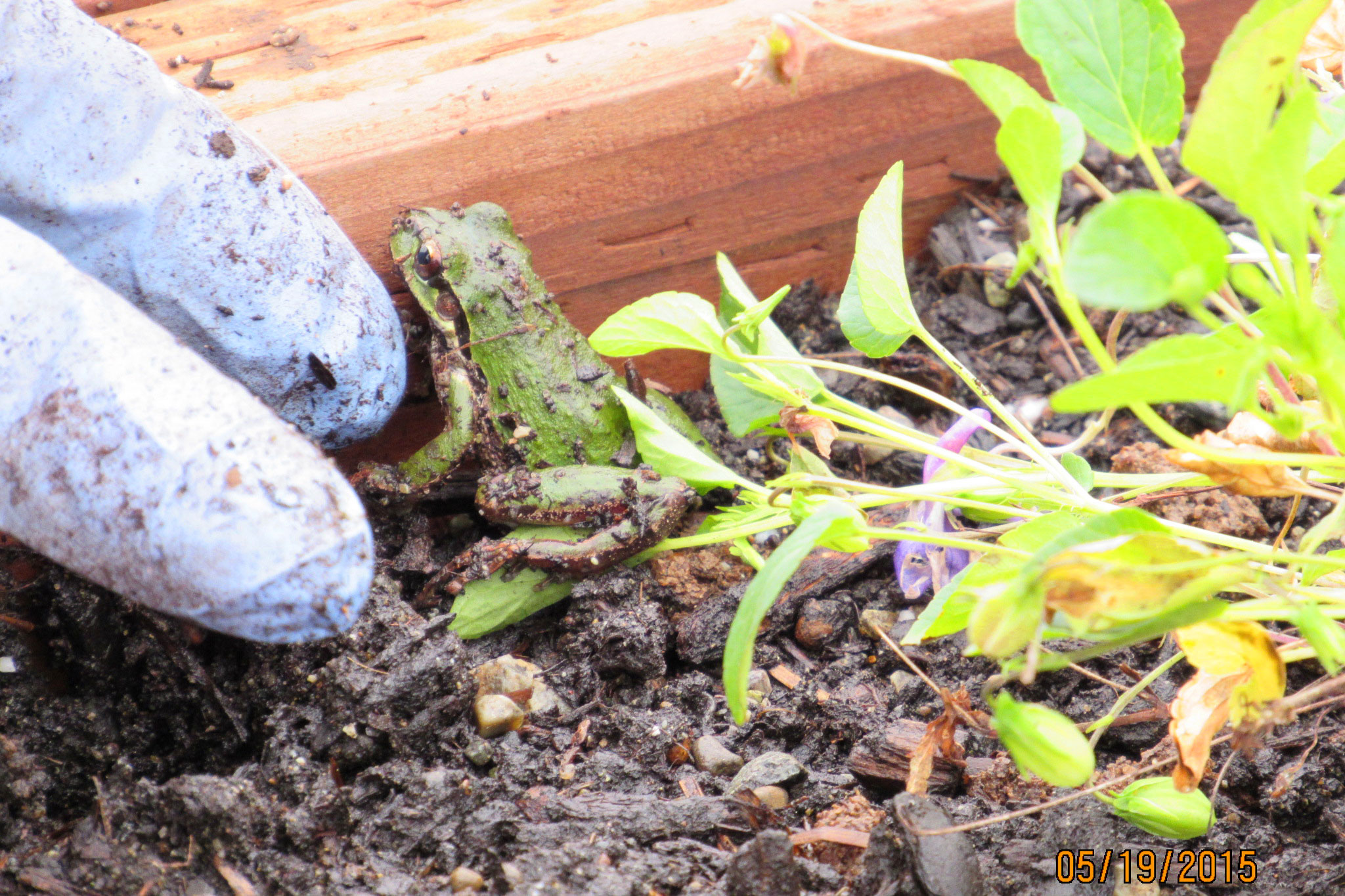
One of the horticulture students discovered a Pacific chorus frog among the violets. Looks like the SPP logo!