SPP Butterfly Internship Experience

by SPP Undergraduate Intern Chelsea Oldenburg

Editor’s Note: SPP has had the pleasure of working with three wonderful Evergreen undergraduate interns during this spring quarter.  Over the next few weeks, blog visitors will have the chance to read about their experiences in the students’ own words.

After 8 weeks of working with the Sustainability in Prisons Project at Mission Creek Corrections Center for Women as an intern for the butterfly program a lot of unexpected things have become commonplace for me. It’s amazing how quickly I acclimate to my surroundings. After only a few days of visiting, the prison guards, razor wire and coveralls seemed normal. As does manipulating the curled proboscis of a butterfly with a paper clip and watching her perfectly paint plantain leaves with bright yellow eggs.

So far my main work this quarter has been facilitating an oviposition preference study that Dennis Aubrey is doing for his masters thesis. This means observing which plants female Taylor’s checkerspot butterflies prefer to lay their eggs on.

The women are carrying out the study five or six days a week and so Dennis, Caitlin (another intern) or I rotate coming out to insure things are running smoothly, bring supplies and run a few of the preference trials ourselves. Usually we also get a chance to help with some of the daily chores of captive rearing. These chores include: feeding adult butterflies a honey-water mixture from a q-tip, transferring eggs into various containers with a paintbrush, freshening water and supplying plantain leaves to hungry caterpillars. Aside from housekeeping and study overseeing there is a lot of time to converse with the women from MCCCW that are working on the project. They seem to truly love the butterflies they are raising and I am always impressed by their fastidiousness, acute observations and consistent positive attitudes. The love seems to go both ways as the butterflies flourish under their care.  A couple of weeks ago I was sent home from The Oregon Zoo with many more larvae, pupae and adult butterflies to bring to MCCCW because of the success with their current stock. Maybe the women at Mission Creek can care for these transforming insects from a place of real understanding as they simultaneously undergo incredible personal transformations themselves.

For the last few weeks of my internship I am excited to erect some raised beds around the butterfly rearing greenhouse. After the frames are built and a lot of soil is shoveled in, we are going to fill the beds with native prairie plants, larval food plants and nectar flowers for feeding the adult butterflies. Two of the women I work with seem genuinely excited to help with the project. Although I will be sorry to end my visits to the prison at the close of this quarter it feels good knowing I will leave behind some nourishing infrastructure.

Want to support innovative educational opportunities and the rearing of endangered butterflies?  Donate to SPP by clicking here.
SPP Plant Profile: Puget Balsamroot (Balsamorhiza deltoidea)

By Graduate Research Associate Evan Hayduk

Basic Information:

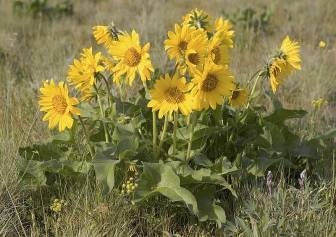
Balsamorhiza deltoidea, or Puget balsamroot, is late spring flowering perennial with showy sunflower like flowers. The distinct leaves of this species are basal, wide, and spear shaped. The flower stems can be up to 3 feet tall, and it is found in open, grassy areas, at low to high elevations from Southern British Columbia to Northern California.

Ecological Importance:

Considered critically imperiled but globally secure in Canada, only eight natural populations containing roughly 1,600 mature plants are thought to remain north of the border. These remaining populations are declining due to development and continued habitat degradation from competition with invasive species. There are 15 reported populations in the state of Washington. Evidence suggests that five of these populations may have been extirpated. A recent study by researchers at the University of Puget Sound* has shown that Puget Balsamroot appears to be incapable of self-pollination, and is dependent on pollinators for reproduction. However, decreases in pollinator species like bumblebees and honey-bee populations and increasing fragmentation and degradation of suitable habitat limits the natural reproduction of this and many other species.

Fun Facts:

Puget balsamroot is well known for its traditional culinary and medicinal uses. This includes its use as chicken feed by early settlers on Vancouver Island, suggesting that it was common in the area during that time period. The roots of Puget balsamroot are edible raw and when cooked have a sweet taste.  Young shoots can also be eaten raw, and seeds eaten raw or cooked. The roasted root can be used as a coffee substitute and seeds can be ground into a powder and made into bread. Medicinally, a decoction of the roots was used in the treatment of coughs and colds.

Puget balsamroot flowering on the prairie.


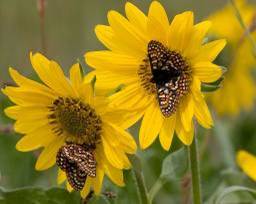
Taylor's checkerspot butterflies and Puget balsamroot. Photo by R. Gilbert.


To donate to SPP and support endangered prairie plant conservation, please click here.

*This study can be found at: http://www.bioone.org/doi/full/10.3955/046.085.0220

SPP at Save the Frogs!

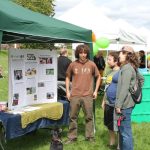
On Saturday, April 28,  SPP Graduate Research Associates Dennis Aubrey, Andrea Martin, and Brittany Gallagher took part in the Save the Frogs Day 5K at Seward Park in Seattle.  SPP Undergrad Interns Jaal Mann and Caitlin Fate also made the trip and ran SPP’s information booth at the event.

It was a beautiful sunny day to run around the park and chat with interested amphibian lovers about restoration through incarceration.  SPP partner Marc Hayes gave a short lecture at the event after the 256 runners had completed the course.

Save the Frogs is an amphibian conservation organization at work in more than 200 countries.  For more information on them, see https://www.savethefrogs.com/index.html.

To find out more about the event in Seattle (and future STF events), visit https://www.savethefrogs.com/day/2012/seattle/index.html.

To see more pictures of SPP at the event (and to hear what else we’re up to), check out SPP on Facebook!  http://www.facebook.com/sustainableprisons.

“Stormwater: Life in the Gutter” at WCCW: Inmate blog

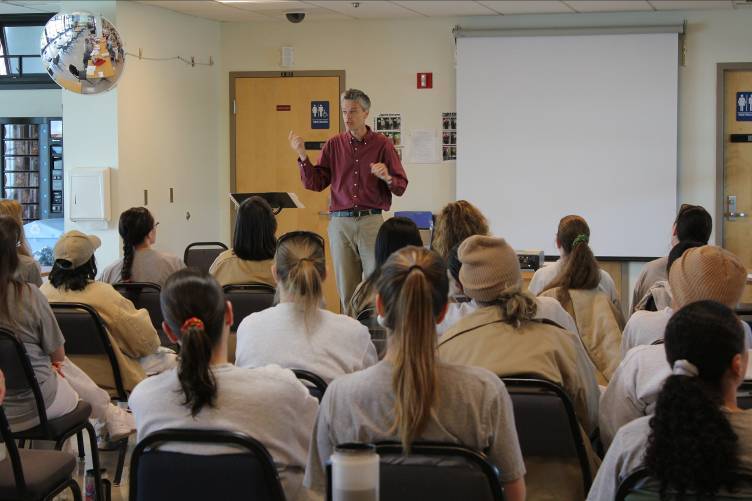
Editor’s note: This post was written by an inmate at Washington Corrections Center for Women (WCCW), where SPP hosts a monthly Science & Sustainability lecture series.  On May 1, Stokley Towles, a performance artist and faculty member at The Evergreen State College, gave a highly entertaining presentation called “Stormwater: Life in the Gutter” to a group of nearly 40 inmates at WCCW.
Mr. Towles will be performing this piece for the public starting this Friday, May 4, at the Seattle Center.  For more information, please see http://www.stokleytowles.com/.

Today I attended a 2 hour presentation of “Storm Watch” which took place in A Building at Purdy Prison, also known as WCCW, or vice versa.

WOW! Talk about an out-of-body experience! Not only was I able to get out of my cramped cell and leave the unit I live in; this is the first time in 5 years of being incarcerated  here in WCCW that I actually felt like being part of a community.

Who would ever guess that hearing about bowel excretion could feel like connecting with one’s community?! No, really! This guy from the Sustainability in Prisons Project was showing us diagrams from a laptop and projector on one of the walls in the visiting room on how storm water and sewage is piped underground from neighborhoods, and pretty soon before I knew it, I was enthralled in the dialog of communication from offenders. This guy whose nickname was “Street”  was beautiful – no kidding – he even showed us the hot pink socks he was wearing! Yeah, right there in the visiting room he props up his leg onto a table with the heel of his black, soft leather , worn dress shoe on the edge of the table and hikes up his beige chino slacks and displays his HOT PINK SOCKS! He, aka Street, says “I spend a lot of time with the sewage plant workers and garbage collectors, getting to know what they do on their jobs, actually walking around with them all day, seeing and hearing how they feel and what they think about what they’re doing. Everyone who works for the Seattle Sewage Plant gets a nickname. It’s for security reasons, because working for the City of Seattle is like being one big happy family and using an alias protects their identity out in the field”.

Today for just a minute I was out there – out in the field with Street, watching the sky for oncoming storms and climbing down storm drains (with a gas mask), checking out neighborhood ponds for “beaver workaholics”. Huh. Yeah. I felt like being connected to something other than being an offender incarcerated here in Prison. I sure the heck wasn’t thinking about all that chaos and drama back in the unit  I live in during those brief 110 minutes or so.

Thank you, Sustainability-in-Prisons-Project!

Thank you Stokley Towles!

Thank you Brittany Gallagher!

Thank you AA Paula Andrew!

Please come back!!

Stokley Towles performs "Stormwater: Life in the Gutter" as part of SPP's Science and Sustainability Lecture Series at WCCW on May 1, 2012.


To donate to SPP and support science and sustainability education in unlikely places, please click here.