By Erica Turnbull, SPP Summer Intern

This July 2013 marked the fourth annual Regional Reentry Conference, organized by the Community Partnership for Transition Services of Pierce, King, and Snohomish Counties in conjunction with New Connections, and Race and Pedagogy Initiative of the University of Puget Sound (UPS).

SPP’s summer intern, Erica Turnbull, from Western Washington University, and SPP’s Roots of Success Environmental Education Coordinator, Rachel Stendahl, from The Evergreen State College, attended the two day conference held on the UPS campus in Tacoma, WA.

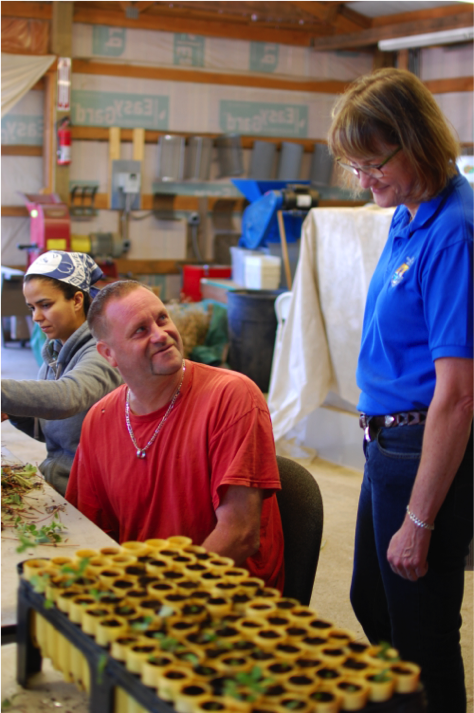
SPP Summer Intern Erica Turnbull and SPP Roots of Success Environmental Education Coordinator Rachel Stendahl. Photo by Brittany Gallagher.

King County Superior Court Judge, Mary Yu, gave the opening speech highlighting the importance of reentry for ex-offenders, their families, and the community as a whole. Upon release, ex-offenders are often barred from financial aid, public housing, education, and employment; these barriers encourage reoffense and supports the cycle of incarceration. This conference brought awareness to these issues and helped people and organizations network to form a more comprehensive safety net for newly released ex-offenders.

Over the two day event Erica and Rachel dispersed along with the 300 attendees, sitting in on nine out of twenty-five sessions. Participation in this conference was a great opportunity to network with reentry centers, counselors, work releases, child support and human resource specialists, judges, and attorneys.

Lower incarceration rates mean lower cost for the state and tax payers
According to Honorable Yu, recent interest in reentry programs appears to be a side-effect of a diminishing budget. Money is tight and building new prisons is an expensive, quick fix to a deep rooted issue. More emphasis has been put on programs that develop skills, resilience, and positive and productive behavior in order to provide ex-offenders with the resources and life skills necessary to keep them from returning to prison.

Prevention over incapacitation
Concluding the conference was a discussion panel about the importance of integrating reentry programs into incarceration facilities and the community. Pierce County Prosecuting Attorney, Mark Lindquist, believes that “tough on crime” should mean better crime prevention programs and better reentry services; prevention over incapacitation. Additionally, community involvement and acceptance of ex-offenders is necessary for success. Panelists stated that offenders have served their time, and should not have to serve an additional sentence through lack of opportunities or labeling. In order to start changing community perception, recent releases should not be called ex-offenders or felons but people in transition.

Reentry is about putting the “we” back into “welcome back”!
From the connections made, and information learned, SPP is compiling a list or reentry resources to offer people in transition as they prepare for community reentry. SPP is also preparing certificates of successful participation and completion of various SPP programs. These resources should provide personal and professional support. Reentry is a collaborative effort among policy makers, community, family, and people in transition.
By GRA Dennis Aubrey, SPP Taylor’s Checkerspot Program Coordinator

Our second season rearing Taylor’s checkerspots at Mission Creek Corrections Center for Women has just concluded, and again the hard work has paid off. Over 2,800 caterpillars are dormant in their diapause period, waiting to be moved to the cold diapause area for winter, eventually to be woken up and released onto south Puget lowland prairies next March.

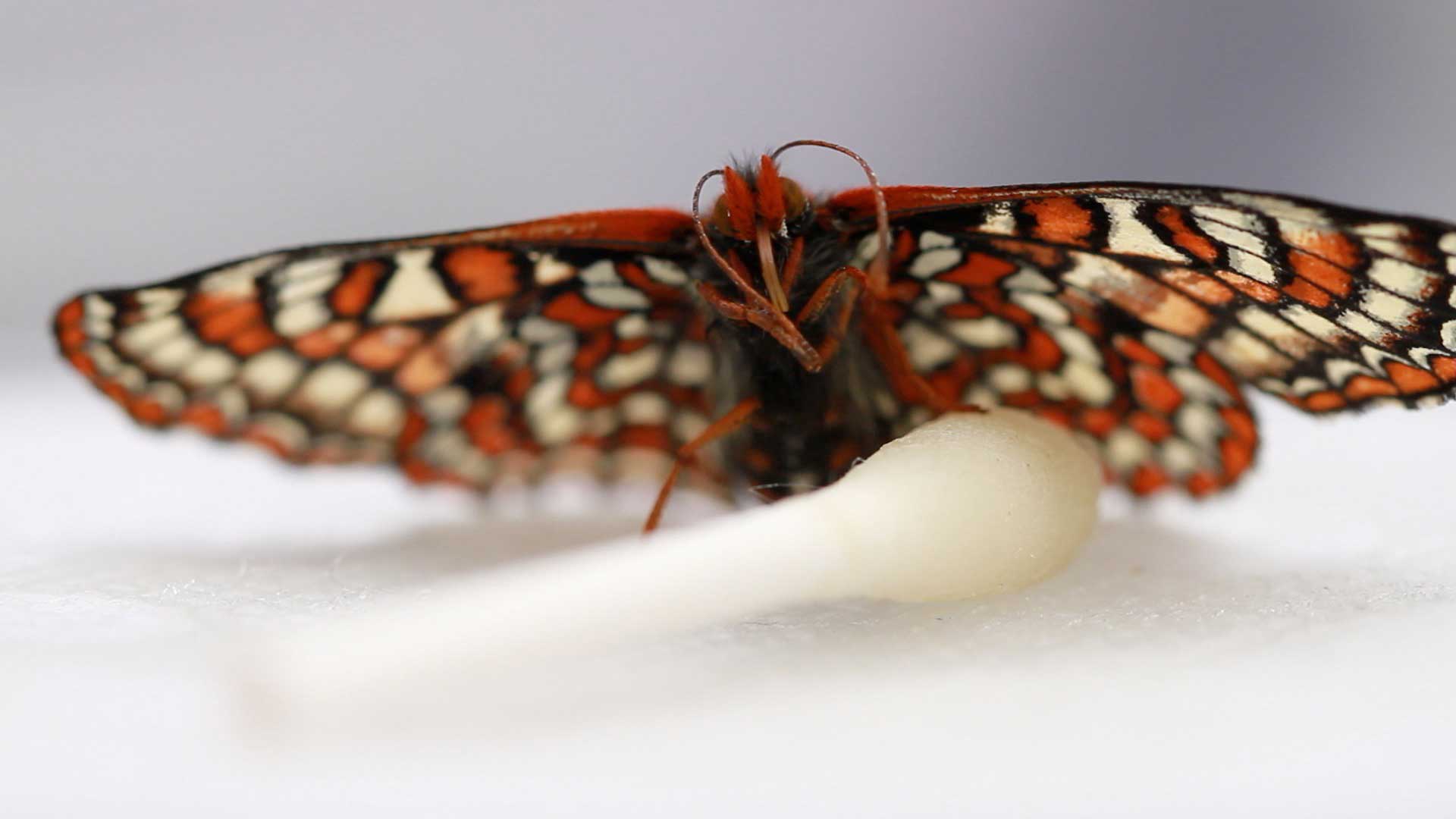
Caption: Adult Taylor’s checkerspots are fed honey water with Q-tips every day. Video still by Rosemarie Padovano.
Adult Taylor’s checkerspots are fed honey water with Q-tips every day. Video still by Rosemarie Padovano.

This season began with a similar release, when our 3,000 caterpillars from 2012 found new homes at Glacial Heritage Preserve, south of Littlerock, WA. The remaining 150 in our care were raised to adults and bred to produce this year’s cohort. Breeding introductions were made according to the genetic pairings designated for us by our partners at the Oregon Zoo, and additional wild females were captured to lay eggs in captivity by our partners at the Washington Department of Fish and Wildlife.

Oviposition study
Additionally, inmates participated in an oviposition preference research project with an Evergreen graduate student, helping to determine which of two native host plants was more preferred for egg laying. Taylor’s checkerspot females choose the host plant for their offspring very carefully, and insight into which ones are most preferred can inform management decisions for restoration in the future.

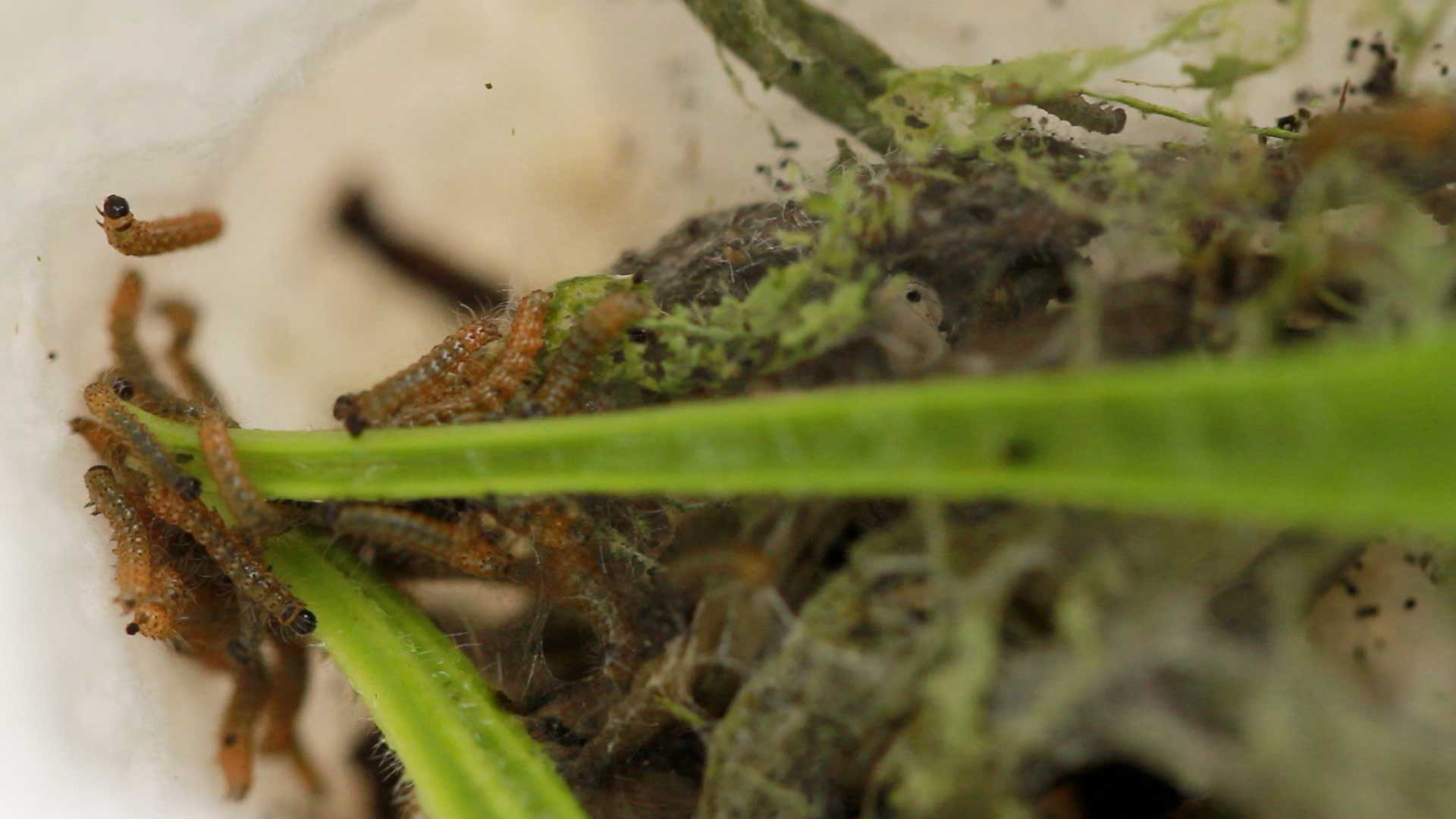
Newly hatched caterpillars are fed fresh plantain leaves and are also given mashed leaf pulp that we call “plantain pesto”. This helps them gain nutrients more easily until their mouthparts become strong enough to slice through the leaves.
Newly hatched caterpillars are fed fresh plantain leaves and are also given mashed leaf pulp that we call “plantain pesto”. This helps them gain nutrients more easily until their mouthparts become strong enough to slice through the leaves. Video still by Rosemarie Padovano.

Surprising genetic anomaly
Interestingly, at the end of the rearing season, the Oregon Zoo had a small number of caterpillars that refused to go to sleep! Taylor’s checkerspot caterpillars typically go into diapause in early July and don’t wake up until the end of February when they emerge to become adult butterflies. These eight individuals at the Oregon Zoo skipped diapause entirely and went directly into adulthood, a behavior more common in migratory butterflies. Because these few individuals may represent a beneficial genetic anomaly, they were moved to the facility at Mission Creek and given extra special care. Just four possible genetic pairings were identified for breeding, and the inmate technicians were able to successfully pair one of the sets, producing 150 eggs which have now hatched into healthy hungry caterpillars. These are currently being reared in the greenhouse and it will be interesting to learn in the next few weeks if they follow their parents and go directly into adulthood, or if they return to more typical patterns and go into diapause as quickly as they can.

Donate to support SPP
To support SPP’s work with endangered species, please donate funds or materials to our programs. Donation funds are used to recognize the excellent contributions made by inmates and to provide them with educational resources.

SPP Book Now Available at Evergreen Bookstore and Online!

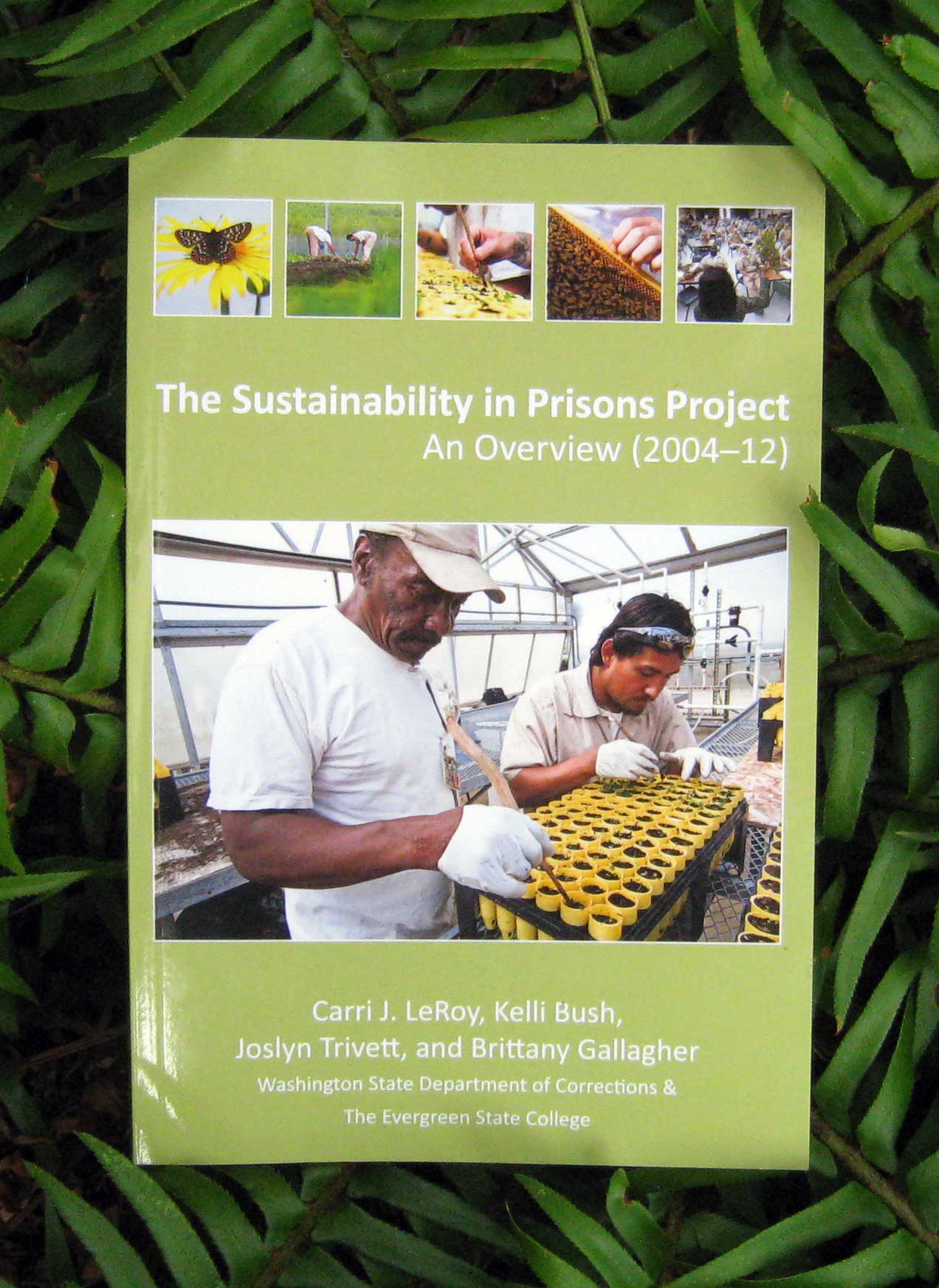
The Sustainability in Prisons Project Overview book is now available for sale at the Greener Store on Evergreen’s Olympia campus AND online!

Published in August 2012, the book is an overview of SPP, and gives readers an understanding of our organizational structure and the history of SPP-Washington.  New and potential SPP partners across the country and the world will have the chance to read in detail about our conservation and education programs, successful efforts to reduce waste, evaluation programs, and media coverage of the Project.  Essential reading for anyone interested in developing an SPP, increasing sustainable practices in prisons, and improving communities!

overview-book-web

Click here to buy the book from the Greener Store.

By Jaal Mann, Graduate Research Assistant

This past week Shotwell’s Landing hosted visitors from the USFWS, Dr. Karla Drewson and Ted Thomas, and David Hays from WDFW. They admired the more than 100,000 plants for fall plant out and marveled at the amount of seed being cleaned and processed for the restoration of Puget lowland prairies. The site visit also coincided with a work day for the offender technicians. The technicians apprised the visitors of the cultivation techniques for some of the 26 species of native prairie plants grown at Shotwell’s Landing.

Shotwell’s Landing nursery has always been a highly collaborative site for SPP, serving as a hub for seed cleaning, storage, and plant distribution to our many partners.

David Hays (WDFW), Karla Drewson (USFWS), and Ted Thomas (USFWS) discuss Castilleja miniata (giant red Indian paintbrush) plants for prairie propagation.

At the heart of SPP’s work at Shotwell’s Landing lies the partnership between the Center for Natural Lands Management (CNLM) and SPP. CNLM owns the site and manages seed production and cleaning, and SPP manages plant production for both direct planting on the prairies and future seed production. Offender technician crews from Cedar Creek Corrections Center provide essential assistance at Shotwell’s Landing to all partners (as well as at several other prairie restoration sites around the area).

David Hays, land manager for WDFW, shows his enthusiasm for the greatly increased yields of rare Plectritis congesta seed at Shotwell’s Landing nursery. Photos by Jaal Mann.
David Hays, land manager for WDFW, shows his enthusiasm for the greatly increased yields…
...of rare Plectritis congesta seed at Shotwell’s Landing nursery. Photos by Jaal Mann.
…of rare Plectritis congesta seed at Shotwell’s Landing nursery. Photos by Jaal Mann.

Key partners who use plant materials produced and processed at Shotwell’s Landing include the Washington Department of Fish and Wildlife (WDFW), U.S. Fish and Wildlife Service (USFWS), The Washington Department of Natural Resources (DNR) and Joint Base Lewis-McChord.

Ted Thomas and Karla Drewson, USFWS, stopped to discuss the planting of wild Virginia strawberry (Fragaria virginiana) with SPP graduate research assistant Drissia Ras and an inmate from Cedar Creek Corrections Center. These plants will be used for planting on prairies in endangered Taylor’s checkerspot butterfly habitat.

By Brittany Gallagher, Education & Evaluations Coordinator

In July, I had the honor of spending two weeks at the United Nations Office in Geneva, Switzerland, for the UN’s annual Graduate Study Programme (GSP).  I was excited to represent SPP and Evergreen in an international group of graduate students and to learn all I could about international civil service.

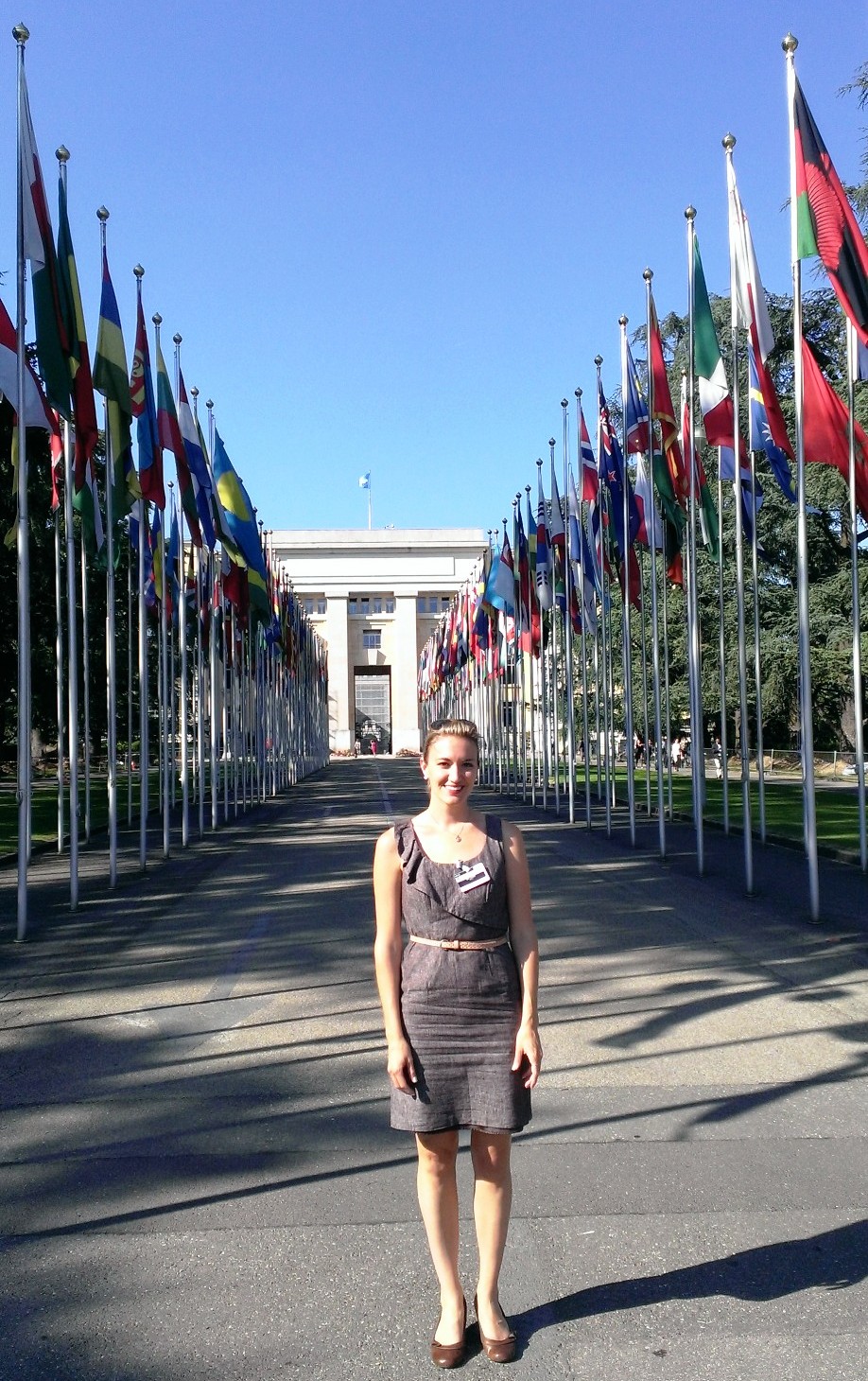
Brittany Gallagher, center, at the UN Graduate Study Programme.

This year’s GSP theme was “Gender Equality and the Empowerment of Women.”  My classmates were students from every continent; representatives came from China, Rwanda, Germany, Mali, Morocco, Australia, Italy, Slovenia, France, Russia, Bolivia, Trinidad & Tobago, and the US, to name only a sample.  Many were studying international relations, law, human rights, or similar topics.  There were a few psychology and public health students, but I was one of only a few studying the environment.  However, thanks to the interdisciplinary nature of Evergreen’s Graduate Program on the Environment and my background in international development, I didn’t feel out of place in education or experience.

We each introduced ourselves to the large group and described our work, studies, and interests.  I was impressed by the level of engagement and the diversity of experience in the room.  After my brief presentation, I entertained a slew of questions about SPP.  These questions continued between classes at the UN office, over lunch, on the tram on the way home, and at the lake on the weekends.  In addition to talking frog conservation with my peers, the speaker from the United Nations Environment Programme was especially interested in what SPP does!  I was reminded of how innovative our project is – people were fascinated by the concept and the practice.  After two years with SPP, I have become accustomed to our mission and daily activities, but I forget that many folks have never heard of conservation programs involving prison inmates.

Representatives from UN agencies visited to present their organizations’ work on gender equality. I went through two notebooks taking copious notes. UNOG photo.
BG at UN Nations gate July 2013

During the two-week program, our class heard from representatives from a variety of UN agencies about their work on gender equality.  We also split up into five working groups and tackled case studies related to the theme.   Each working group was mentored by a UN staff member from the relevant agency; they advised our work and challenged us to create high-quality “work plans” addressing current real-world issues related to gender.  I chose to work in the United Nations Population Fund (UNFPA) group, and we were given the freedom to select a topic.  We designed a country program for addressing sexual and gender-based violence in camps for internally displaced people in Haiti.  Our report is nearly finished and will be presented to the ‘real’ UNFPA in September.

I am enormously grateful to SPP and Evergreen for supporting my attendance at the GSP, and to the UN for providing students like me with this extraordinary opportunity.  Check out the links in this post and the UN-GSP Facebook page if you want to learn more about it!

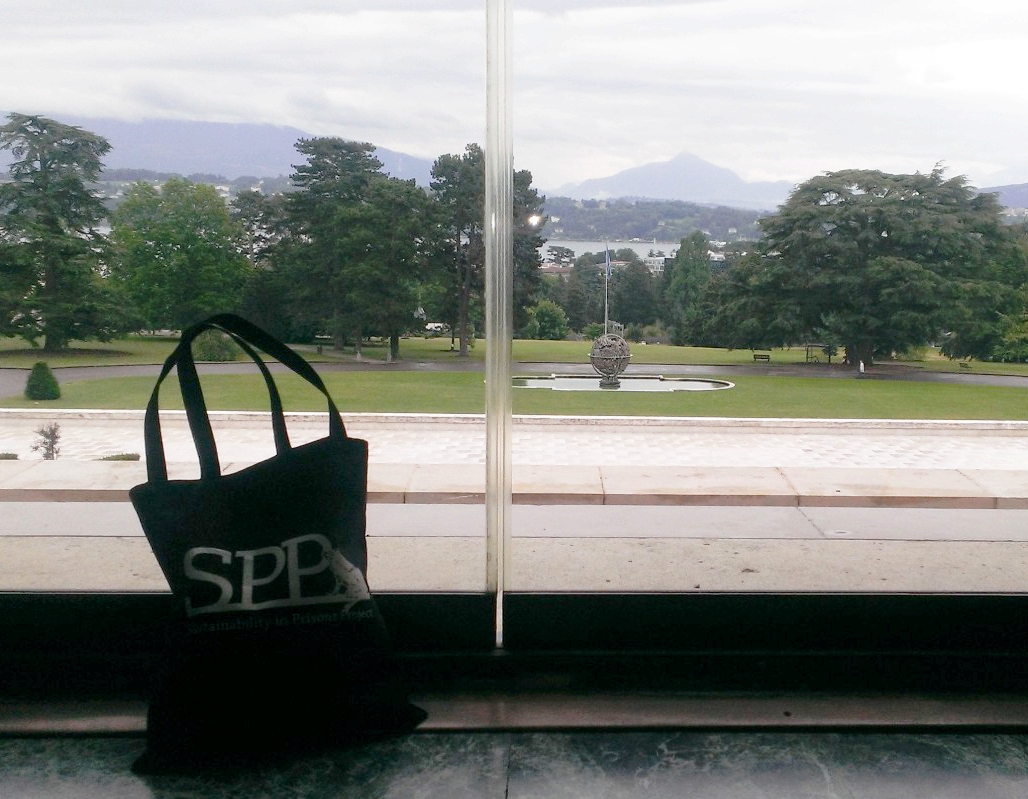
As in Olympia, newcomers to Geneva complained about the weather (but, as in Olympia, the weather in July was gorgeous). They also have a Mountain that, like ours, hides on cloudy days. The view from the UN office is great even on an overcast day.

by Fiona Edwards, SPP Graduate Research Assistant

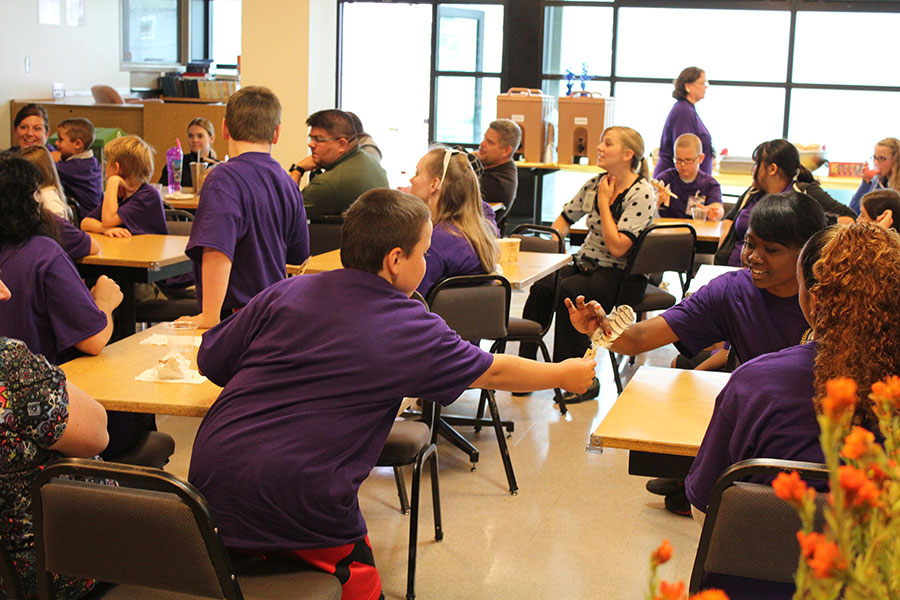
A great horned owl feather is passed around for the kids to see.

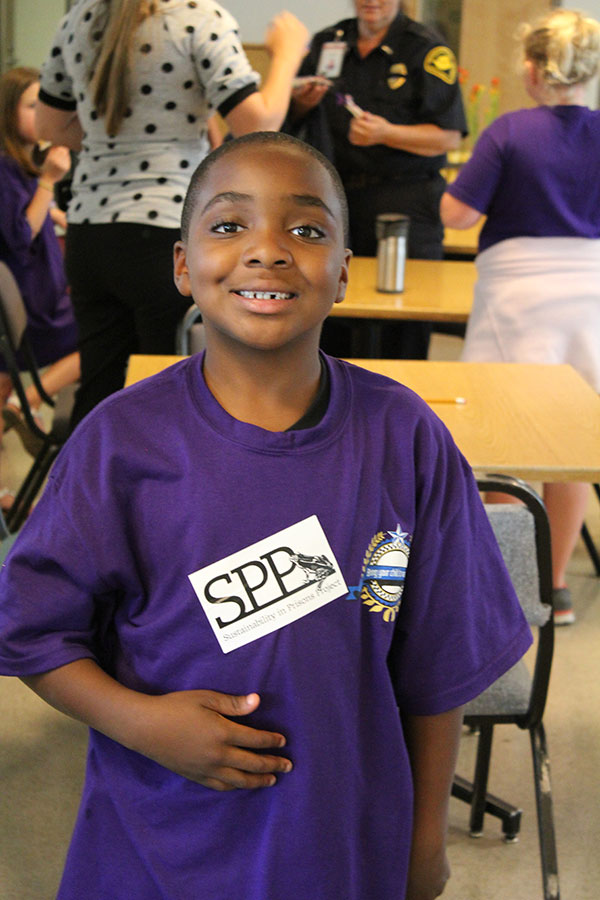
On Wednesday, Washington Corrections Center for Women (WCCW) hosted Take Your Child to Work Day. SPP Graduate Research Assistants Brittany Gallagher, Bri Morningred, and Fiona Edwards joined the festivities.

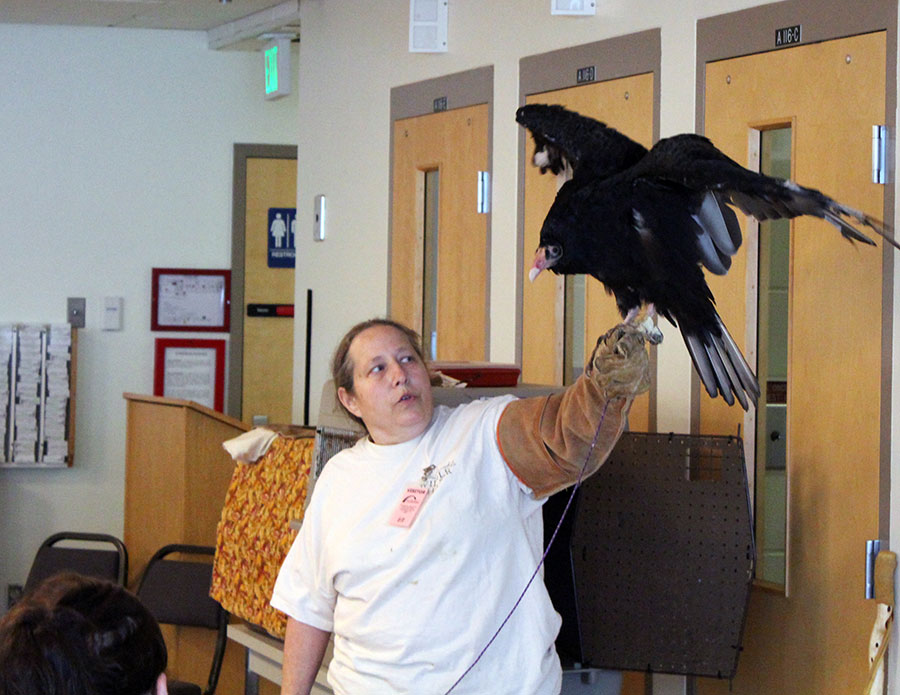
At the suggestion of Paula Andrew, the Science and Sustainability Lecture Series lead staff member at WCCW, Brittany invited a popular SPP guest lecturer, Lynne Weber from West Sound Wildlife Shelter, back to visit the prison again. Ms. Weber gave a presentation about birds to the kids.  She brought a great horned owl and a turkey vulture, both of which were hugely successful with the audience. Lynne explained how animals ended up in the care of the West Sound Wildlife Shelter, and how important it is to respect wildlife. Many questions were asked, my favorite being: “Will the turkey vulture get its license when it’s 16?”

Lynne Weber from West Sound Wildlife Shelter shows Remington, a turkey vulture, to the audience.

Next up, Brittany and Bri did an exercise on the meaning and applications of sustainability, asking the kids to share their experiences with sustainable practices. Then I spoke about the Western pond turtles, which SPP is expecting to care for very soon. I attempted to explain the concept of shell rot (a disease which the turtles suffer from) without gory details, and when I asked how a healthy turtle’s shell is supposed to feel, one audience member told me, “It’s hard like a sandwich.” In the coming year, I’m hoping to get the sick turtles’ shells back to sandwich levels.

The Prison Pet Partnership came out next with two well-trained dogs. They showed the kids how they could help their future owners by flipping on light switches, closing doors, picking up fallen items, grocery shopping, and rolling on their backs so the owner could inspect for anything unusual. One excited audience member asked if the dogs could jump over the table, to which the head of the program replied that the dogs are in fact taught to jump: one of the dogs jumped over a cardboard box and inspired roaring applause.

After lunch, we helped the children color paper Taylor’s checkerspot butterfly wings and told them about the relationship between the Taylor’s checkerspot and the prairie plants. And even though we were not allowed to give away plugs of beautiful Castilleja hispida to those who asked, we had a great time; we hope we get to come back next year!

IMG_0127-reduced