On October fifth in Gig Harbor, Washington, Olympia resident Dick Meyer walked through the security gates of the Washington Corrections Center for Women (WCCW) headed for the visit room. “When I worked here thirty years ago,” he said, “they didn’t have all this security.”

The reason for his visit? To bring fair trade education to prisons through the Sustainable Prisons Project’s Science and Sustainability Lecture Series, a program geared toward scientific education and sustainable practices.

A former counselor for WCCW in the early 1970’s, Meyer left social work to become a small business owner in the Puget Sound region. The founder of Traditions Café in Olympia and owner of The Antique Sandwich Shop in Tacoma, Meyer currently uses his storefronts and free time to promote fair trade partnerships and awareness.
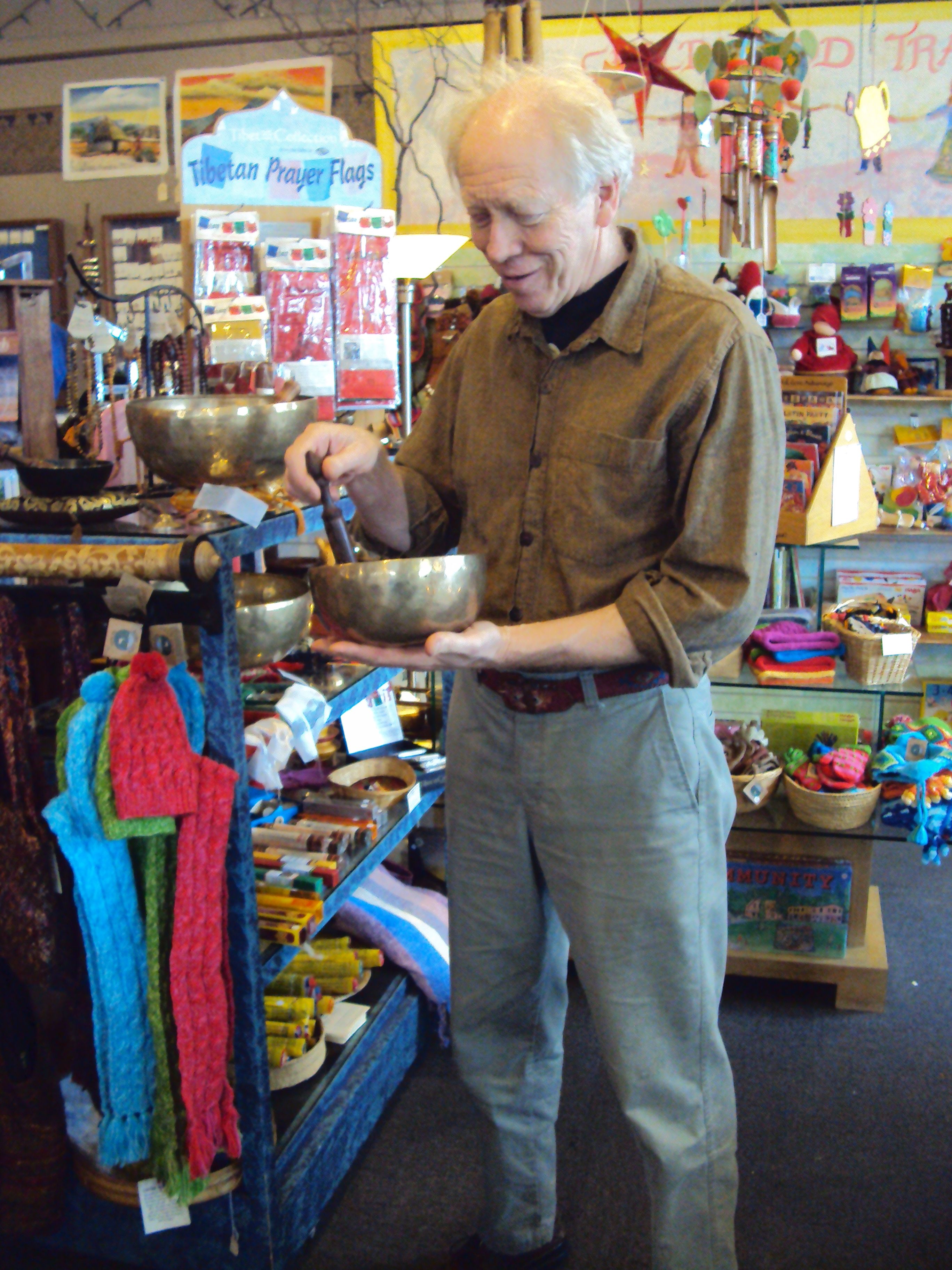
Guest lecturer Dick Meyer demonstrates a Tibetan singing bowl inside his fair trade shop in Olympia, WA.

“I view talking about fair trade and doing outreach as something that’s motivating for me to do. Whatever opportunity to engage people in talking about values and relationships is important to me,” Meyer said.

Each month, the Sustainable Prisons Project hosts guest lecturers in three of Washington’s prisons to speak with offenders and DOC staff about topics related to science and sustainability. Speakers include scientists, engineers, environmentalists, farmers, business owners, and community activists, with topics ranging from bear ecology to sustainability in poetry.

Seated in a circle with DOC offenders and Sustainable Prisons Project staff, Meyer began his talk with a brief history of the fair trade movement. According to the Fair Trade Federation, of which Meyer is a member, fair trade is an economic partnership based on dialogue, transparency, and respect. Fair Trade organizations seek to create sustainable and positive change.

Stories about various products, such as clothing and chocolate, stimulated an hour-and-a-half long discussion between Meyer and the offenders about the issues surrounding fair trade. Having brought sample items from his stores, Meyer demonstrated what fair trade products look like and how the average person can go about finding and supporting such partnerships. Nearly all the products were hand-made by women cooperatives in developing countries.

Through the Science and Sustainability Lecture Series, the Sustainable Prisons Project seeks to connect lecture participants to the larger world of scientific research and conservation while introducing offenders to educational and employment opportunities they may pursue upon release. A large part of this involves presenting on lecture topics that have relevancy and meaning to the offenders’ current situation as prison residents.

Meyer discussed the connection he saw between the women sitting with him in the prison and those working across the globe in conditions and economies that fair trade is trying to change. “The information is not readily available about how much the rest of the world has to work to survive,” he said. “And to a certain extent they can’t control their own destiny. The message is not exclusively, but predominately, about women, and to the extent women inmates can empathize and understand; I think that at least one part of it becomes a shared empathy.”

For more information about fair trade, visit www.traditionsfairtrade.com.

In our last entry we wrote to tell you that funding for the Sustainable Prisons Project (SPP) was cut as a result of significant budget cuts within the Washington Department of Corrections (WDOC) and throughout the state. Since we received the news, Sustainable Prisons Project students and staff have been working hard to identify alternative funding sources.

We are pleased to report our first major success. The Evergreen State College (TESC) has provided “bridge funding” from reserves of the Academic Division. This will serve as a temporary bridge to give us “breathing space” through June 2011. It will provide enough support to: maintain our basic operations; provide one science lecture per month (rotated among our current corrections centers); support one graduate student; and initiate a green collar training program in arboriculture. It will also allow us to: maintain our website; connect with the media; and write grant proposals to foundations and individuals to further support and extend our work.

Our Co-leader, Dan Pacholke (WDOC), has extended the reassurance that the WDOC will continue to support this work with available staff effort, access to inmates and facilities, and guidance in shaping our program for the future. We have also been working with our conservation partners — at The Nature Conservancy, the Washington Dept of Fish and Wildlife, the Oregon Zoo Foundation, and the Department of Defense — to augment their current funding so that we can sustain our current commitments of raising endangered frogs, prairie plants, and rare butterflies to enhance regional biodiversity and provide training for inmates.

Despite this funding setback, awareness of our project expands. Just yesterday, we learned that our project has been featured on the website of the National Science Foundation – a piece produced by Science Nation, which was filmed at Stafford Creek Corrections Center this summer. It captures very well our vision of linking offenders with science and conservation directly, and the benefits that accrue to all involved. Here is the link: http://www.nsf.gov/news/special_reports/science_nation/sciencebehindbars.jsp

During these difficult economic times, it has been warming to witness people stepping forward to help as much as they can. We have received hundreds of notes and responses to the WDOC termination announcement on our blog from people around the country and around the world, stating their support for the project, and their desire for it to continue. We will work hard to find ways to keep our program moving forward in the short and the long term.

Post by Project Co-Director Nalini Nadkarni

Economic conditions at the national and the state level are increasingly difficult due to sharp drops in state tax collections. Responding to these lean times, Washington State Governor Christine Gregoire has instituted deep budget cuts.  She recently enacted a 6.3% across-the-board cut to head off a deepening budget deficit

Over the past three years, the Washington State Department of Corrections (WDOC) has funded the Sustainable Prisons Project through a contract with The Evergreen State College. During that time, the WDOC has cut more than $220 million from its budget, frozen or cut more than 1,200 jobs, closed two prisons, slashed inmate populations, and cut the number of offenders on community-supervision probation.

On October 1, 2010, Eldon Vail, Secretary of the WDOC, announced a new 6.3% cut in its budget, which translates to a $53 million reduction. To achieve the savings, one prison will be closed, and 300 jobs will be frozen or cut. Employees will experience employee furlough days and cuts in pay. Inmates in larger prisons will be locked-down one day a month to reduce staff overtime costs. Drug treatment and education programs will be reduced.

Sadly – very sadly – the two-year contract for the Sustainable Prisons Project that began July 1, 2010 will be another casualty of this process. With one month of notice, WDOC funds that have supported our staff and students to carry out our activities will disappear. These activities include our science and sustainability lecture series, green collar job training, and conservation biology projects. Recycling, gardening, and composting will continue, as they have become part of regular DOC operations.

Our SPP group and The Evergreen State College are working hard to find alternative and bridge funding through grants and donations. Although there are some promising leads from the many people who strongly support our project, we have no guarantees for the future at this time.

We will keep our readers posted on this blog and through the media. If you have any suggestions or contacts that might lead to future support for this project, please contact our leaders (below). We are hopeful that our project will flourish even in these hard economic conditions.

Contact:
Nalini Nadkarni, Co-Leader, The Evergreen State College
nadkarnn@evergreen.edu
(360) 867-6621

Dan Pacholke, Project Co-Leader, WDOC
djpacholke@doc1.wa.gov

Kelli Bush, Project Manager, The Evergreen State College
bushk@evergreen.edu
(360) 867-6863