SPP Plant Profile: Philadelphia or Common fleabane (Erigeron philadelphicus)

By Graduate Research Associate Evan Hayduk

Last week, SPP and CNLM staff, along with volunteers from the community, sowed more than 130 flats (about 12,748 individual cones and roughly 131,200 seeds) of Erigeron philadelphicus. What a perfect time for a SPP plant profile highlighting this species!

Basic Information

A fairly common species, Philadelphia fleabane is found across the United States as well as in most of Canada. This low-growing perennial has alternate leaves that clasp the stem, with the lowest leaves found in a basal rosette. The flowers of this species are small, pink to white with more than 100 ray flowers per head with a bright yellow center.

Ecological Importance

The pollen and nectar of this species attract many insects, including long-tongued bees, short-tongued bees, wasps, flies, butterflies, skippers, and beetles.

Fun Facts

The genus, erigeron, comes from the Greek eri (early) and geron (old man). This may refer to the early flowering of the species, as well as the hoary down that is found on the plant, reminiscent of an old man’s beard.

This species is also a widely used medicinal species. A tea made from the plant is astringent, diaphoretic, and diuretic. It has been used in the treatment of diarrhea, gout, and epilepsy. A poultice (soft, moist mass of plant material) is used to treat headaches and is applied to sores. However, treatment can induce miscarriage in pregnant women, and some people experience minor dermatitis when handling this species.

Erigeron philadelphicus is considered invasive in suburban Shanghai, China. In these areas it has been found to accumulate heavy metals including Cu, Cd, Cr, Pb and Zn in the root, leaf and stems. It has also been shown to exhibit allelopathic effects on the growth of seedlings of four crop species in the area. Aqueous extracts from the species inhibited growth of Brassica chinensis, Brassica campestris, Cucumis sativus, and Lycopersicum esculetum.
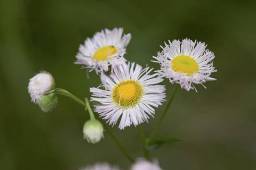
Close-up of Philadelphia fleabane. This species has more than 100 ray flowers per head. Photo by R.Gilbert.
Erigeron philadelphicus on a prairie. Photo by R.Gilbert.


SPP Evaluations Internship Experience

by SPP Undergraduate Intern Jaal Mann

Editor’s Note: Jaal is one of three stellar Evergreen undergraduates who have been working with SPP during the spring quarter.  He has been an intern for not one but TWO (related!) SPP programs: evaluations and prairie plant conservation.  This week, he writes about the world of survey analysis and lecture-based environmental education.

As an undergraduate intern with the Sustainability in Prison Project for the last 10 weeks, there has been a lot to learn. I have spent much of my time analyzing the survey responses from the lecture series in the prisons, and it has been fascinating and inspiring to see some of the positive feedback that the inmates return.

Inmates learned about the benefits of shopping locally and pledged to do so in the future after attending a lecture about organic agriculture. After a lecture on energy use and biofuels, they learned how biofuels could play a role in solving energy problems and “would love to see [biofuels] to be used by our farming communities to operate their equipment.”

The lecture series is able to reach a much broader inmate population than the frog, butterfly, or native plant projects.  It is SPP’s hope that this wide variety of inmates attending sustainability lectures will take home a different view of the subject of the lecture and of the overall subject of everyday sustainability.

Many of these lectures have left inmates with lasting lifelong information and skills, such as how to use natural herbs to treat illnesses, that “not just herbicides will kill plants”, and “to be mindful of what goes down the drain.”

Evaluation of effectiveness is a complex subject, but so far it is evident that not only knowledge-based responses are improving through lectures, but attitudes about the subjects and sustainability as well.

While our evaluation techniques are still being improved, when we hear that attendees have learned “about the importance of balance needed between our use of land, care for land and the value of butterflies to the balances needed,” and that “the world is way more complicated than I ever thought,” it definitely helps us know that we must be doing something right.

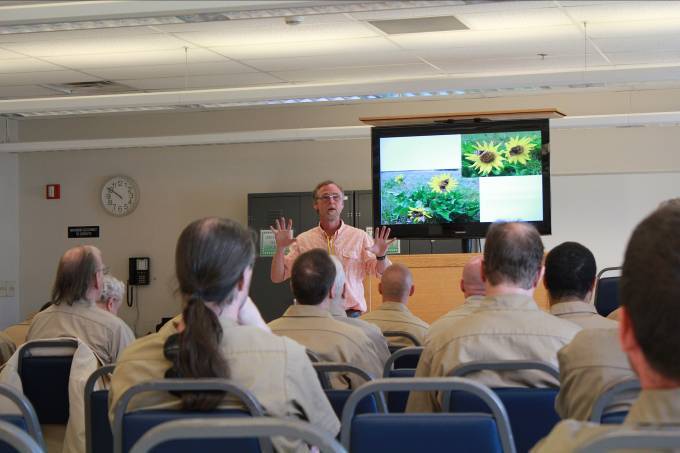
SPP staff member Carl Elliot gives a lecture at Stafford Creek Corrections Center. Lecture content is evaluated using pre- and post-lecture surveys.
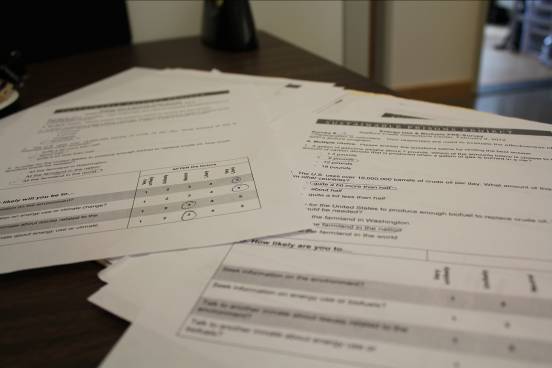
Sorting through pre- and post-lecture evaluations is a big job! We use evaluations to understand knowledge retention and attitude changes as a result of our lectures and workshops.

To support unique educational opportunities for college students as well as incarcerated men and women, click here to donate to SPP.