Newly arrived Taylor’s checkerspot butterflies thriving at MCCCW

By Graduate Research Associate Dennis Aubrey

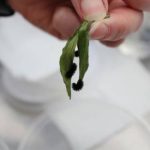
After a more than a year of preparation, the butterfly program at Mission Creek Corrections Center for Women is finally rearing endangered butterflies! Mary Jo Andersen brought 755 post diapause Taylor’s checkerspot larvae from the Oregon Zoo in early March, and when they emerged from their blue cooler, they found that they had been transported directly to caterpillar paradise. Cool nights and warm bright days, no rain but perfect moisture, tender hand-picked leaves delivered fresh every morning, no predators, vehicles, or hard freezes; what more could a caterpillar ask for? Many of them headed directly for the fresh leaves and began eating vigorously, much to Mary Jo’s amazement.

Part of the beauty of the new facility is the quality of the light. One of the limiting variables in rearing butterflies is UV light exposure, and the structure was built with that in mind. When the caterpillars arrived conditions were perfect and they responded immediately.

Of the 755 that Mary Jo brought, 600 were released a week later onto a Joint Base Lewis-McChord reintroduction site and 155 continue to develop at the prison. Because of the conditions, they have been growing and molting more quickly than at the Oregon Zoo, and some have already pupated. If anything, conditions may be too perfect!

As one way of assessing the “quality” of the conditions, inmates will be weighing and measuring adult butterflies when they emerge. This will be used to compare their weights with historic averages from the Oregon Zoo, because it is generally very challenging to rear full sized adults in captivity. One of the original goals of the facility design was to more closely mimic natural conditions in order to produce butterflies as large as wild-caught individuals, something Oregon Zoo has been unable to accomplish.

Another part of what we hope is our formula for success is the constant and thorough care that inmates can provide. The four currently involved with the project care for their charges meticulously, and we hope that also helps to produce natural-sized, healthy animals.

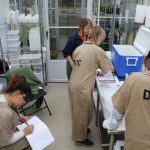
In addition to TLC, inmates also keep highly detailed records of their observations. In fact, they are now filling their third notebook with records beyond those they are asked for. They even hand-draw spreadsheets with rulers when details they want to record are not covered by the official forms.

This careful manner will soon become critical when they undertake an upcoming research project examining host plant preference. This will attempt to show which native prairie plants are most valuable to the butterfly as a resource in restoration plots. Not only is this critical, relevant research, but it also involves a second endangered species! One of the plants to be examined is state-endangered golden paintbrush (Castilleja levisecta), so this spring inmates will be caring for two endangered species at Mission Creek!

To donate to SPP and support the rearing of endangered butterflies in Washington state, click here.
Spring and Cold Moisture Storage at Shotwell’s Landing and Stafford Creek Corrections Center

By Graduate Research Associate Evan Hayduk

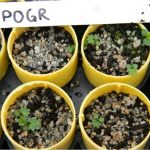
The snow, hail, and lumpy rain falling around here the last few weeks may make you think it’s still winter, but spring has arrived at Shotwell’s Landing and Stafford Creek Corrections Center (SCCC). Seeds sown in late December and early January are germinating, undaunted by the unseasonably cool temperatures and higher than normal precipitation. Our propagation plan includes two sowing “seasons.”  The majority of seed sown last fall and winter were left to stratify in situ. Twenty percent of our seeds go through cold moisture storage (CMS), and then are sown in the spring. The CMS process involves imbibing seeds in water and placing them in a refrigerator for 15-90 days. This process broadens the temperature range at which the seeds will germinate.

At SCCC, Castilleja hispida, Viola adunca, and Lomatium utriculatum seeds sown in December are showing signs of life. A recent trip to account for germination of Castilleja hispida shows that certain seed lots are producing as high as 70% germination. Close attention is paid to which seed lots are showing faster or more germination, and what types of nursery practices are increasing germination rates. At Shotwell’s, Castilleja levisecta, Erigeron speciosis, and Eriophyllum lanatum are also germinating at high rates. All seeds sown have been kept in hoop houses to control moisture levels for optimal germination during this soggy La Niña winter.

25 species have been placed into CMS, the process starts with an ingenious “seed bubbling” system constructed from recycled materials. This system is used to soak seeds for 24-48 hours before placement in CMS. Previously, seeds had been soaked in standing water, which in cases led to the seeds over-imbibing with water. The new system soaks the seeds in running water, allowing for more oxygen flow and lowering tannic acid buildup in the soak water.

In the coming weeks the second “season” of sowing ensues at Shotwell’s with the seeds that are currently in CMS. This work will be done by SPP and Center for Natural Lands Management (CNLM) staff, our tireless volunteers and Department of Corrections community work crews.

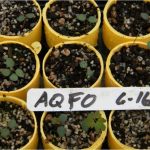
Close-ups of studies for identifying the cotyledon of seedlings from 2011 plants.  Photos by Carl Elliot.


To donate to SPP and support the restoration of native prairies in Washington state, click here.
Inmates Participate in Egg Mass Surveying at West Rocky Prairie, 2.28.12

By SPP Graduate Research Associate Andrea Martin

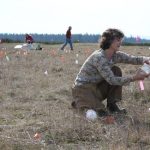
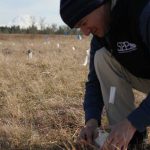
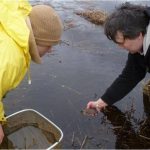
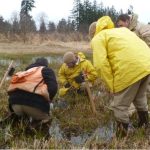
When Julie Tyson, a biologist with the Washington Department of Fish and Wildlife, took me and the two inmate frog technicians that are raising endangered Oregon Spotted Frogs (OSF) at Cedar Creek Correctional Center (CCCC), and two officers out to look for OSF egg masses, I was afraid I would walk right past them, or worse, step on one.

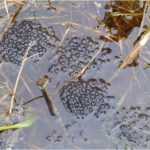
Lucky for all us egg survey newbies, Julie found the first one. It became pretty obvious that they would be hard to miss. The egg masses are very dark, and float at the surface of the shallow water in wetland areas like West Rocky Prairie. West Rocky Prairie, also known as Beaver Creek, is just 13 miles south of Olympia, and less than a mile from Millersylvania State Park. The site is one of a handful of areas in Western Washington where the endangered frogs lay eggs every season.

Oregon Spotted Frog season is now upon us, and the site of the nearly-black gelatinous spheres is the first sign of the reproduction of the endangered species. Soon, a few hundred OSF eggs will be brought into CCCC and several other institutions, and the rearing process will begin.

In total, we found 19 egg masses.  Thirteen were found on the West side of Beaver Creek, of these, 10 were new. On the East side, where our group was the first to survey of the year, we found six.  Several of the egg masses had freeze damage because of the erratic late-winter/early spring weather. It’s likely that the frogs have stopped laying for now until the weather warms a bit; Julie estimated that the most recent egg masses we found were 2-3 days old.

In addition to the OSF egg masses, the inmates, officers and I found many Northwest Salamander egg masses, which are gelatinous, but solid as a baseball. Despite the freezing weather, and threat of snow, the inmates really enjoyed the opportunity to get outside the prison walls, and to learn more about the project they are working so hard on.

This will be the 4th season that inmates at CCCC have raised endangered frogs. Both of the inmates who will be responsible for feeding the frogs, keeping them warm and safe and recording all the changes they will go through in their life cycle are veterans of the rearing process. They were new, however, to the first step of finding the eggs.

The inmates’ participation in the egg surveying at West Rocky Prairie shows a new level of trust and desire to collaborate between SPP and its partners. The frogs that are raised at CCCC are the biggest and healthiest of all of SPP’s rearing partners, due in large part to the amount of time and attention the inmate frog technicians are able to give to the animals. The frog rearing program at CCCC has been highly successful, and its importance has been recognized by SPP’s partners, other scientists, and the prison community. This contribution was a major factor in the decision by the Department of Corrections to allow the inmates to participate on Tuesday.


To donate to SPP and support the rearing of the Oregon spotted frog in Washington state, click here.
SPP Plant Profile: Golden Paintbrush (Castilleja levisecta)

By Graduate Research Associate Evan Hayduk

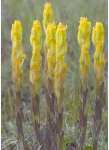
Basic information: Castilleja levisecta is an endangered perennial herb that can grow up to 20 inches tall and is covered with soft, sticky hairs.  Occurring in open grasslands in the Puget Trough, the species used to be common from British Columbia to the Willamette Valley in Oregon.  Now only a few populations remain, mostly in the area of the San Juan Islands and in the Puget Sound prairies.  Similar to other prairie species, populations have declined due to loss of habitat to agriculture, residential, and commercial uses.  The suppression of fire disturbance, a vital component of the prairie ecosystem, has also led to the decline of populations (see previous post on Prairie Fires).  The U.S. and Washington Department of Fish and Wildlife are actively reintroducing this species that nearly went extinct within the last two decades.

Ecological Importance:

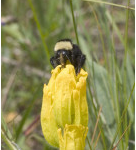
Golden Paintbrush is relatively short-lived, with individual plants only surviving for 5-6 years.  Although it tends to grow in clumps from one to fifteen stems, it seems to reproduce only through seed.  As mentioned in previous posts, paintbrush species are hemi-parasitic.  Studies have shown Golden Paintbrush that were established with Roemer’s Fescue (Festuca roemeri), were more successful after outplanting than those established alone or with Oregon Sunshine (Eriophyllum lanatum).  Other studies have shown that Castilleja levisecta grown in a greenhouse with Eriophyllum lanatum were larger than with other host species.  Pollinators of Golden Paintbrush are currently being studied, but previous research described a species of bumblebee (Bombus californicus) as an active pollinator.

Fun Facts:

Paintbrush species are known to actively absorb selenium, which is a mineral that is toxic in high concentrations.  This is an unexplored use of paintbrush for reclamation of areas contaminated with selenium.  The dense growth nature of Castilleja levisecta may make it the most useful for this purpose.

Babel goes to prison

Editor’s note: This post was written by former SPP staff member Alicia LeDuc, who recently spent several months volunteering in Tanzania.  She returned to Washington and shared her story at WCCW as a guest lecturer last month.  She wrote about the experience on her own blog, which we are re-posting here with her permission.  To see the post in its original context, please visit:  http://babelsfables.com/2012/02/07/babel-goes-to-prison/Enjoy!

The inmates at the Washington Corrections Center for Women in Gig Harbor, Washington got an inside look into life in east Africa today when Babel partnered with the Sustainability in Prisons Project to deliver a presentation inside the prison as a part of the project’s Science and Sustainability Lecture Series. The lecture, titled Sustainability and Biodiversity in Tanzania, East Africa,  featured a slide show of over 400 photographs documenting the daily life and amazing biodiversity of rural Tanzania.

The crowd proved both attentive and entertaining, sharing their own revelations about sustainable living and even a few personal horror stories inspired by the photographs of deadly fruit and spitting cobras.

The event was hosted by SPP’s Brittany Gallagher, an Evergreen State College graduate student and former Peace Corps volunteer.  Gallagher said she enjoyed the presentation, as it reminded her of the two years she spent living in a small village in Niger, in western Africa.  The inmates thoroughly enjoyed it as well, with one woman concluding the event by thanking the speaker and host and asking Babel to please, go on a trip to Hawaii or the Philippines, then come back again!

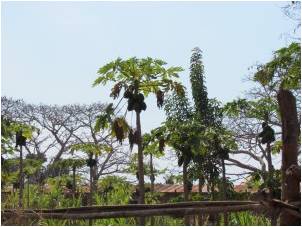
A lush papaya grove in Tanzania. (Photo by Alicia LeDuc)