Written in November, 2012 by compost-technician and inmate at Cedar Creek Corrections Center

Deep within each human being there lies an enigmatic force, or power, if you will. This power lies dormant until activated by something unique to each individual. Children often have this force brought to life by their parents, a role model, or teacher. What is this spark that can change the course of a young life? What can motivate someone to fly to the moon? What can cause dreams to become reality? What can make an incarcerated person believe in a bright future? One word: HOPE! Unfortunately, this fuel of dreams is rare, to say the least, in the place where these words originate. You see, I write from behind the fences of a Correctional Facility. I am one of the truly fortunate ones, however, for this power I write of was brought to life in me by a visitor. The irony is that the person who instilled hope in me is most assuredly unaware of the gift they gave me. Let me explain.
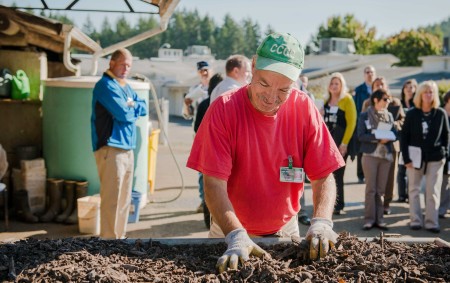
During a tour of the SPP national conference, the author demonstrates sifting compost at Cedar Creek Corrections Center, September, 2012. Photo by Shauna Bittle.

I was invited to attend my first Live Green, Learn Green lecture at Stafford Creek Correction Center approximately four and a half years ago. Dr. Nadkarni from The Evergreen State College came to Stafford Creek to speak. I don’t remember much of the content of that first lecture, what I do remember was that the good Doctor brought pine bows with her and placed them at each table. While pine bows might seem a bit insignificant to people who are not incarcerated, their significance increases a hundred-fold if you have been living in a concrete house for a decade. I found myself inhaling the sweet fragrance of pine that took me back to a better time. I am a native of the Pacific Northwest, so of course pine has the smell of memories clothed in innocence and nature that have always held a special attraction for me. I still find it amazing that an odor can inspire, and a simple touch of something from nature can bring to life something in me that had lay dormant for far too long.
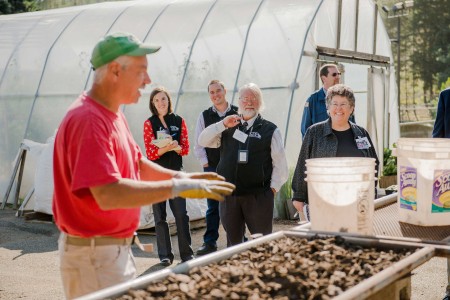
Another photo of the author from a tour of the SPP national conference in September, 2012. Photo by Shauna Bittle.

After that first lecture, I attended nearly thirty-six more lectures on various topics. I learned about butterflies, birds, bats, riparian areas, forest canopies, bears, salmon, and my absolute favorite, Apis mellifera (honey bees). The foregoing is not a comprehensive list, but a smattering of the gifts given to me by The Evergreen State College and the many fine people that brought the lecture series to the concrete habitat I lived in.

I don’t want to be misunderstood when I make this reference to concrete. I made my bed and I certainly must sleep in it. My point is that in prison there is a lack of things of nature. So, as I sat in the lectures, I became more and more interested and looked forward to the day when I could be actively involved in things green.

After approximately one year of attending the lecture, I was introduced to a young man by the name of Sam Hapke who was an entomologist from The Evergreen State College. Mr. Hapke taught me and several other inmates the wonderful art of beekeeping. I was previously afraid of bees, so it was with much trepidation that I forged ahead and gained an appreciation, no a love, for these wonderful and oh so necessary creatures. I studied the literature and paid close attention to Sam’s teaching and soon found myself as the sole inmate tasked with caring for the bees at Stafford Creek Correction Center. I love bees and plan to be actively involved with them in some capacity upon my eventual release.
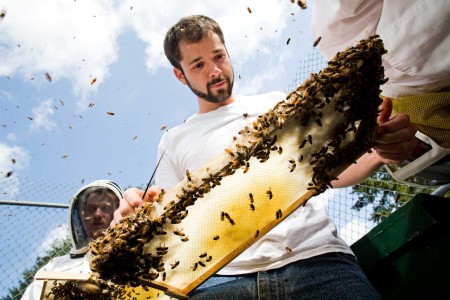
Entomologist Sam Hapke from The Evergreen State College works with an inmate technician in the beekeeping programming at Stafford Creek Corrections Center. Photo from 2009 by Benj Drummond.

I have left Stafford Creek and am now at Cedar Creek Correction Center, a minimum security camp. I am currently working in the garden and composting area of the camp and am actively involved with sustainability. I have been fortunate enough to be involved in several tours for the public, including people from Paris, New York, and Washington D.C., as well as many folks from the legislature here in the state of Washington. I don’t believe any of this would be possible had it not been for the sweet smell of that pine bow so long ago. Thanks Doc!
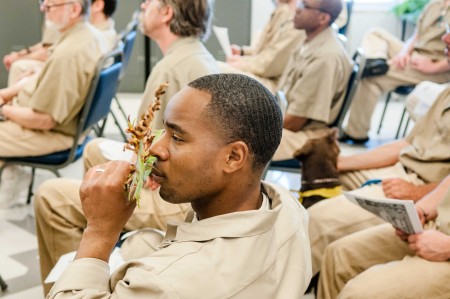
As the author says, smelling something green can be a rare delight for those incarcerated; this image from a 2012 lecture at Stafford Creek Corrections Center. Photo by Shauna Bittle.

In conclusion, I would like to express my gratitude to all the people who gave their time; that myself and others not only learned of sustainability, but actually felt like we could become contributors to our communities and the world as a whole. The future seems brighter than it has most of my life. I have a new found and lasting respect for this planet I live on. I understand more than ever that I am a steward charged with the care and sustainability of wherever my feet touch. I cannot go backwards for I am also tasked with sustaining the hope that was instilled in me.
By Bri Morningred, SPP Graduate Research Assistant and Washington Corrections Center for Women Ecological Conservation Nursery Coordinator

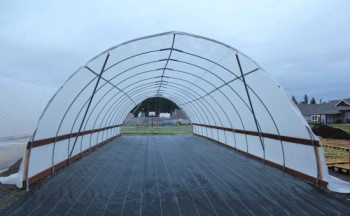
This third hoop house at WCCW differs from the first two in that it does not have doors; this will allow us to grow plants who like things a little colder.
The third hoop house at WCCW differs from the first two in that it does not have doors; this will allow us to grow plants who like things a little colder.

At long last the third hoop house in SPP’s conservation nursery at Washington Corrections Center for Women (WCCW) is complete! There they stand, all in a row, ready to shelter the upcoming rounds of sowing and hard work that the WCCW crew will complete. As I started with SPP after the first two hoop houses were already constructed, it was an amazing experience getting to see one built from the ground up—literally!

It all begins with marking the space where the hoop house is supposed to go, measuring the width of the poles and their spacing from each other, and marking everything with spray paint or tape. Next comes the hole-digging. This is a really difficult task but the WCCW crew made it look like a piece of cake. 🙂

Once the holes are dug, cement is poured into the holes, the base poles are set into the cement and left to harden. Further construction can’t happen until those poles set otherwise everything will tip over! Next comes attaching the frame to the supporting poles—here’s the cool part—and these frames and all the pieces to connect them are created at Stafford Creek Corrections Center! A very cool part of the partnership to get these hoop houses built, I think.

Once the frame is attached, boards are attached horizontally along the lower sides of the houses as base-boards for the wire lock track (I’ll get to that part in a minute). To do that, and to attach the wire lock track to the rest of the metal frame, we actually had to drill holes into the metal—a feat I had no idea was even possible until this project. The track for the wire lock is a groove that the wire lock (or wiggle-wire 😉 ) fits into; this holds the plastic in place without ripping it. With the wire lock tracks in place, now we can unroll and place the plastic. This was the most difficult part as the plastic is in a giant roll which is insanely heavy, and has to be hoisted up above the frame and unrolled little by little. Once again, the crew made it look so easy! After that, all that was left to do was to trim the plastic, attach it to the frame with the wiggle-wire, and lay the black ground cloth inside the hoop house and TA-DA third hoop house done!

Unlike the first two hoop houses, this one will not have doors on either end; it will be open in order to accommodate those plants that prefer to be more cold than warm throughout the growing season. After a very successful first sowing season at WCCW, we are excited to grow additional prairie plant species in this new hoop house in the coming season. We will keep you posted—thanks for tuning in!

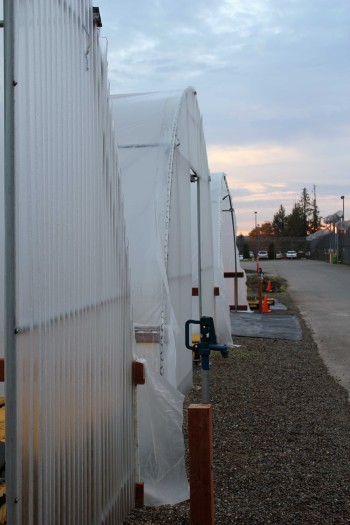
The three hoops houses at WCCW lined up in the dawn sunlight--they will be supporting over 10 species of native prairie plants through the next sowing season.
The three hoops houses at WCCW lined up in the dawn sunlight–they will be supporting over 10 species of native prairie plants through the next sowing season.

Thanks to Joint Base Lewis-McChord for funding construction of the third hoop house.

Cheers,

Bri


By Joslyn Rose Trivett, SPP Network Manager

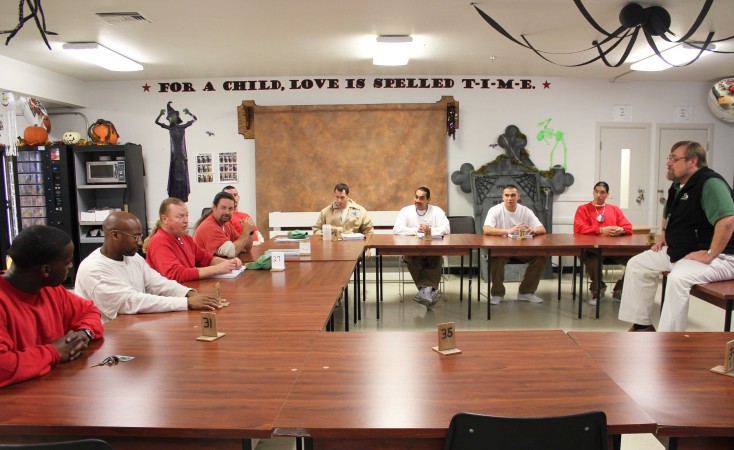
November4th, 2013, I had the pleasure of attending the first Roots of Success graduation ceremony at Cedar Creek Corrections Center (CCCC). Roots of Success is an environmental literacy curriculum recommended to us by Ohio corrections, and this year we are piloting the program at four corrections facilities: Correctional Industries, Stafford Creek Corrections Center, Washington State Penitentiary, and CCCC. Correctional Industries (CI) has funded and led program implementation. Special thanks to them, especially to Lucienne Banning and Michael Colwell of CI, for making the program possible.

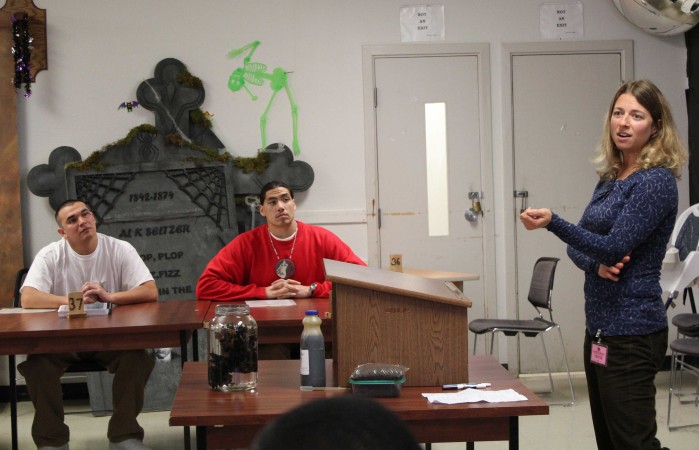
Superintendent of CCCC, Douglas Cole, discusses the merits of Roots of Success with the graduating class. Photo by Joslyn Rose Trivett.

The ceremony took place in the visiting room, still abundantly decorated for Halloween. The ceremony began with Superintendent Douglas Cole asking the class what they had learned in Roots of Success. The inmates detailed their new knowledge, and also spoke of the general importance of environmental literacy. One said, “This class has taught me the language of right now.” Another felt similarly lucky; he smiled as he said, “I feel like I’m buying Microsoft stock in 1982.”

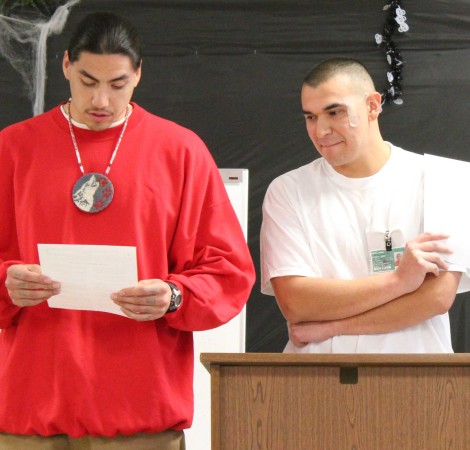
Two Roots graduates read a speech by Chief Seattle to the class. Photo by Joslyn Rose Trivett.

Two inmates from western Washington native tribes read a speech from Chief Seattle, and the reading was received with reverence and appreciation. One of the presenters said that he considered earlier technologies of this culture to be the “messier kind;” newer technologies, such as they had learned about in Roots of Success, are providing a way to connect back to nature.

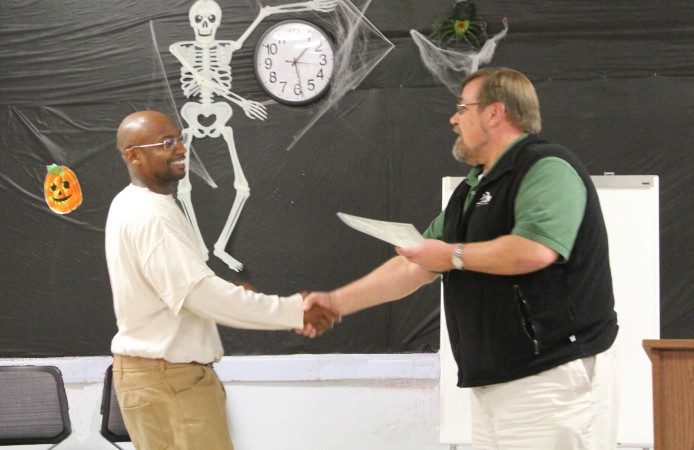
A Roots graduate receives his congratulations from Superintendent Cole. Photo by Joslyn Rose Trivett.
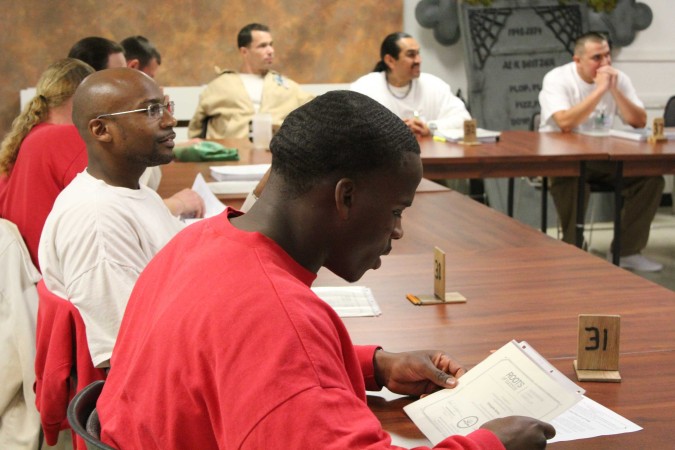
One of the Roots graduates reads his graduation certificate. Photo by Joslyn Rose Trivett.

The inmate students received their certificates to applause. We also acknowledged the two inmate instructors, and the SPP Graduate Research Assistant who has worked on Roots, Rachel Stendahl.

Guest speaker Aimee Christie from the Pacific Shellfish Institute describing CCCC's participation in a water quality improvement program in southern Puget Sound. Photo by Joslyn Rose Trivett.
Guest speaker Aimee Christie from the Pacific Shellfish Institute describing CCCC’s participation in a water quality improvement program in southern Puget Sound. Photo by Joslyn Rose Trivett.

Finally, a guest speaker, Aimee Christie from the Pacific Shellfish Institute, described how mussels are being used for nitrogen sequestration in southern Puget Sound. CCCC recently accepted about 2000 lbs of harvested mussels from the Institute and will process them in the prison’s new composting system.

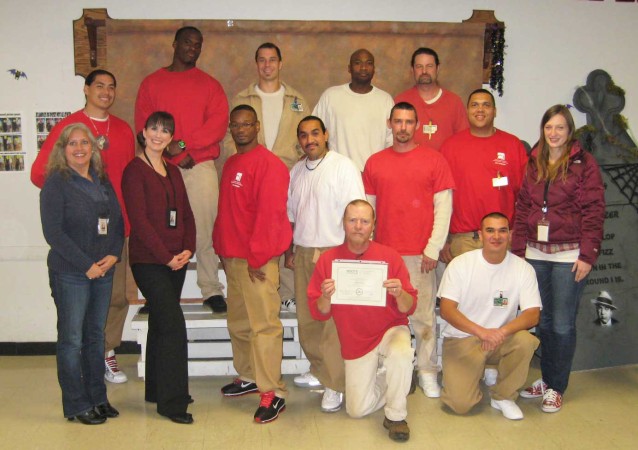
Roots of Success 2013 graduating class at CCCC. The women on the left are both Roots instructors: Rita Reynoldson, a corrections staff member, and Lucienne Banning, Offender Workforce Development Specialist for CI. The woman on the right is Rachel Stendahl, the SPP Graduate Research Assistant  who has coordinated Roots for Washington Department of Corrections. Photo by CI staff.
Roots of Success 2013 graduating class at CCCC. The women on the left are both Roots instructors: Rita Reynoldson, a corrections staff member, and Lucienne Banning, Offender Workforce Development Specialist for CI. The woman on the right is Rachel Stendahl, the SPP Graduate Research Assistant who has coordinated Roots for Washington Department of Corrections. Photo by CI staff.

I missed the cake and ice cream, and still I can say it was a wonderful event! I look forward to many more Roots graduations to come.


SPP needs funding to sustain our education programming: to donate, please visit our page at the Evergreen Foundation.


By Joslyn Rose Trivett, SPP Network Manager

In the short time that Cedar Creek Corrections Center (CCCC) has had their new in-vessel composter operational, I have heard many great things about it. In early November, I had the chance to see the composter in action and be further thrilled by its capabilities.

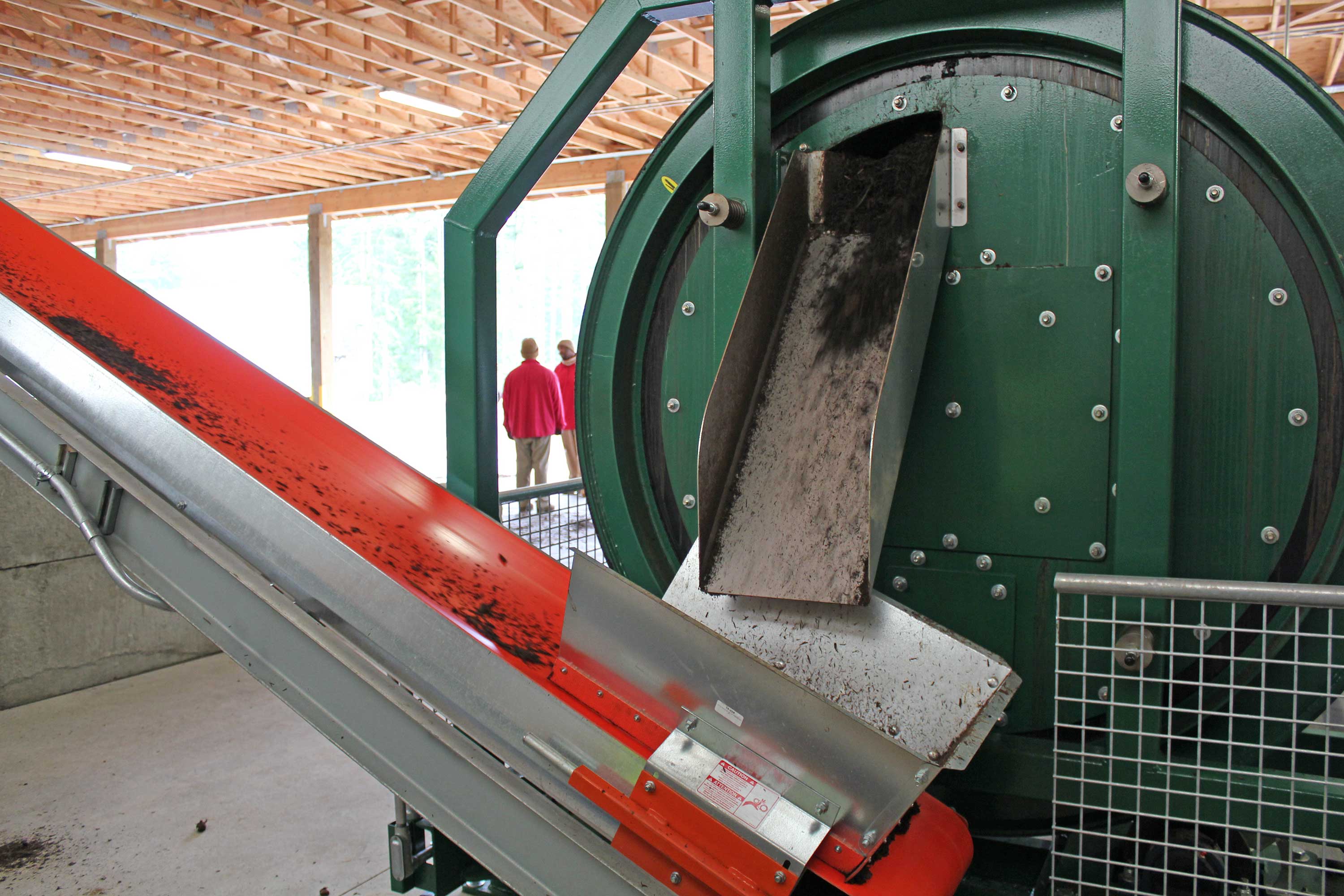
The new in-vessel composter at CCCC. This is the back end of the drum, and finished compost is falling onto the conveyor ramp that takes it to a holding pile.

The morning I visited they had added 1000 lbs of food waste to the front end of the drum. The drum’s rotation is sufficient to move the material along, so that if you looked at the drum in cross-section you would see the progression from fresh waste to finished compost along its length. Eric Heinitz, Environmental Specialist for Washington Department of Corrections (WDOC), showed me the metal markers used to ensure that inputs of material have a residence time of at least the 14 days; the first marker was dated and put in the drum 2 ½ weeks ago, and has not yet showed up in the finished product—a promising sign that the composter is working as it should.

Eric Heinitz, Environmental Specialist for WDOC, showing a metal marker used to determine compost's residence-time in the composting drum.
Eric Heinitz, Environmental Specialist for WDOC, showing a metal marker used to determine compost’s residence-time in the composting drum.

One of the inmate technicians has become especially proficient at operating and servicing the drum composter; he has been able to fix operational problems as they arise. The system’s manufacturer has requested that he get in touch with the business post-release, because they want to put his talents to work as an employee.

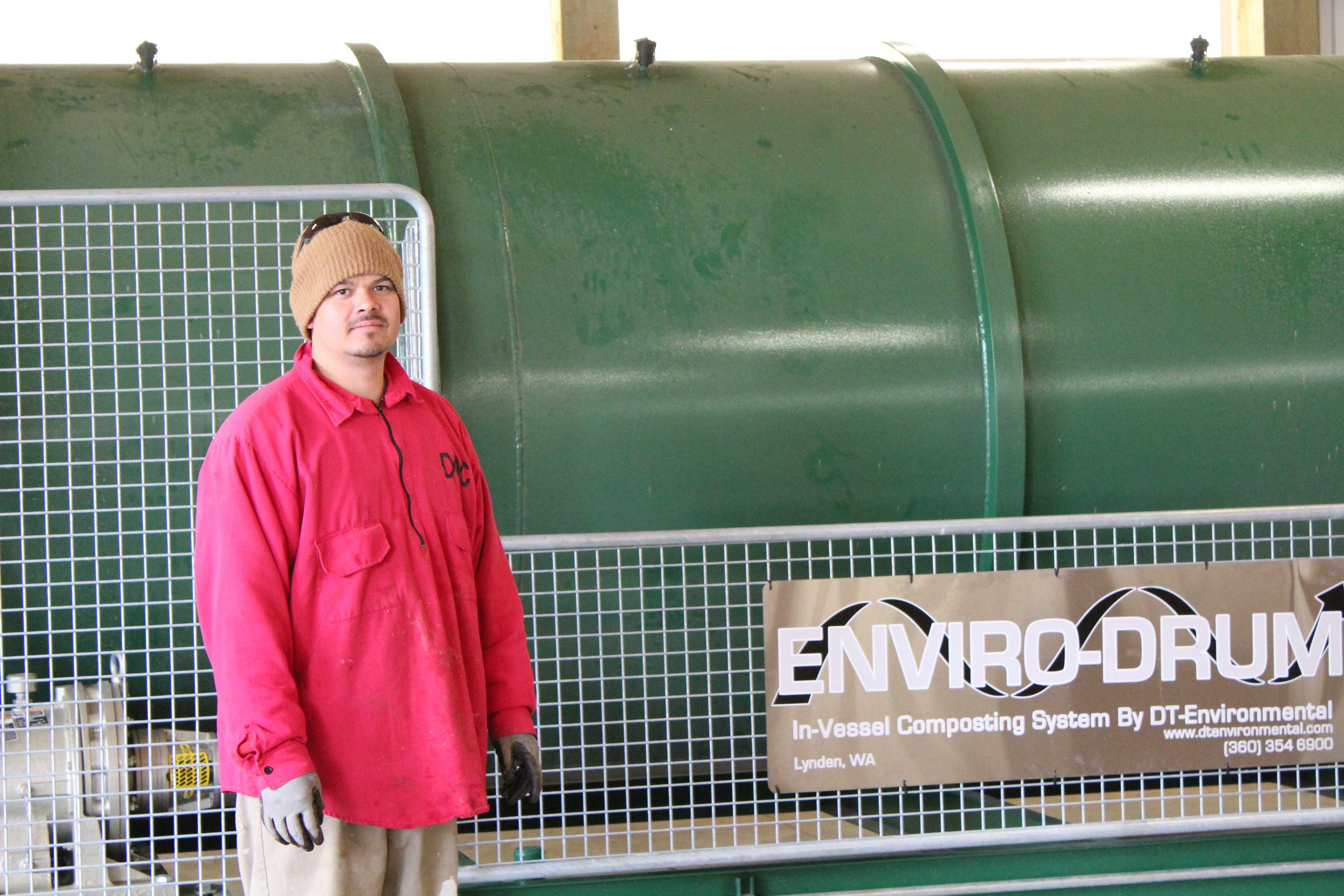
An inmate technician for CCCC's large-scale composting program was pleased to pose with the new machine.
An inmate technician for CCCC’s large-scale composting program was pleased to pose with the new machine.

Vermicomposting continues at CCCC’s small-scale composting area, a longtime highlight of SPP tours. With the new large-scale composter, plus their intensive recycling program, CCCC is cancelling its regular contract with the solid waste collector, Lemay, Inc. The prison is processing more than 95% of their solid waste on site!