By Graduate Research Associate Sarah Weber
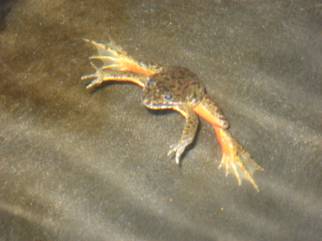
Oregon spotted frog


The Oregon spotted frogs (OSF) at Cedar Creek Corrections Center (CCCC) are the subjects of a growth comparison study between two separate OSF populations: Black River and Conboy Lake.  Inmates at CCCC are raising the two populations side-by-side in separate tanks, keeping all rearing conditions identical, in order to compare growth rates.  Measurements have been taken throughout the rearing season and will be taken again just prior to release in October at Joint Base Lewis McChord.  The OSF population at Conboy Lake is the only source population that successfully cohabitates with bullfrogs, a primary predator of OSF.  The hypothesis is that OSFs from Conboy Lake are bigger in size, and as a result of that, are faster in their response to predation.  This study will help determine whether or not captive rearing efforts should focus primarily on the Conboy Lake population.

As part of the comparison study, the OSFs predator response instincts were also tested.  Twenty frogs from each population were isolated for a short period of time in a stimulus free environment.  One by one, they were placed in a large plastic tub filled with just enough water to cover their bodies.  Once they relaxed enough to come to the surface and rest with their eyes out of the water, a plastic ball–tethered to stop before impact–was dropped from above, simulating a predator in the wild.  Each individual test is filmed to record the amount of time it takes each frog to react to the “predator”, and also to record response distance in its effort to escape.  The film is reviewed and data logged at the Oregon Zoo.  The data will allow for a parallel test between the Black River and Conboy Lake populations, and also a comparison between OSF rearing institutions, CCCC and Oregon Zoo.

The experiment took place at CCCC under the supervision and guidance of Senior Research Scientist Dr. Marc Hayes and Kyle Tidwell from the Oregon Zoo.  SPP interns Dennis Aubrey and Sarah Weber, and CCCC OSF inmates assisted with noting sex, coloration and tag number as well as taking the measurements and weight of each individual frog in order to identify any size or mass related variation in response. The inmate’s contribution to the predator response experiment and the side by side growth comparison study is integral to development of the OSF captive rearing program.  The rearing season continues at CCCC with inmates raising fat, healthy frogs getting closer to their release date.

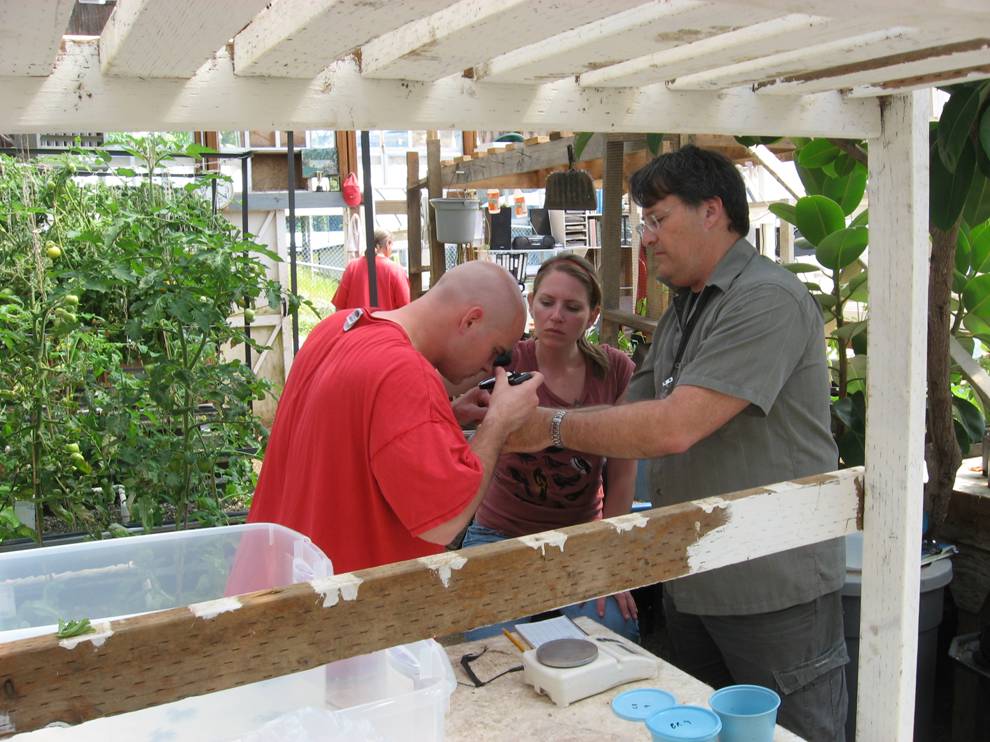
Predator response experiment underway!


Weighing and measuring frogs

By Graduate Research Associate Sarah Weber

Congratulations to SPP Director Dr. Carri LeRoy, and SPP Research Associate Carl Elliot on their recent publications in the Northwest Science Journal!

Together with Dr. Dylan Fischer of Evergreen State College they co-authored Germination of Three Native Lupinus Species in Response to Temperature.  Experiments to determine the effects of pre-germination treatment and germination temperature conditions on the proportional germination of three species of Lupinus are discussed.  The results could lead to better understanding of germination requirements of native species, an important component of restoration in south Puget Lowland prairies.

Dr. LeRoy was also co-author of a paper on Responses of Prairie Vegetation to Fire, Herbicide, and Invasive Species Legacy.  Native and exotic plant community diversity and composition were measured across areas that differed in burning history and grass-specific herbicide application in an effort to evaluate prairie plant community variation in a matrix of restoration treatments in the south Puget Lowland prairies.

Both papers are available for download via Open Access on the Northwest Science BioOne page:

Germination of Three Native Lupinus Species in Response to Temperature is available at:  http://www.bioone.org/doi/abs/10.3955/046.085.022

Responses of Prairie Vegetation to Fire, Herbicide, and Invasive Species Legacy is available at:  http://www.bioone.org/doi/abs/10.3955/046.085.0216

Celebration and Transition

By SPP Project Manager Kelli Bush

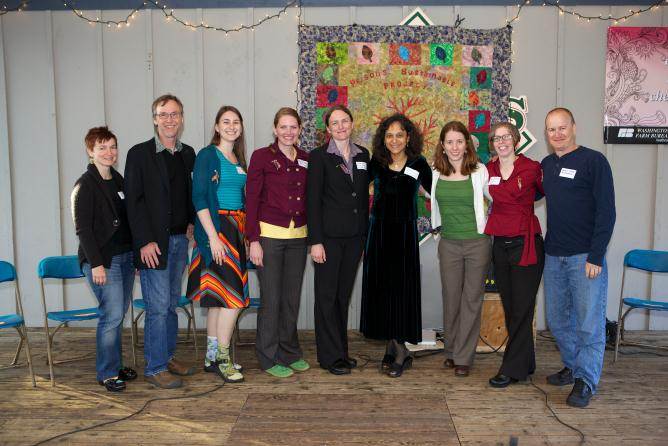
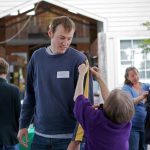
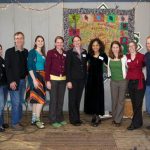
The Sustainable Prisons Project (SPP) recently celebrated another year with our many wonderful partners.  The event, held on a cool summer evening at the Olympia Farmer’s Market, featured a wide range of guest speakers representing various aspects of the Sustainable Prisons Project.  Speakers from Department of Corrections, Joint Base Lewis McChord, The Evergreen State College (TESC), Center for Natural Land Management, Washington Department of Fish and Wildlife, and a prison volunteer each spoke about the significance of SPP from their perspective.


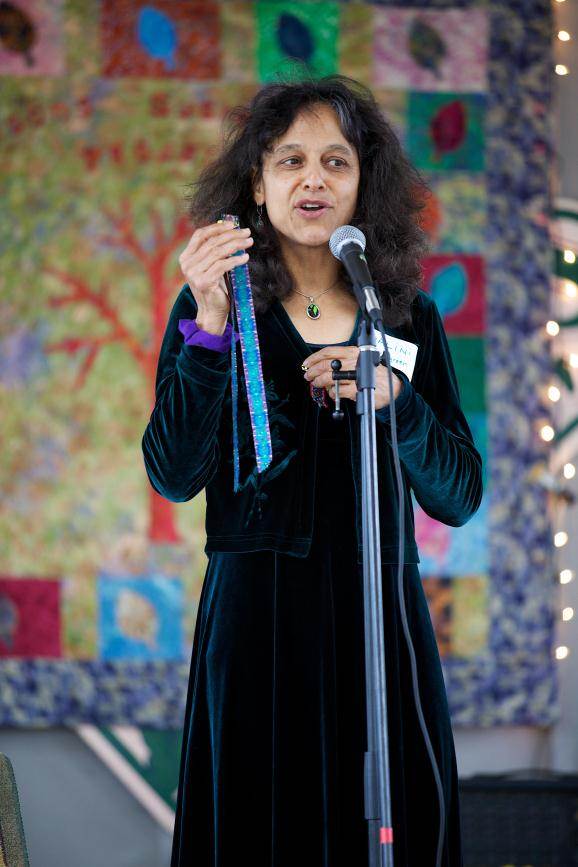
The event was also an opportunity to honor out-going Co-Director and Co-Founder of the SPP, Dr. Nalini Nadkarni.  Nalini has accepted a position at University of Utah as the Director of the Center for Science and Math Education.  She will remain involved with SPP as Senior Advisor.  Nalini is also continuing work to share SPP with other states, including at her new location in Utah.


We also welcomed new SPP Co-Director Dr. Carri LeRoy.  Carri began working with the SPP team in April and she officially began her new role as SPP Co-Director July 1st.  She is a stream ecologist and a member of the Masters of Environmental Studies faculty at Evergreen.  Carri is an excellent addition to the team and we look forward to continuing the Project with her leadership.


After a year filled with declining budgets we are extremely grateful to our partners, students, TESC staff, foundations, and grant funding sources that helped keep this project going.  We are excited to see what the next year brings!


To donate to the SPP and help bring conservation into Washington prisons, click here.