Butterfly Techs at Mission Creek Helping with the Evergreen Environmental Observation Network
By Dennis Aubrey, SPP Graduate Research Assistant & Taylor’s checkerspot program coordinator
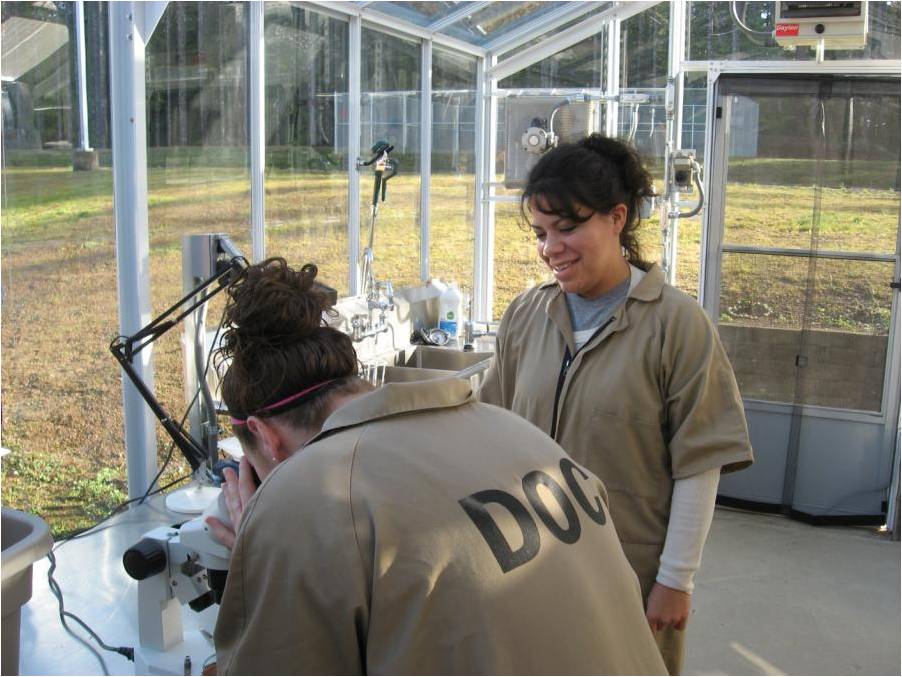
While the Taylor’s checkerspot caterpillars at Mission Creek Corrections Center for Women are sleeping under terra cotta pots for the winter, the inmate butterfly techs on the project have not been idle. They’ve helped to write season ending reports, compile data, produce rearing protocols, and last week they started helping with an ongoing ecological study through The Evergreen State College and the Evergreen Environmental Observation Network (EEON).
Evergreen sits on 1,000 acres of second growth lowland temperate rainforest, and EEON is a series of 44 fixed long-term study plots within this forest. Students and faculty conduct a wide range of research projects using the network, and the latest involves bigleaf maple leaves and the tar spot fungus (Rhytisma punctatum).
Tar spot fungus is not well studied in Pacific Northwest forests, but it has a fascinating life history. It infects the new maples leaves each year, and creates a small dark spot where it is somehow able to hijack the photosynthetic machinery of the leaf. As the trees try to reabsorb precious chlorophyll with the onset of autumn (the reason leaves change color) to store over the winter, the tar spots are able to hold on to a last bit of green. Dr. Carri LeRoy, co-director of the SPP, is interested in understanding how the higher nutrients remaining in the infected areas interact with the fungal tissue to influence rates of leaf litter decomposition.
Research at The Evergreen State College is examining this question (LeRoy et al. 2011, Freshwater Biology), and in the meantime there is also much to learn about the fungus’ population structure and spatial distribution. The inmates at Mission Creek are examining leaf litter from the EEON plots to try to gain a better understanding of how it varies across the forest landscape. They are sorting the leaves, removing tar spots and weighing both the tar spots and the remaining leaf material. This will provide a measurement of relative biomass in 44 locations. Meanwhile, Evergreen students are working on quantifying forest stand structure in the plots so that tar spot density can be compared to the percentage of maple trees in each location.
This collaborative work provides real involvement in science to the inmates and also much-needed lab support to EEON. As usual, the butterfly technicians at Mission Creek have been meticulous and dedicated research partners.
 Gig Harbor, Wash.—Emphasizing the importance of sustainability, the horticulture program at
  “Because each offender demonstrated a high capacity of responsibility for day-to-day farm activities, I decided to assign special projects for each lady,” Little said. “The project idea was a way for the offenders to take ownership of the farm, learn something new and educate each other on their respective projects. Being a part of the learning process was an enriching experience as a manager, and I look forward to working with Washington Corrections Center for Women to explore new boundaries, build knowledge and experiences and work together to fight hunger.”