Posted by Graduate Research Associate Carl Elliot
The long-term goal of the prairie plant nursery project at Stafford Creek Correction Center (SCCC) is to produce seed to be used in restored South Salish Sea prairie ecosystems. All of the plants grown at the SCCC nursery are planted out on Joint Base Ft. Lewis-McChord at the seed nursery production unit. Additional seed production beds are at Washington State Department of Natural Resources Webster Nursery. This month the offenders received hundreds of pounds of seed from this nursery to hand clean in preparation for the fall sowing season. The work provided an excellent opportunity to participate in the full circle of restoration activities.
Lupines were the genus of focus for this stage of the seed cleaning project. The Sustainable Prison Project (SPP) staff delivered bags of seed and chaff of Lupinus albicaulis, Lupinus lepidus, and Lupinus bicolor for cleaning. Cleaning these seeds is a satisfying activity because with a little work they produce a hefty amount of seed. Lupines provide important ecological services as nectar sources and larval food for the Puget Blue Butterfly (Icaricia iracioides blackmorei). They also facilitate the growth of other prairie plants by fixing atmospheric nitrogen. SPP staff led a workshop to educate offenders on the ecological contributions of lupines and basic seed cleaning protocols.

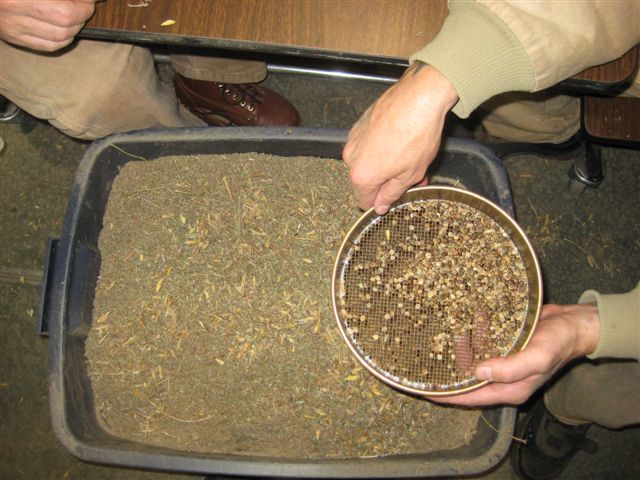
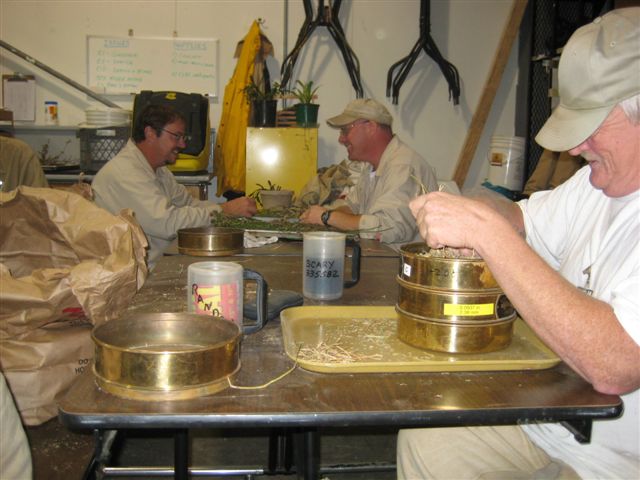
The offenders created a number of unique means to process the seed with improvised tools that they had on hand. Large industrial cookie sheets were turned into shaker tables that allowed the larger seed to roll out and separate from the lighter chaff above. After that initial cleaning, other offenders used the hand sifters we provided to fine clean the seed. Using hand lenses, we identified larval and young adult seed weevils (Thychius germar) that were mixed in with the lupine seed, and dispatched of them humanely. Over the next month offenders are going to build seed screens in the wood shop so we can quickly process seed in larger quantities, and move on to processing wet seed such as Sambucus nigra ssp. cerulea and Viburnum ellipticum.