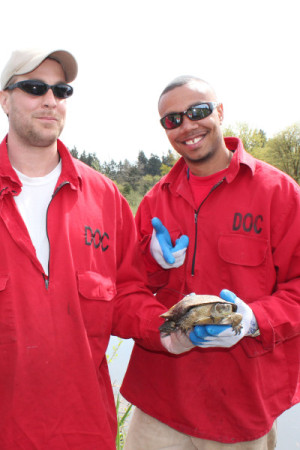
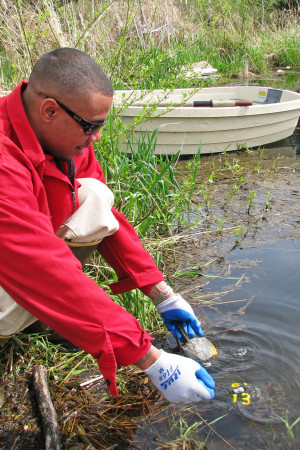
Photos by Joslyn Rose Trivett, SPP Network Manager.
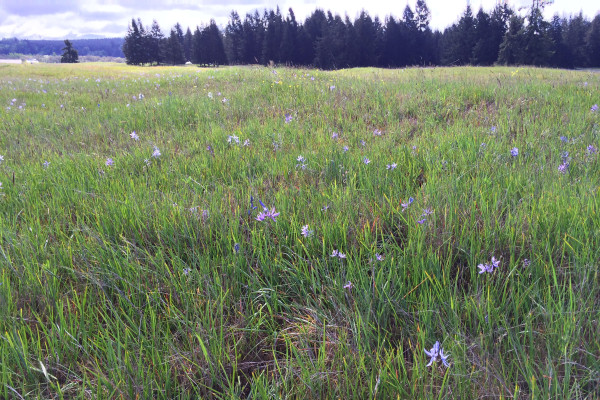
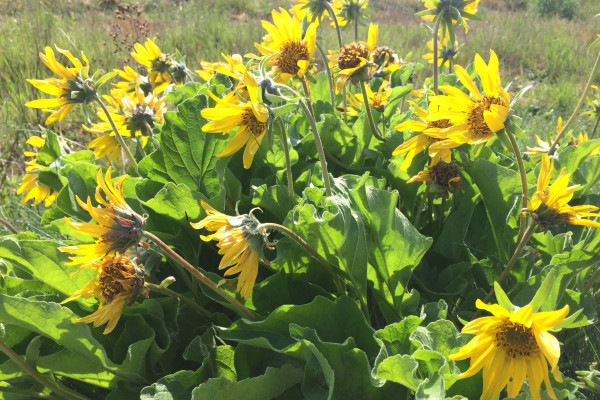
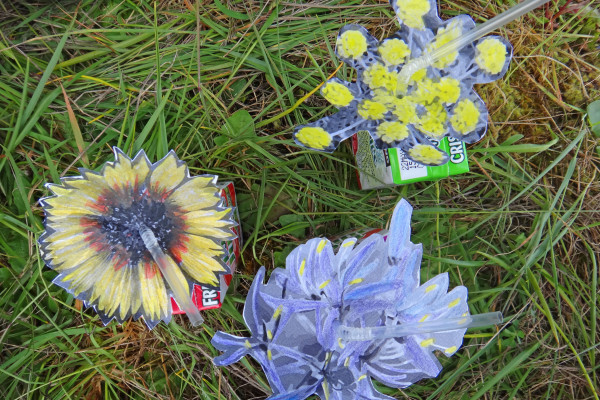
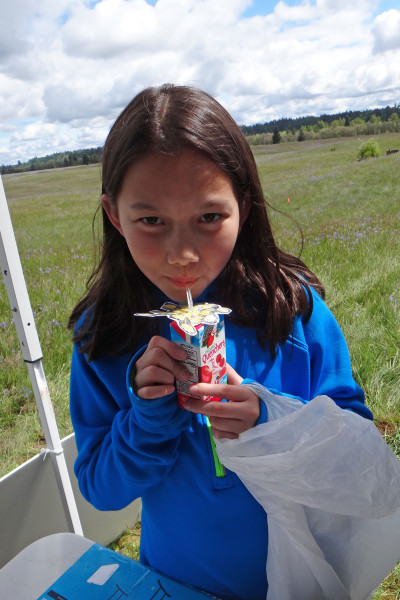
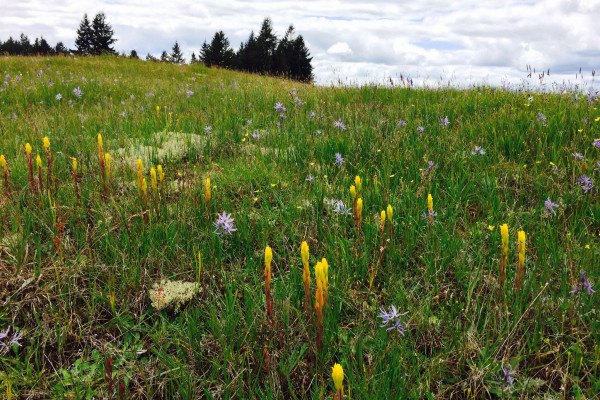
To find out more about Prairie Appreciation Day, see the article: Butterflies, flowers and prairies, oh my! by one of SPP’s conservation nursery coordinators, Bri Morningred.
Photos by Joslyn Rose Trivett, SPP Network Manager.
To find out more about Prairie Appreciation Day, see the article: Butterflies, flowers and prairies, oh my! by one of SPP’s conservation nursery coordinators, Bri Morningred.
By Jamar Glenn, Western Pond Turtle Technician
Who would’ve thought a turtle’s life was so parallel to mine? I was given a great opportunity to work with an endangered species, the western pond turtle (WPT), which was placed here at Cedar Creek Corrections Center (CCCC). These animals were infected with an illness called “shell disease.” This disease eats at the plastron, which is the bottom half of the turtle shell. If not treated immediately this disease can kill the animal.
From the beginning of the turtle’s life it’s faced with an obstacle to reach its destination of “freedom.” In the beginning stage the mother lays her eggs along shore, leaving her young to fend for themselves. It’s up to the turtle to follow nature’s designed course to make it to its final destination. To get there the turtle has to go survive a series of threats to finally be free:
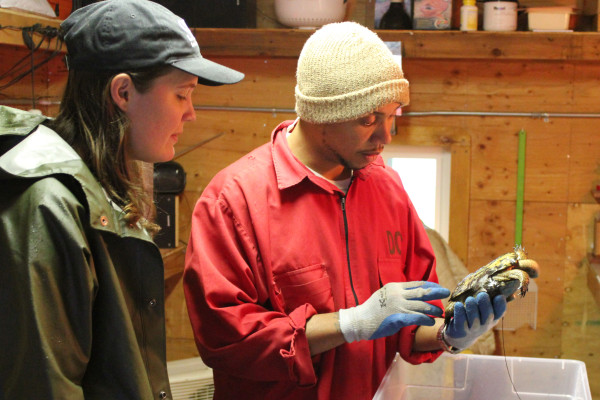
In this particular case of shell disease, Washington Department of Fish and Wildlife (WDFW) run a series of tests and administer intensive treatments with the turtles. Once the turtles are treated, they are then given to CCCC for additional care: we give 20-minute iodine baths, feed them a diverse diet, weigh them, and give additional care to any lesions located on the plastron. We then submit observation notes to the scientist and veterinarians so they can keep records on each individual turtle. The turtles stay under my care for 2-4 months. Once healed, the turtles are released back into the wild to carry on with their turtle lives.
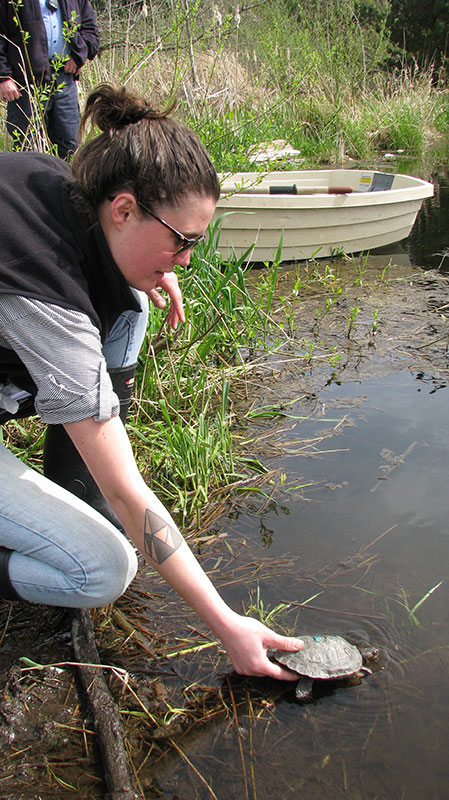
As I released my first turtle, I thought about the turtle’s life and the events it had to endure. Constantly on the run from predators, being captured and taken away from its natural habitat, and riddled with illness, to finally returning home healthy and determined to stay free if she has anything to do with it. She was tagged upon release, so she’ll be under the watchful eye at all times.
As she swam away, I thought about my own life. How I also had to go through my own life struggles ever since I was a youngster. I’ve been alone with no assistance. Predators were my enemy (rival gangs). My illness was my addictions (drugs/alcohol), and my loss of habitat was prison. I too will be tagged and watched by “the eye.”
|
|
|
I came to prison when I was 16 years old; I’ve been incarcerated now for 17 years. My time has come for me to be released here next year. This program has really enlightened my heart and mind, opening my eyes to a whole new world of opportunity. It’s taught me how to be consistent, responsible, great job ethics, and communication skills. These are tools I didn’t possess in my younger years. I finally can give back to society in my own special kind of way, doing something I never could imagine myself doing. I too will be under the eye, I too will return home healthy, and determined to stay free if I have anything to do with it! Who would’ve thought a turtle’s life was parallel to mine.
For more about the turtle release, see Fiona Edward’s blog on the event.
by Fiona Edwards, SPP Graduate Research Assistant
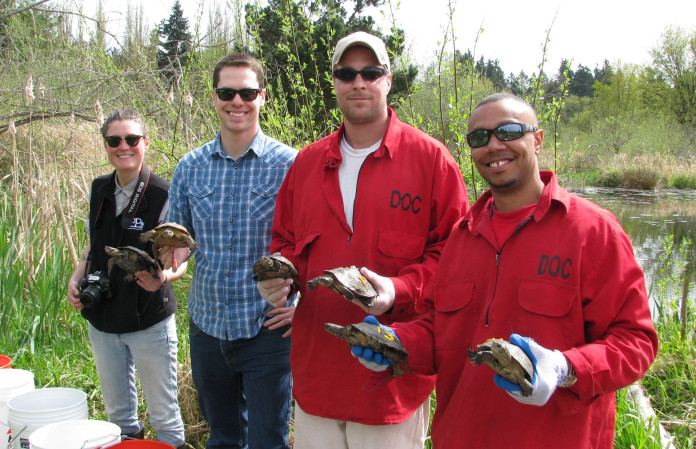
In mid-April, 10 western pond turtles (WPT) were released from Cedar Creek Corrections Center (CCCC) back into the wild. The turtles were housed at CCCC for 4 months where they received care from 2 inmate technicians, Jamar Glenn and Timothy Nuss, for shell disease. The Washington Department of Fish and Wildlife (WDFW) and veterinarians at PAWS determined the turtles were healthy based on new shell growth, regular basking, and consistent appetite. WDFW biologists will monitor their progress as they reenter their natural habitat.
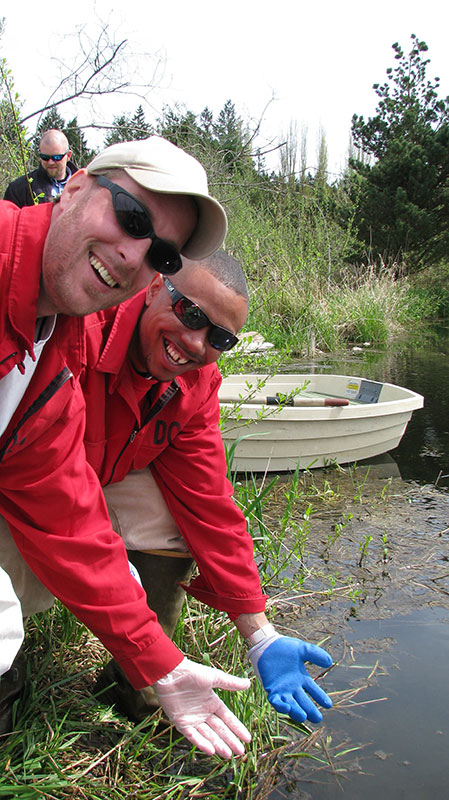
The release marked the end of SPP’s first season participating in the WPT recovery effort. A WDFW biologist organized the release. Participating in the release were: inmate technicians Mr. Glenn and Mr. Nuss, along with SPP Liaison and CCCC Classification Counselor Anthony Pickard, CCCC Superintendent Douglas Cole, CCCC Correctional Unit Supervisor Cheryl Jorban, Correctional Officer James Erwick. Upon arriving at the site, we geared up into our muck boots and carried the turtles into the water. Mr. Glenn and Mr. Nuss released the first set of turtles, wishing them well as they swam away. Then the rest of us took turns returning the turtles to their home. Afterwards, the biologist taught us more about the turtles’ habitat and their behavior in the wild. We were shown a turtle nest and learned about how they lay their eggs and the long period the eggs and hatchlings remain underground before emerging and crawling towards water.
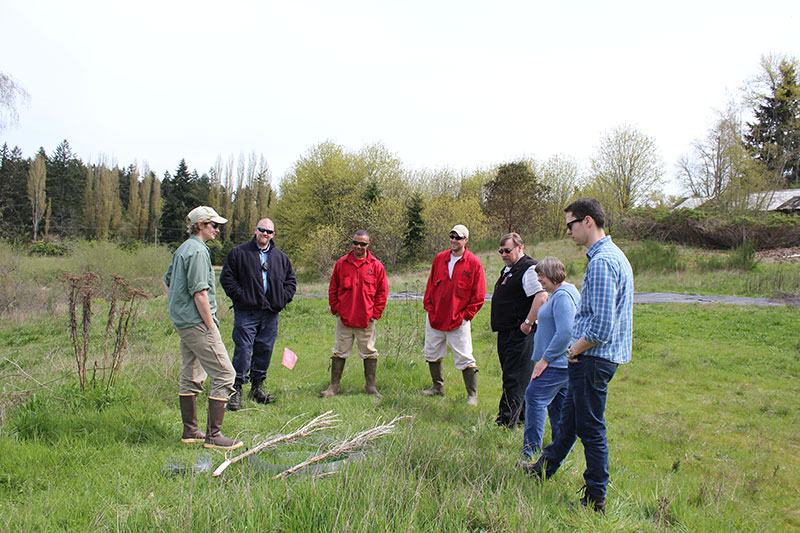
After months of hard work, including the construction of a new turtle facility at CCCC, it was rewarding to be a part of this crucial step toward recovery. It was especially enjoyable because the inmate technicians were able to attend the release, a first for SPP – thank you to WDFW and CCCC for making their attendance possible. Visiting the site allowed all of us the chance to better understand the significance of rehabilitating the turtles and reminded me of the importance of each of our partners’ contributions to the recovery effort. The turtle release wouldn’t have been possible without the collaborative power of PAWS, WDFW, CCCC, and Woodland Park Zoo. Thanks for your continuing support!
Stay tuned for a blog from SPP Technician Jamar Glenn about his experience working with the turtles. For a video on the release, click here.

VISION: In response to the dual crises of ecological degradation and mass incarceration, we aim to reduce recidivism while improving human well-being and ecosystem health, Read More