Come see one of our student Research Associates participate in a panel presentation ….

As climate change and dwindling resources create mounting concerns, societies across the globe are turning to the foundations of sustainability to enlighten future decisions.   On August 7, 2010 at the Capitol Theatre in downtown Olympia, WA, the Sustainable Prisons Project will take part in a panel discussion regarding sustainability and its implications for the future,  following a screening of the thought-provoking film 2012: Time for Change,  hosted by the Olympia Film Society. The film begins at 6:30pm with the panel discussion to immediately follow.   This event provides an engaging opportunity to discuss how we as individuals can create sustainable projects and futures.

We invite you to attend, and encourage your comments and participation during the guest panel discussion.  We’ll see you at the box office!

More Information:

2012: Time for Change

The Olympia Film Society

The Sustainable Prisons Project has a lot to celebrate these days.  Our contract – between The Evergreen State College and Washington Department of Corrections – was recently renewed, providing two more years of funding.  We’ve hired two more graduate students, rounding out a strong team.  We’ve hired our new Project Manager, Kelli Bush, who will make sure we keep all the pieces of the project flowing and growing smoothly.  And we’re preparing to launch several new (or revived) pieces of the project.  In sum, we have a lot to celebrate.

Even as we hire more staff, we know that this small team represents only a fraction of the work being done.  The Sustainable Prisons Project could not succeed without all of the support we receive. A few examples include:

  • Classification Counselors, Officers, Environmental Planners, and others at the prisons that spend time coaching offenders in gardening, horticulture, and frog rearing projects.
  • Officers and others that take time out of their duties to escort our staff and speakers through the prisons.
  • Department of Corrections administrative staff that schedule and coordinate our events at the prisons.
  • Evergreen State College staff that interpret our budget documents, process grant documents, and make sure that our students get paid.
  • A diverse group of presenters, including scientists, academics, and state agency and non-profit employees who have presented intriguing subjects to offenders.

On last Monday night (July 19) we brought just a few of those partners, participants, and others together at Mercato Ristorante in downtown Olympia – not for a meeting, but to celebrate. Although we’ve created this web of scientists, Department of Corrections staff, Evergreen State College staff, and others through the years, we rarely gather in the same room.  It was great to see biologists from Fort Lewis talking with secretaries from the college, and students chatting with prison superintendents.  We were also very fortunate to have Governor Gregoire stop by to acknowledge the work we’ve been doing, and remark on how relatively small efforts such as ours have big echoes in the halls of government.

Energized by recent events, and this gathering, our team is in the trenches, eagerly charting new paths for the Sustainable Prisons Project.  Who knows what successes we may be celebrating at our next gathering!

Thanks again to Mercato Ristorante in Olympia for graciously donating the space, hors d’oevers, and staff time to help us create wonderful celebration.

After six seasons as a ranger in the National Parks and Forests, and three years in graduate school, I joined the Sustainable Prisons Project team, as the interim project manager, back in March.  Over the past few months I’ve managed the project largely from the sidelines, from my keyboard and telephone.  I’ve had a few ventures to the prisons we’re active in.  After one of my visits, I returned to a staff meeting and frankly I begged to be included on the lecture schedule.

This week I had the fortune of presenting talks on bear biology both at Washington Corrections Center for Women and McNeil Island Corrections Center.  Although I’ve presented many an evening program in my days as a park ranger, and I’ve talked with a lot of different audiences, presenting in a prison is a unique experience.

The first challenge in preparing was to decide on my topic.  As a park ranger I’ve studied volcanoes, bears, caves, marine mammals, and other subjects.  Being in the Northwest, a landscape of mountains and public lands, bears seemed to be a perfect topic.  The next challenge was to decide which aspect of bears the talk should focus on. There are just too many options!  Rather than focusing on one subject I hoped to show offenders that you can study something seemingly simple, an animal such as the bear, from many perspectives.  I crammed basic bear biology, ecosystem ecology, conservation, and my favorite nature literature that has focused on bears, into 50 PowerPoint slides, and hoped for the best.  An ambitious lecture indeed, but I’ve been consistently impressed by how much information offenders eagerly and ambitiously absorb.

Last Wednesday, at the Washington Corrections Center for Women, I found an enthusiastic audience of about 30 women.  They were particularly interested to understand the life cycles of bears, and the ways that humans interact with bears.  My stories of daily life in Katmai National Park and Preserve, when I was a ranger, and how those stories relate to bear biology were hits.

On Thursday, after a quick tour of McNeil Island, our DOC staff escort led our staff to the visiting room for the lecture.  We scrambled to set up the room for the 90 offenders who signed up for the lecture, and I ticked through my PowerPoint slides, hoping I had enough material to keep the offenders occupied and engaged for nearly 90 minutes.  Quickly I realized I had no reason to worry about time, as within five minutes, offenders hands were raised as they asked intriguing and creative questions about bear foods, life cycles, biology, and the implications of climate change and habitat fragmentation.  I was floored by the depth and intelligence of the questions I was asked.  A few offenders had very good and valid ideas about how to recover imperiled brown bear populations in the lower-48.  If I knew how good the questions would be, I probably would have read just a few more scientific articles before the lecture!

As our team sat on the boat venturing back to the mainland (McNeil Island Corrections Center is indeed on an island as the name implies, with the prison operating ferry boats for staff and visitors), I found myself reflecting.   For six seasons I talked about bears, volcanoes, caves, and wildlife around campfires and amidst wild land.  These days I find myself behind numerous gates and fences presenting to offenders, and yet the offenders still manage to deeply appreciate nature and science, even from a distance.  Although it’s easy to miss the campfires and hikes of working in our National Parks, I’m developing a deep appreciation for interacting with offenders. Their deep intellect and curiosity persists, even as they serve (often long) sentences for crimes that are painful to think about. 

Our next staff meeting is on Tuesday and I think I’ll probably ask to speak at another prison.  I really appreciate the ideas that offenders brought forth, and I hope they continue to ask questions that send me to the books and journals seeking answers.

We recently joined the Facebook world…please visit our page, “like” us, and share with your friends!

Posted by Graduate Research Associate Sarah Clarke

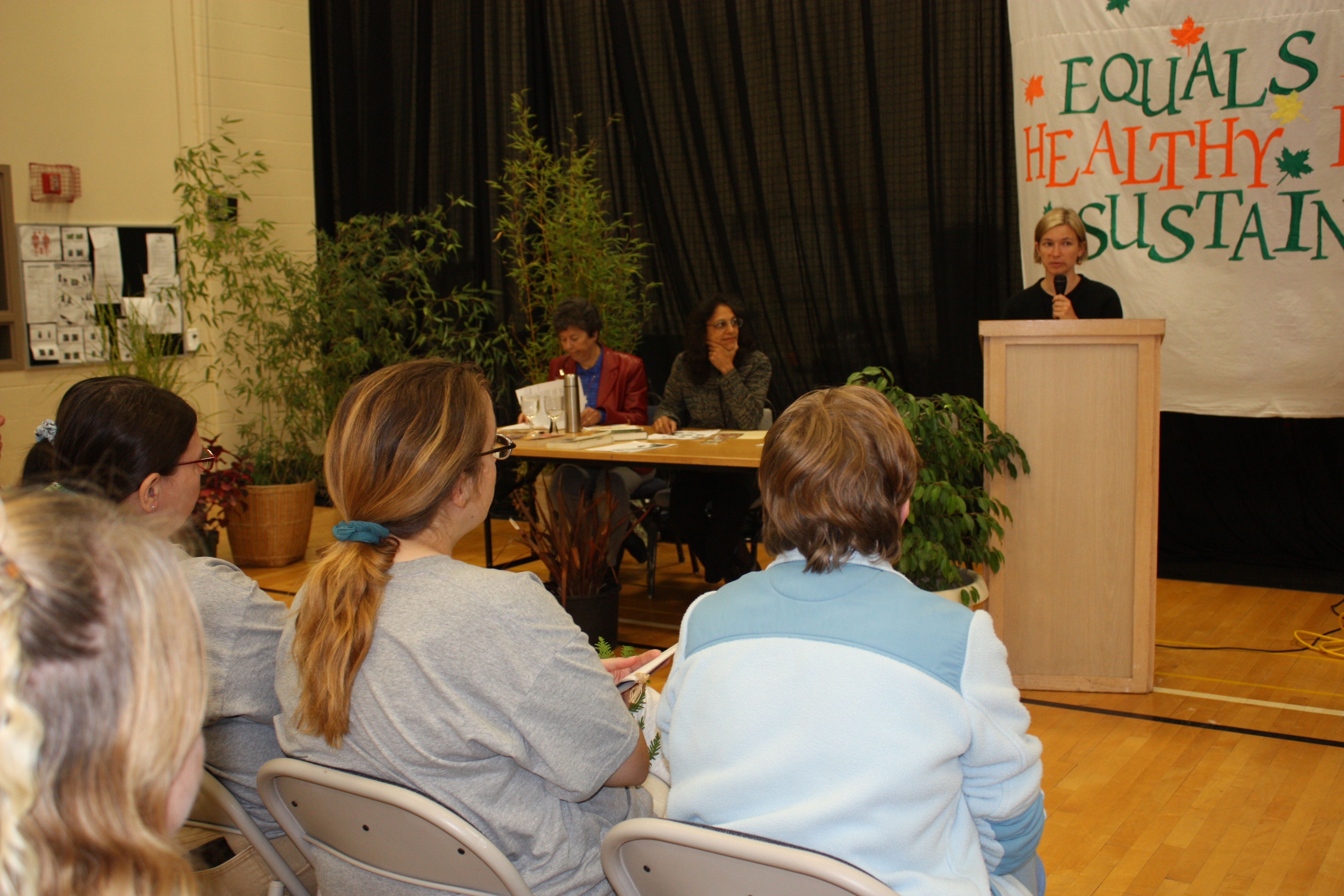
In September 2009 we kicked off a science and sustainability lecture series at the WCCW in Gig Harbor, WA. Included as part of a yearly Women’s Health Conference titled “The Mind, the Spirit, the Environment Maintained, Equals a Healthy Body Sustained,” our lectures there on Trees and Human Health as well as Toxics and the Environment started what has become a popular series for offenders at the WCCW.  Now, 10 months into this series, we recently noted the diversity of presentations we’ve been able to offer at WCCW.

Sarah Clarke, Research Associate, speaks to offenders at WCCW at the conference held in September 2009

Each facility in the Washington Department of Corrections is a little different, and we adjust lecture series accordingly.   From the start, staff and offenders at WCCW tasked us to find lectures that integrate the personal health aspects with the environmental aspects of sustainability. This unusual and challenging task has turned out to be very fruitful as it has led to a diverse mix of guest lecturers and topics.

Lectures have included such topics as Poetry and Sustainability, Yoga and Sustainability, Ethnobotany, and more traditional science and sustainability lectures like Nearshore Restoration in Puget Sound, Salmon in the Pacific Northwest, Beyond Waste in Washington State: Reducing Toxic/Solid Waste and Reusing Organic Waste, and Wolves: Endangered Species Ecology, Ecological Conservation, and Wildlife-Related Jobs. Future topics include Biology and Ecology of Brown Bears and Purple Martin and Western Bluebird Ecological Conservation.  

Frequently during lectures we (SPP staff, inmates, and officers) reflect on the maxim “we will not fight to save what we do not love.”  As organizers, we feel we have helped offenders not only understand the science of restoration, salmon, and wolves, but also to further their love of the plants and animals native to the Northwest.  Offenders consistently show a deep level of curiosity as they ask insightful and unique questions, exhausting available Q&A time.