Posted by Graduate Research Associate Carl Elliott

In a plant nursery that focuses on native plants and restoration, expectations are a bit different than at a traditional commercial nursery. Commercial nursery production has focused on those plants that make a good economic return for the grower. All managers of commercial nurseries know that if you have a rapid and efficient turn-over of plant material through the year, you generate a greater income per square foot. There is an industrial infrastructure and research to support the industry in this process.  For restoration nurseries interested in basic germination protocols or more complex issues of genetic integrity or in-breeding depression, there is not such a well-developed research infrastructure, and a great many questions remain to be answered.

At the conservation nursery at Stafford Creek Corrections Center, we have generated a number of basic scientific questions regarding the germination ecology of the prairie species we cultivate. One of the most engaging is the seeds response to prairie fires. Fires have been an integral tool to maintain prairies in the Pacific Northwest for at least 8,000 years. The fires in this ecosystem are not natural; they were used by First Peoples to maintain the extant and health of the prairies that are surrounded by evergreen woodlands. The seeds of over 250 species of plants have been shown to significantly increase in response to the smoke generated by fires. This is particularly true for species from fymbos matorral, chaparral and grassland ecosystems. So, our project developed a question to determine whether the smoke from fires could increase the germination rates of some of the more difficult to germinate plants.  Rather than apply smoke (and therefore fire) to the seeds themselves we applied smoke infused water as a treatment to seeds.

I took on the scientific design and execution of the seed germination experiments as part of my graduate thesis at The Evergreen State College. However, the experiment is a fully collaborative endeavor. The Nature Conservancy collected and curated the seed from their Shotwell’s Landing nursery. The offenders at Stafford Creek cleaned the seed, counted out replicates and participated in the germination experiments involving six of the species. The experiment involved measuring the germination rate of the six species. The seeds were divided into three treatment groups: two different levels of smoke water and a plain water control. The offenders applied the treatments to 10 replicates of each and the monitoring for germination went for 35 days.
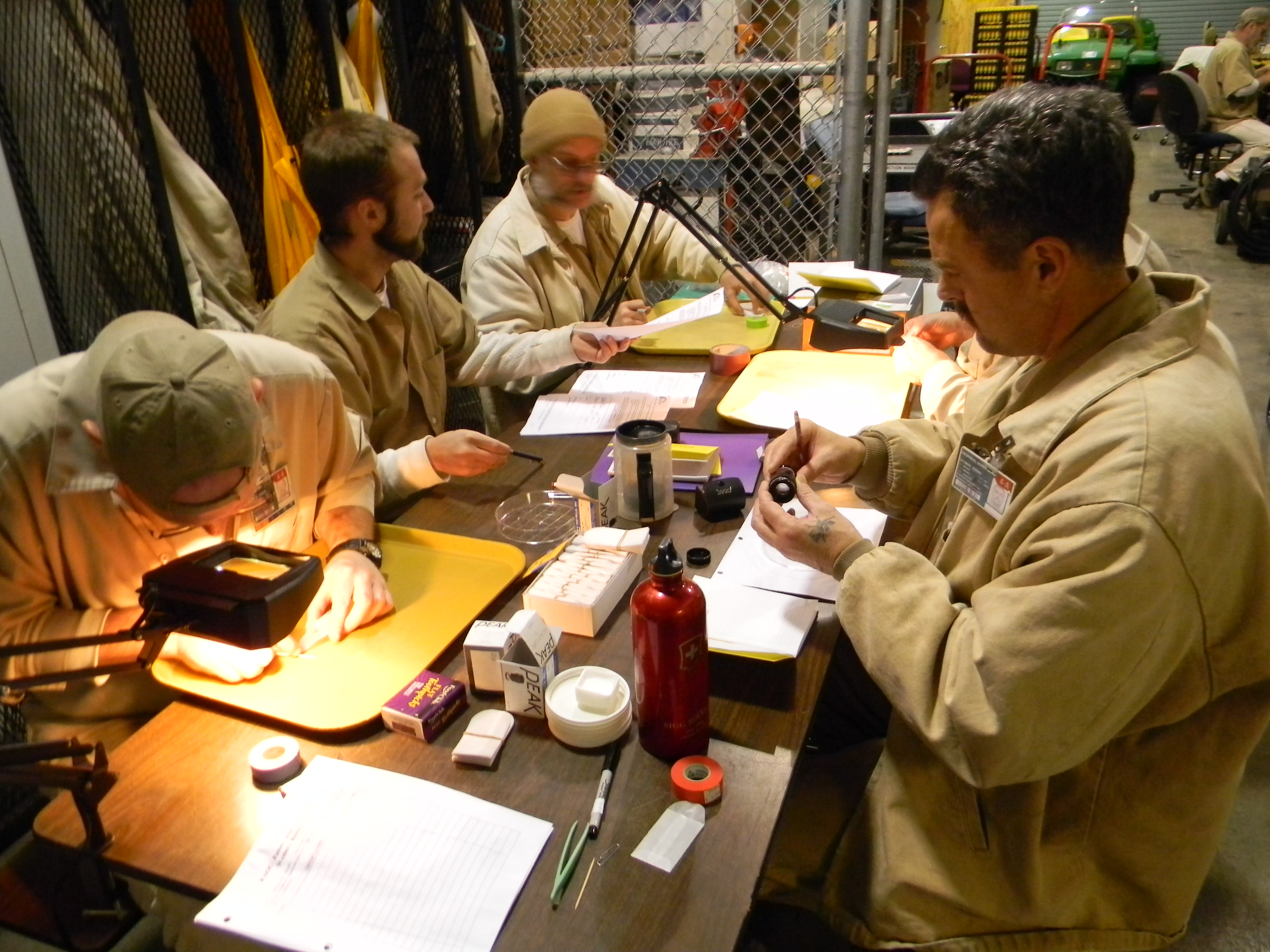
Inmates at Stafford Creek Corrections Center count seed.

To prepare for the experiments, the offenders participated in workshops designed to facilitate discussions about the scientific methods used to come to robust conclusions. It was not the first time that offenders were exposed to a scientific reasoning process. Many have previous educational experience or have attended enough lectures organized by the Sustainable Prisons Project to be confident about offering their opinions to a discussion on scientific methods. At this point the experiments are nearly complete on most of the species and we can compile and analyze the results. My goal is to be able to go over some of the statistical methods used and get the offenders input on how the results we get can be used in the nursery to increase our propagation success. Look forward to the results in future posts.
By Graduate Research Associate Carl Elliot

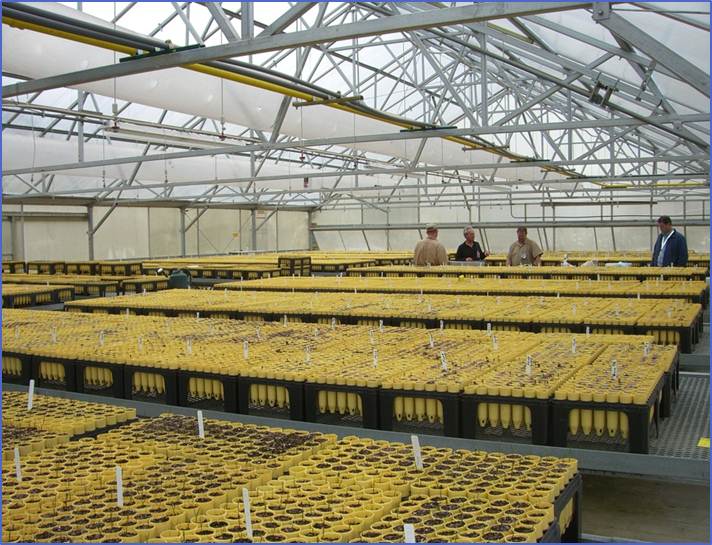
The nursery sowing season at Stafford Creek Correction Center (SCCC) opened amidst mud and construction.  Excessive rainfall throughout the spring led to great volumes of mud around the nursery, just as we completed the moving of the greenhouses from one area of the prison to another. I know that sounds redundant – excessive rainfall in Aberdeen, Washington – but it was truly more rain that usual.  April 2011 was one of the top five coldest April’s on record and one of the top ten years for precipitation. The State Climatologist’s report has some interesting facts about our anomalous weather. The rainfall combined with construction made for a muddy mess, but the building was well organized by the construction supervisors and crew at SCCC. Though they had to apply more foundation rock into the muddy morass than was budgeted, the green house and two hoop houses were up and running by the middle of April.

The greenhouse is beginning to get full as offenders sow seeds

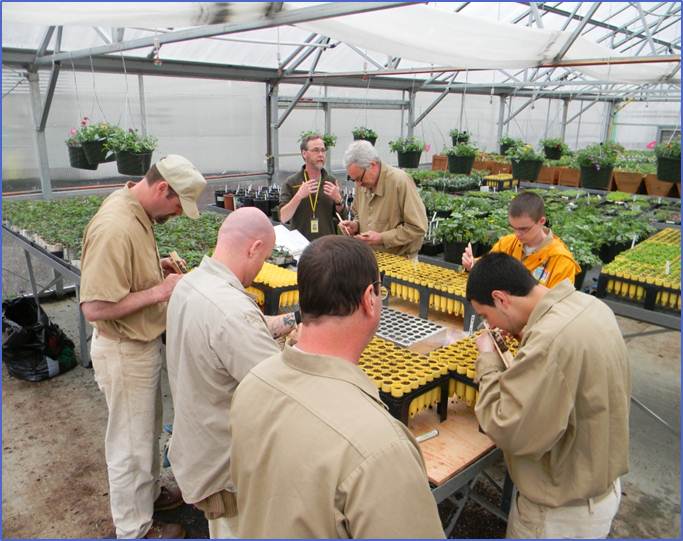
Sowing began with some new species this year and some of the target species from previous years. Lomatium triternatum, the nine leaved biscuit-root, was a new species to the nursery and the early sowing in April should make for well rooted plants by October. Castilleja hispida (harsh Indian paintbrush) and Viola adunca (blue violet) are two species vital to the pollination ecology of the Salish Sea (Western Washington) prairies. We will probably be sowing these two species every year at the nursery for as long as it is in existence; the need for them for pollinator restoration is inexhaustible. With these two species, our goal this year is to perform trials, testing the germination rate in response to varying lengths of stratification. Stratification is the process of subjecting seeds to cold and/or moisture to replicate environmental conditions required to break seed dormancy.  Through trials, we hope to determine the appropriate amount of stratification time these seeds require to generate a high germination and seedling success rate.  To date, our experiences germinating these species in the nursery has not corresponded with what is indicated in the published literature. 

Research Associate Carl Elliot teaches about the ecology of the plants offenders are learning to sow.

We’ve also had several new members join the crew.  These new offenders have benefited from the training and experience of those that have returned from last season. The training video that was produced last year is very helpful in providing and introduction to nursery techniques.  We’ve partnered each new member with a mentor to learn about nursery production.  By learning each aspect of the nursery from soil making to record keeping, the offenders develop a greater range of skills to use when they re-enter society.

By Graduate Research Associate Alicia LeDuc

Two of SPP’s former Graduate Research Associates have completed theses for the Master of Environmental Studies program at The Evergreen State College.  Liesl Plomski and Sarah Clarke selected topics related to the Sustainable Prisons Project. Both women have been integral parts of SPP since its early inception, working closely with inmates and DOC staff in two of Washington’s prisons.

Liesl Plomski presented her thesis regarding best practices in the rearing of endangered Oregon Spotted Frogs, drawing on her experience working with inmates at the Cedar Creek Corrections Center in Little Rock, Washington.  Plomski said she enjoyed working with inmates on the conservation efforts and that, “experiencing the importance of tuning people into a passion for positive development has definitely affected my subsequent career choice since finishing at Evergreen.” Plomski now lives in Portland, Oregon where she works mentoring at-risk youth.

Sarah Clarke completed her thesis on the impact of horticulture therapy and how working with living things affects the knowledge, behavior, and attitudes of inmates participating in the Sustainable Prisons Project.  Her work included data from four institutions working with  SPP.  Reflecting on her experience with inmates at the Washington Corrections Center for Women in Gig Harbor, Washington, Clarke said, “working with SPP has profoundly changed my life.  It has been rewarding on a personal level to work with inmates and see how interacting with nature benefits them.” One of SPP’s first Graduate Research Associates, Clarke said it was exciting to be part of a ground-breaking project from the very start. “It was a meaningful job that will be hard to replace,” she said.  Clarke now works at the Evergreen State College as a youth educator in the childcare center.

Both former SPP staff attested to the personal growth and professional rewards of working with the SPP.  Referring to her work lecture coordination and project evaluation efforts, Clarke said SPP enhanced her ability to work independently, manage time efficiently, work with a wide range of people, and change roles quickly. “I gained confidence to make judgments and take actions in new territory,” she said. Plomski agreed with Clarke’s observations, adding that working with SPP also improved her communication and analytical skills while working in a variety of different settings.

Most of all, the former Research Associates attested to the immense personal reward and satisfaction they felt when working with SPP.  Plomski said, “You come home at the end of the day and honestly feel like you’ve made society a little better, you actually did something.” For Clarke, it was, “really rewarding to witness the human healing that comes from working with nature.”  Both Plomski and Clarke have made contributions that continue to leave a lasting impact on the inmates, DOC staff, and community members they worked with over the course of their tenure with the Sustainable Prisons Project.

To view Sarah Clarke’s thesis, click here.

Liesl Plomski’s thesis is available here.