SPP Plant Profile: Spring Gold (Lomatium utriculatum)

By Graduate Research Associate Evan Hayduk

Basic Information:

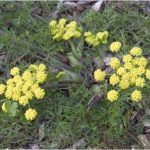
Lomatium utriculatum, or Spring Gold, grows in upright clumps with mostly basal leaves. Leaf blades are dissected into very narrow, fern-like ornate leaves. Flowers are small and bright yellow, and clustered in open umbels. Spring gold grows in meadows, woodlands, open and rocky areas from California to British Columbia. A spring flowering perennial, it has a persistently blooming flower, often flowering from as early as January to late July.

Ecological Importance:

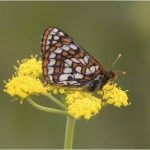
Lomatium utriculatum has been found to be the primary nectar sources of Taylor’s checkerspot (Euphydryas editha taylori) butterflies in certain locations. Where it is not present, Taylor’s checkerspots use wild strawberry (Fragaria spp.) instead. In restoration efforts, planting of important nectar source species, like Spring Gold, near larval host plants such as Harsh Indian Paintbrush (Castilleja hispida) is important because Taylor’s checkerspot butterflies do not move a long distance when foraging or laying eggs.

At the Scatter Creek Wildlife Area, in south Thurston County, Lomatium utriculatum has also been found to be an important nectar species for mardon skipper (Polites mardon) butterflies.

Fun Facts:

Lomatium is in the carrot family, and the root is edible raw or cooked. It can also be dried and ground into a power or roasted as a vegetable. Young leaves and shoots can also be eaten raw or cooked as greens. Historically, a decoction of the plant was used as a wash for swollen or broken limbs. The root of the plant is analgesic and stomachic; it was chewed or infused as a treatment for headaches and stomach upset.

Inmate Frog Technicians Experiment with Cricket Rearing

by: Inmate Frog Technicians at Cedar Creek Corrections Center

Editor’s note: Below is a message from our frog technicians at CCCC, who are currently experimenting with raising crickets to feed to the endangered Oregon spotted frogs being reared at their facility.

On 10/16/11, we received 65 over-winter frogs from a handful of sites. When received, frogs were about as big as dimes. Now they have grown to the size of half-dollars. They are doing very well, very good coloring, spotting on top and red on bottom.

When frogs were received, four frogs looked very bad and have since died. I don’t know what exactly was wrong with them, all I know is they would not eat and were very thin because of it. Except for that, everything has been going very smoothly.

We have now started a new cricket project. We have always bought our crickets from Fluker Farms to breed, but we have been unable to breed multiple generations with them.  Recently we got Jamaican Black Crickets from Woodland Park Zoo and we feel that we could breed a generation of these crickets.  What we hope to do is cross-breed European crickets with these Jamaican Black Crickets and try to get the long life span from the Jamaican but the easier edibility of the European House Crickets we buy from Flukers.

We are going to get 2500 European crickets (5 weekers) and 2500 Jamaican crickets (5 weekers) and raise them side by side, do everything the same between the tanks, food, water, temperature, etc. We are hoping to see which cricket is a more efficient candidate for our cricket project. And also see which crickets we can raise generations from.

In a totally separate experiment, we want to get 500 of each style crickets and raise them together in one tank, hoping to cross-breed these two crickets, getting traits from both.   We’ll see if that may be the best candidate for our cricket program.

Cricket Traits:

European House Cricket: The more popular of the cricket species, these crickets can grow up to 2cm in length. They are more extensively fed to reptiles. Easily digested.

Jamaican Black Cricket: These crickets grow fast and get bigger, probably reaching 3-4cm in length. In my experiences these crickets live longer and are easier to breed, but might be harder for the frogs to eat when they get too big.

To donate to SPP and support the rearing of the Oregon spotted frog in Washington state, click here.

By SPP Project Manager Kelli Bush

The Sustainability in Prisons Project (SPP) recently received generous donations from two different family foundations. The funds from the first donation will be used to help support our evaluation program, efforts to expand SPP to other states, and some of our general operating costs. The second donation provides much needed help with general operating costs such as supplies for our conservation projects, printed pamphlets describing our work, education materials for incarcerated individuals or transportation to prisons. Both awards are greatly appreciated and make a significant difference in helping us accomplish our mission. If you would like to make a donation to SPP through The Evergreen State College Foundation please click here.