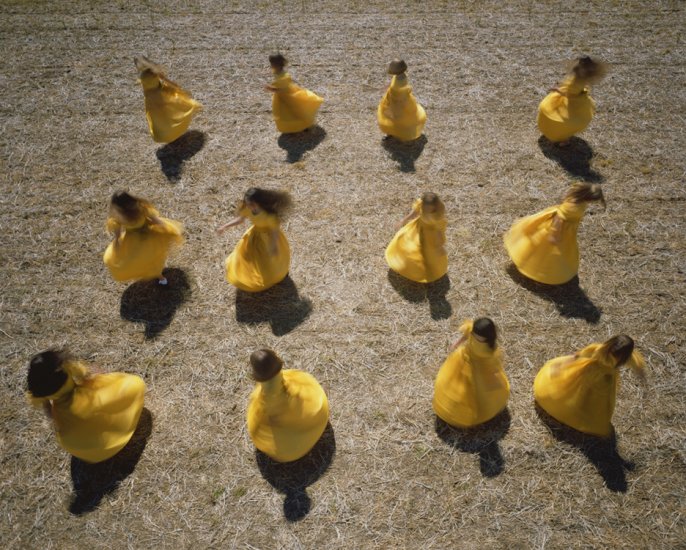
Photo by Rosemarie Padovano titled “Nocturne.” (source: http://www.rosemariepadovano.com/portfolio/nocturne/)
Last week, New York visual artist and filmmaker Rosemarie Padovano visited Washington Corrections Center for Women (WCCW) and Mission Creek Corrections Center for Women (MCCCW). She contacted the Sustainability in Prisons Project after finding our website, and we welcomed her interest in filming inmates at their work in SPP conservation programs.
The video sessions were very gratifying. Ms. Padovano brought high levels of curiosity, respect, and openness to her work. Unlike videographers whom we’ve worked with previously, her focus was on creating artwork. She worked to capture the visual impact and beauty of interactions between technician, plants, and butterflies. She was particularly interested in revealing the ”profound nature of transformation” as seen at SPP.
We are grateful for Ms. Padovano’s attention, and for the willingness of staff and inmates who worked with her. She may return in the summer for more days of filming, and we will certainly share the final product on our website when it is available.
Introduction by Carl Elliott, SPP Ecological Conservation and Restoration Coordinator
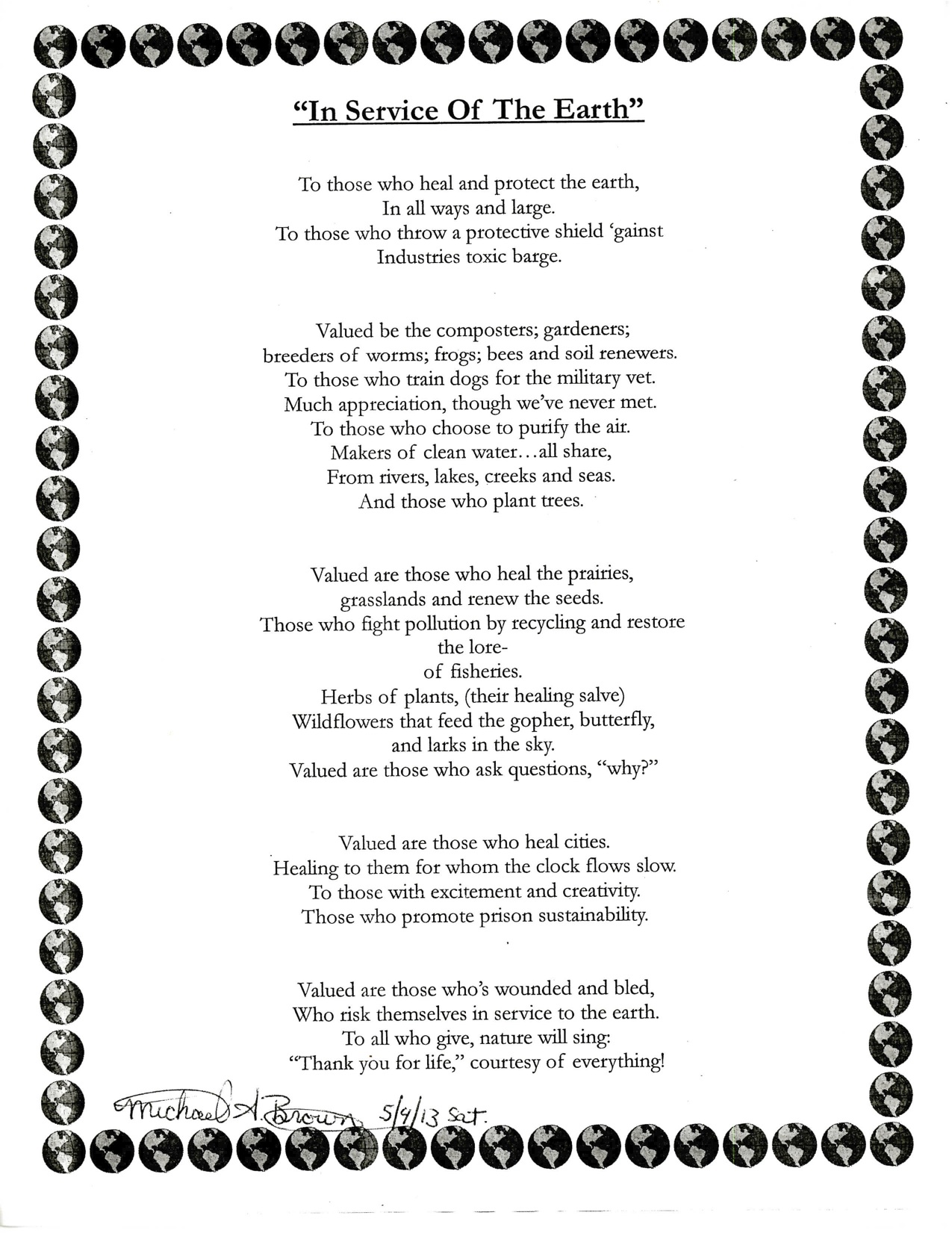
While working with the dedicated prairie crew from CCCC, the spring quickly blows by and work is often performed in hints of hot summer weather. The crew has ably taken on a wide range of tasks on the prairies, and at the conservation nursery and seed production farm. Staff from WDFW, WDNR, SPP and CNLM have been enjoying sharing information and skills. The work presents a steep learning curve in botany, ecology and nursery production. Not only has the crew been learning skills, also the work for conservation and service to ecological restoration has inspired one technician to create poems about service and restoration of Earth’s ecosystems:
By Marina House, DOC Staff at the Washington State Penitentiary
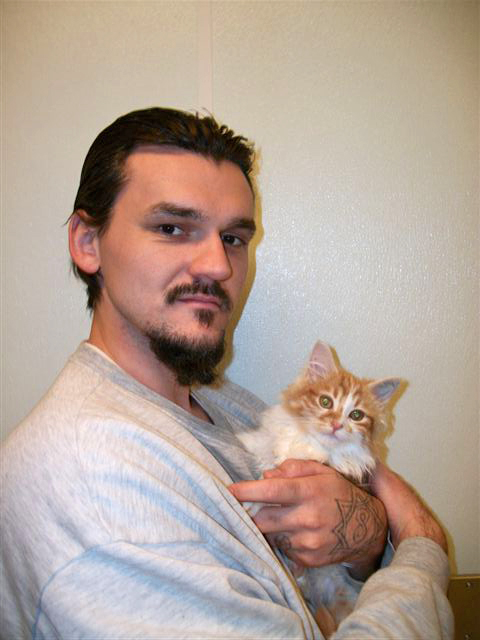
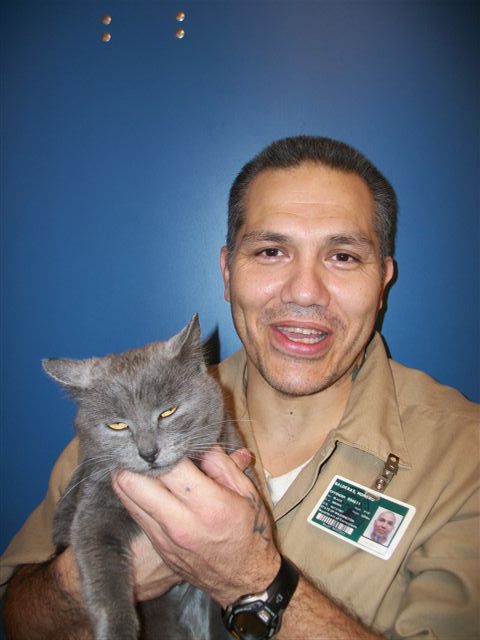
I just wanted to share my observations concerning the success of the cat program. When we found out we were getting the cat program I was mildly hopeful because I had been involved with equine assisted therapy for at risk kids and their families, so I’m aware first hand that animals have beneficial effects on people, but I had no real hope it would be this successful.
I have seen inmates who have NEVER interacted with staff or other inmates now joking and smiling. I have seen inmates who would normally fight walk away to avoid trouble. The unit is calmer and far more peaceful than before. There is lots more positive social interaction in the dayrooms now. It’s very nice to have a program that so easily promotes pro-social behavior. I am very much in favor of any program that makes our jobs easier and safer, and this kitten program does both.
How about some bottle fed puppies now for B Mod?
By Dennis Aubrey, Brittany Gallagher, and Andrea Martin
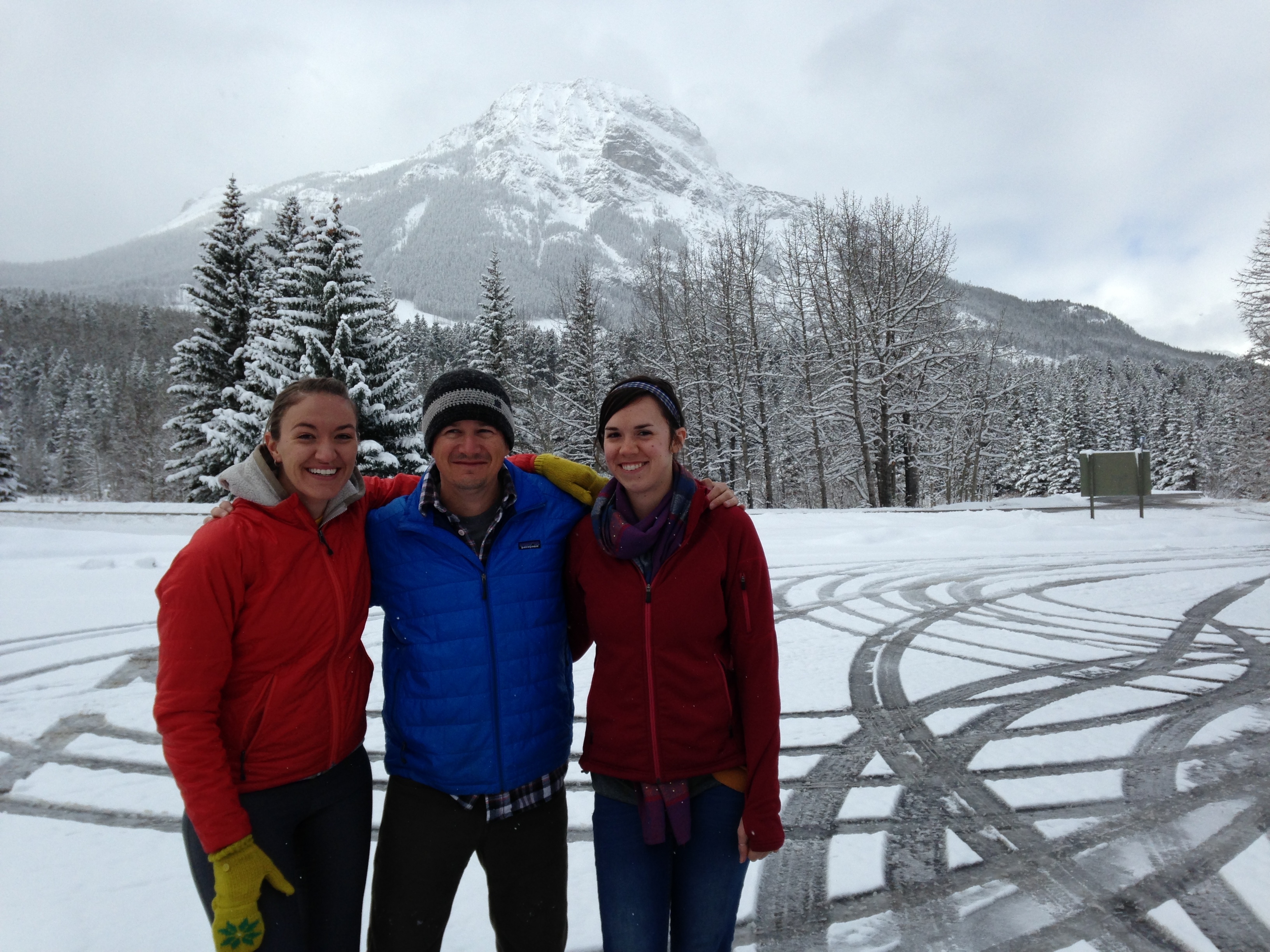
Brittany Gallagher, Dennis Aubrey, and Andrea Martin in Canada for CONFOR West.
In late April three SPP Graduate Research Assistants attended CONFOR West, an annual conference in Western Canada highlighting environmental science, forestry, and collaborative conservation. This year the SPPers, along with another Evergreen Masters of Environmental Studies student, were the only four students from the United States.
This year the conference was held in Kananaskis, Alberta, in the spectacular Canadian Rockies just southeast of Banff. The four of us chose to drive together rather than fly, both to save money and to gain a better appreciation for the landscape and culture of the region. The first night we stopped and soaked in Radium Hot Springs, near the entrance to Kootenay National Park. The next morning we drove up into the Kootenay high country, where we saw a large bull moose crossing a river, and over 50 white-tailed and mule deer browsing near the road in meadows newly emerged from the melting snowpack. After crossing a few passes and traversing northward through long valleys, we made our way up and over the continental divide, simultaneously entering Alberta and Banff National Park. It was still early in the day so before heading south to Kananaskis we turned north and drove about 75km up the famed Icefields Parkway, where we snapped pictures of hanging glaciers and frozen lakes amid towering frosted peaks.
The conference itself was set at the Canadian Rockies and Foothills Biogeoscience Institute, and consisted of two mornings of presentations followed by afternoon activities, with poster sessions and keynote speakers in the evenings. Morning-session presentations were in two formats: 5-minute lightning talks and 15-minute featured presentations. Lightning talks at CONFOR are doubly challenging, as they include self-advancing PowerPoint slides, making practice and timing essential. Some general themes that emerged from the talks given by Canadian students were related to mountain pine bark beetles, tar-sands impacts and mitigation, and involving First Nations peoples in collaborative conservation.
All three SPP graduate students gave presentations on our thesis work. Both Brittany and Andrea took the challenge and gave well-received lightning talks. Brittany presented on her work with the Sustainability in Prisons Project evaluating the effectiveness of environmental, educational, and sustainability programs in Washington state prisons. Andrea talked about evaluating the effectiveness of youth conservation corps leadership programs. Dennis gave a 15-minute presentation which included an overview of the Sustainability in Prisons Project, and a brief discussion of his research with incarcerated women exploring Taylor’s checkerspot butterflies’ use of golden paintbrush. At the end of the conference, Dennis’ presentation was voted best 15-minute presentation and mentioned as a close second for most creative presentation overall.
Another unique aspect of CONFOR West is that it is planned and attended solely by graduate students. This tends to give it a more casual and festive atmosphere than other scientific conferences. Groups went snowshoeing and hiking in the mountains, and informal discussion groups formed in the common area and dining hall. Overall, the trip was a rewarding and educational experience. Many fellow attendees commented enthusiastically on the novelty of SPP, and some expressed interest in the idea of bringing SPP to Canadian correctional institutions. Some of the relationships and perspectives we gained will undoubtedly serve us in the future, allowing us to more effectively collaborate with our colleagues across the border.
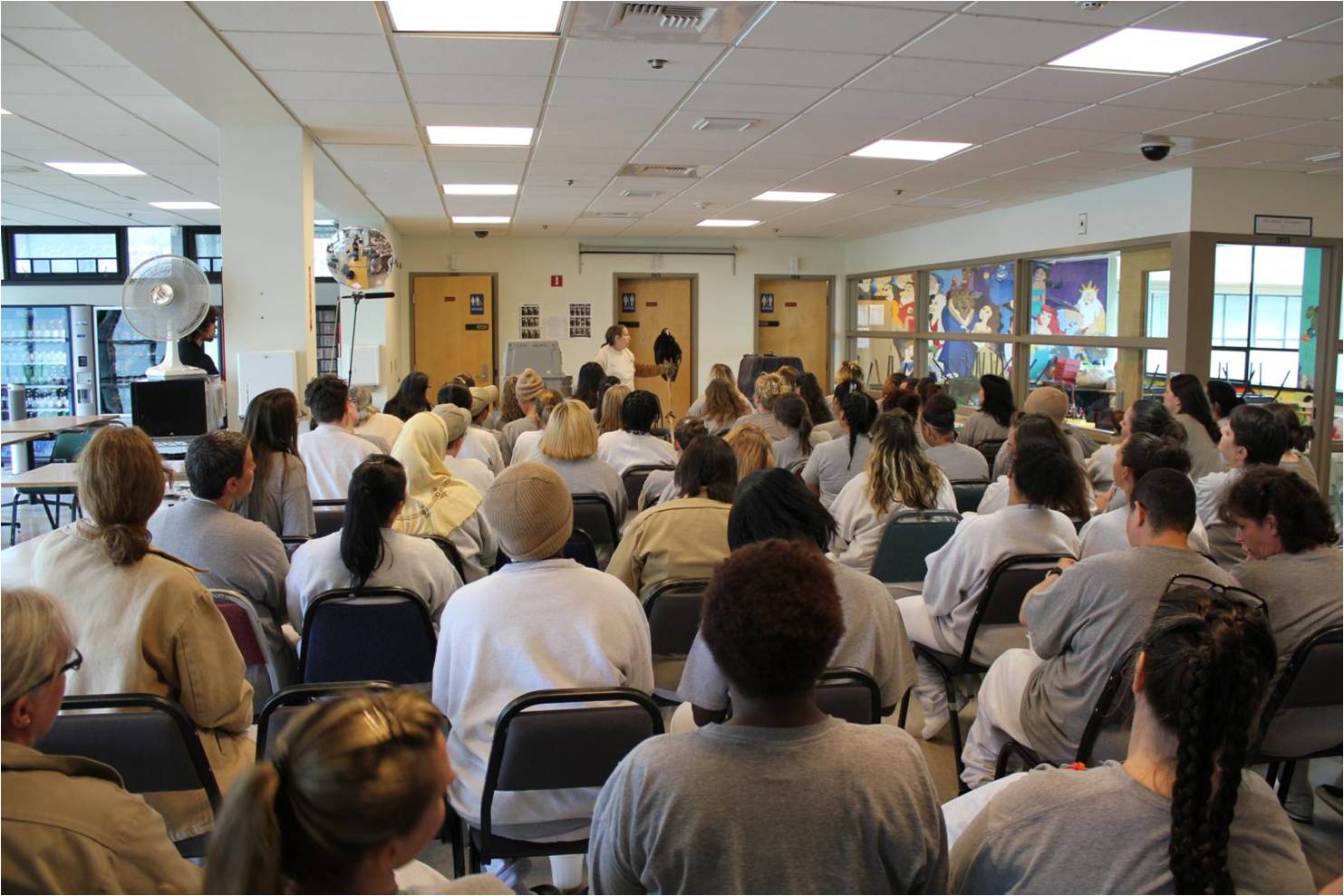
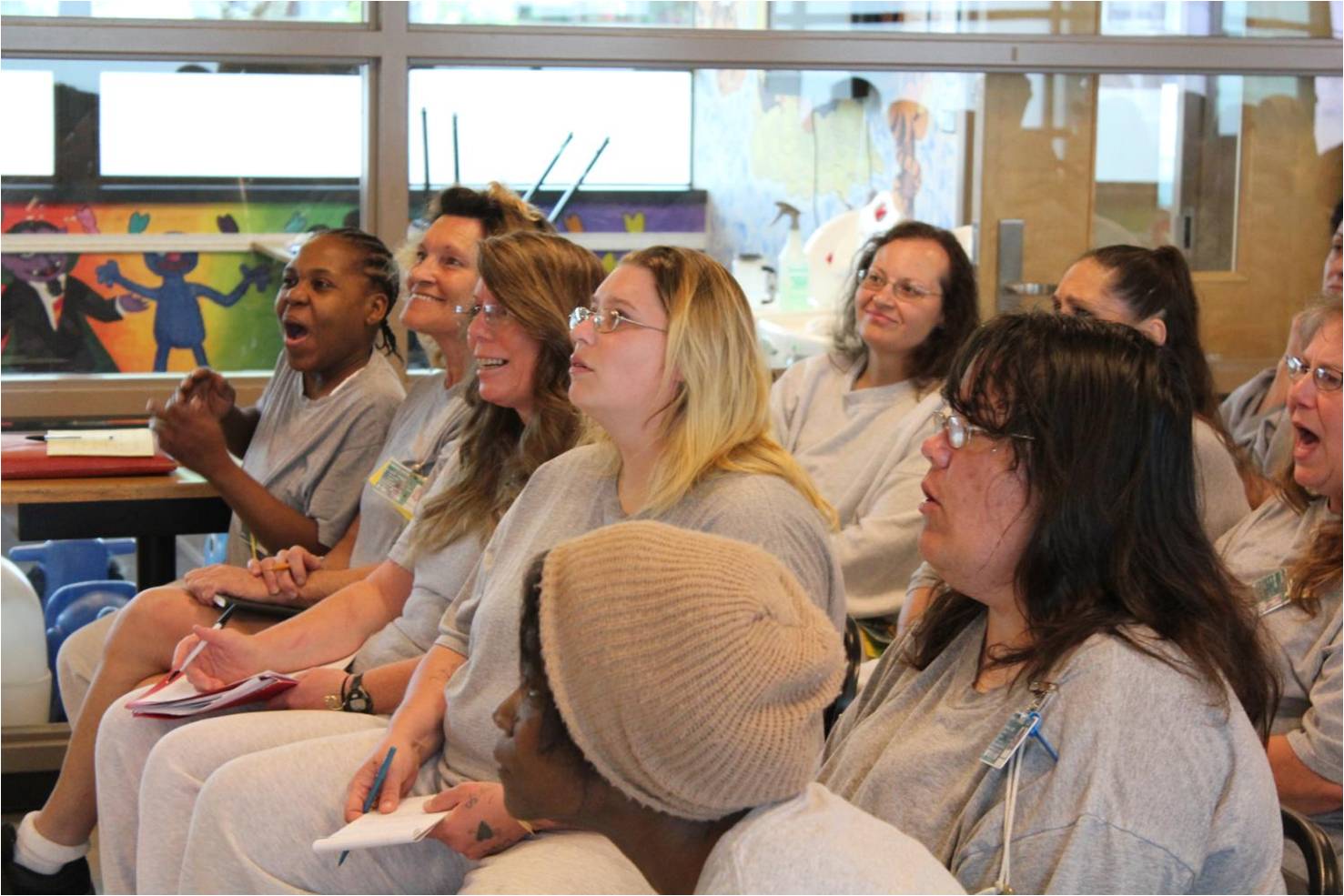
Editor’s note: Today’s post was written by an inmate and SPP lecture series attendee at Washington Corrections Center for Women. On May 7, Lynne Weber from West Sound Wildlife Shelter visited WCCW with Yukon, a red-tailed hawk, and Remington, a turkey vulture, to talk to the inmates about wildlife rehabilitation.
WCCW’s Science & Sustainability Lecture Series: An Inmate’s Perspective
By Jain Cannard,* WCCW
I have attended several Sustainability in Prisons Project (SPP) lectures here at WCCW and always come away having learned some amazing facts. The lecture today on raptors was an experience of a lifetime! Seeing those incredible birds up close allows us to better understand how our ecosystem works, and that each part of the chain is important and vital.
Lynne Weber and Remington, a turkey vulture, visited WCCW on May 7 and presented to a record crowd of 73 inmates.
Your work here at WCCW helps to make these women better stewards of their community resources, better parents, and better citizens. That’s important work!
Each lecture is so different – I look forward to learning and researching the subject so I can imagine what the lecture will be like. I am always surprised!
The surveys are also interesting. Who knew that opossums love slugs?! It’s good that SOMEONE loves them. The survey is a concrete way to ascertain how much we learn.
Thanks – please keep coming!
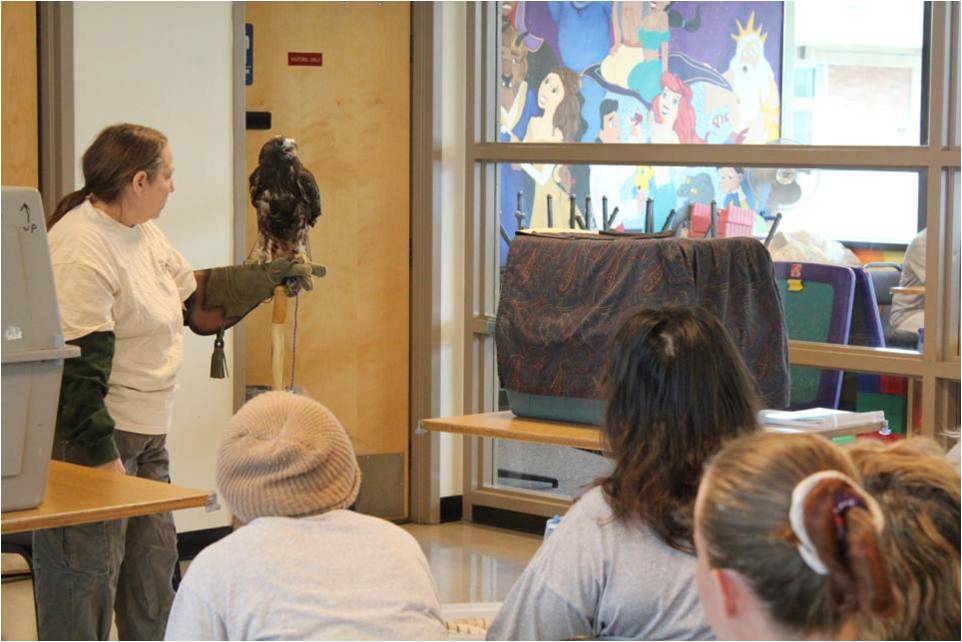
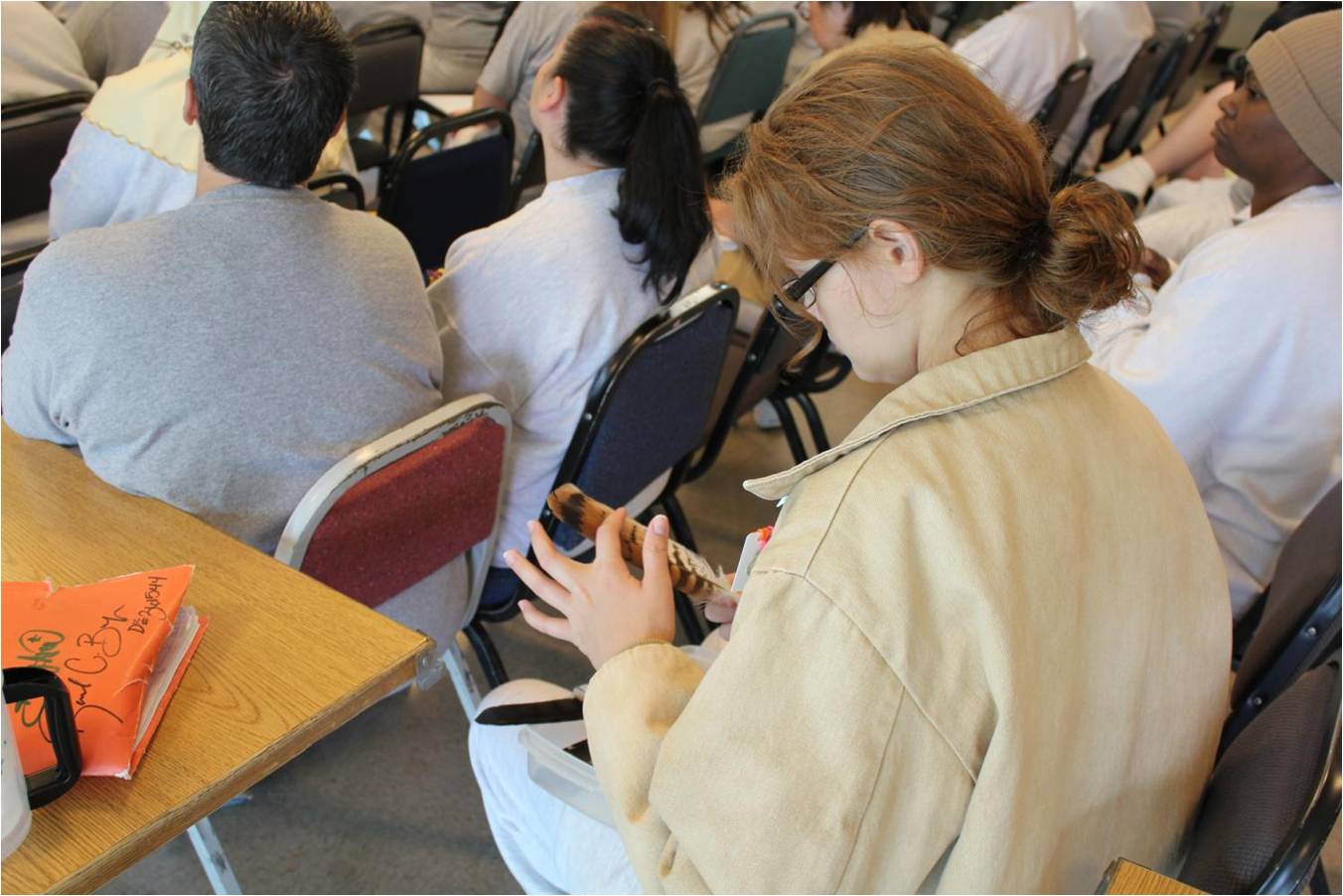
Wildlife rehabilitation specialist Lynne Weber and red-tailed hawk Yukon answered inmate questions about West Sound Wildlife Shelter.Inmates had the opportunity to examine red-tailed hawk feathers during the presentation.Lynne, Yukon, and Remington were a huge hit at WCCW! Photos by R. Stendahl.
*name used with permission
By Carl Elliott
Ecological Conservation and Restoration Coordinator
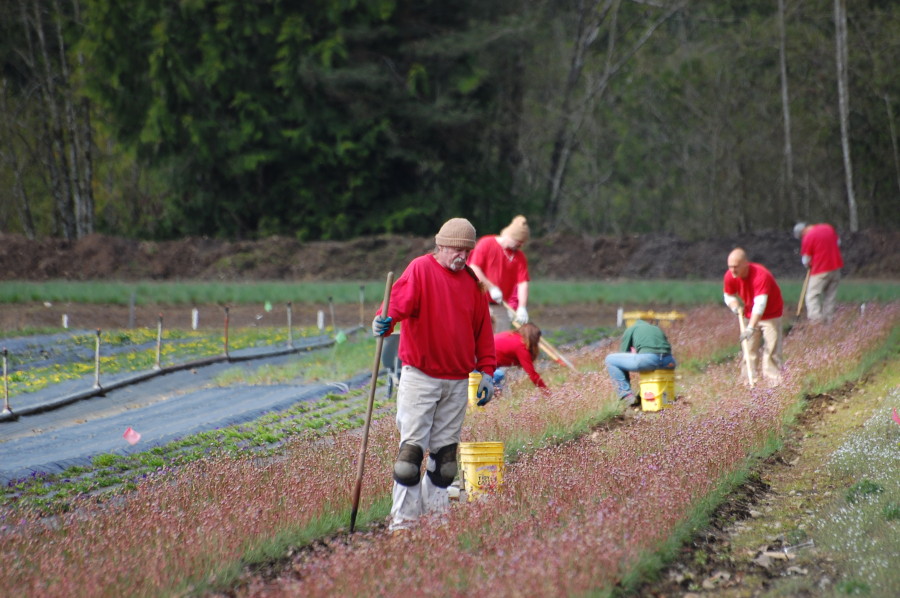
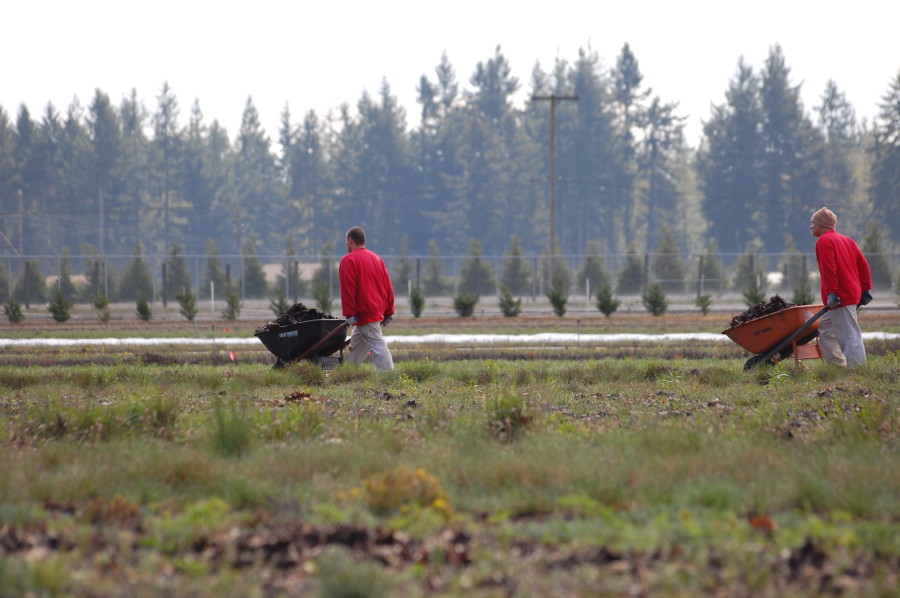
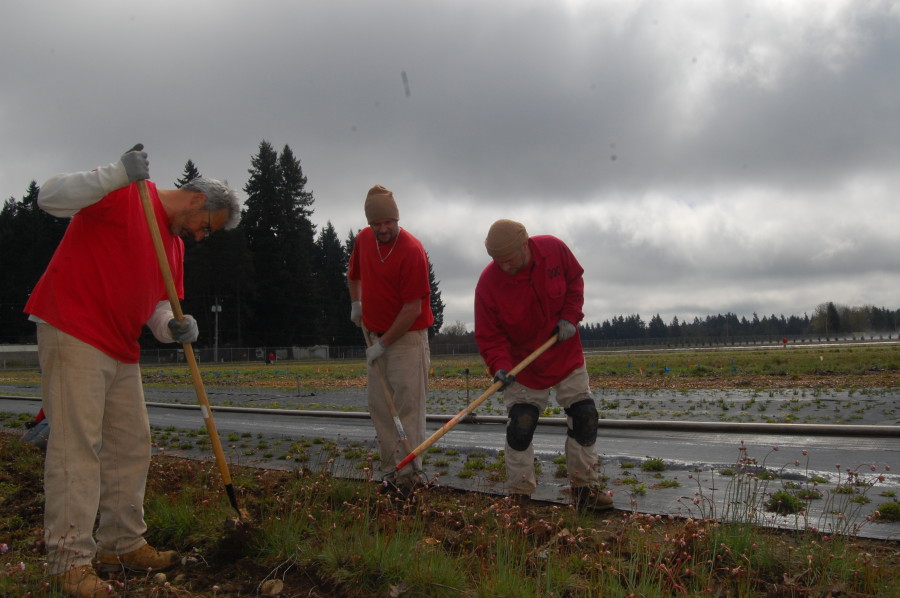
Inmate work crews from the Washington Department of Corrections (WDOC) have worked in the community for over 20 years. These off-site crews maintain the infrastructure along highways and at parks and public facilities throughout the state. The Sustainability in Prisons Project (SPP) recognized the value that the crews from Cedar Creek Correction Center (CCCC), could bring to restoration work on south Puget Sound prairies. Through a close collaboration with the Center for Natural Lands Management (CNLM), Washington Department of Fish and Wildlife and Washington Department of Natural Resources, a CCCC community crew of ten men dedicated to prairie habitat restoration just began their first week of work.
The new crew’s enthusiasm and eagerness to learn was evident from the first day. Many expressed a sharp interest in the cultivation techniques of prairie plants at the nursery site and the seed farm. We expect their learning curve will be steep. Restoration on prairies is a complex and interdisciplinary undertaking. The crew will gain and improve skills in a wide variety of techniques, including plant propagation, noxious weed control, seed production and processing, prescribed fire techniques, and plant re-introduction.
The staff, officers, and inmates at CCCC have shown incredible support for establishing the new crew. SPP and CNLM look forward to providing instruction, resources, and guidance to the crews so their work will be an enriching educational experience at the same time as they contribute to regional restoration efforts. The on-going conservation programs at WDOC facilities raising Oregon Spotted Frogs, Taylor’s checkerspot butterflies, and prairie plants, will provide a foundation of curriculum, restoration reference materials, and protocols that can lead to the crew’s success. The investment and optimism shared by all parties suggests a bright future for this new endeavor.
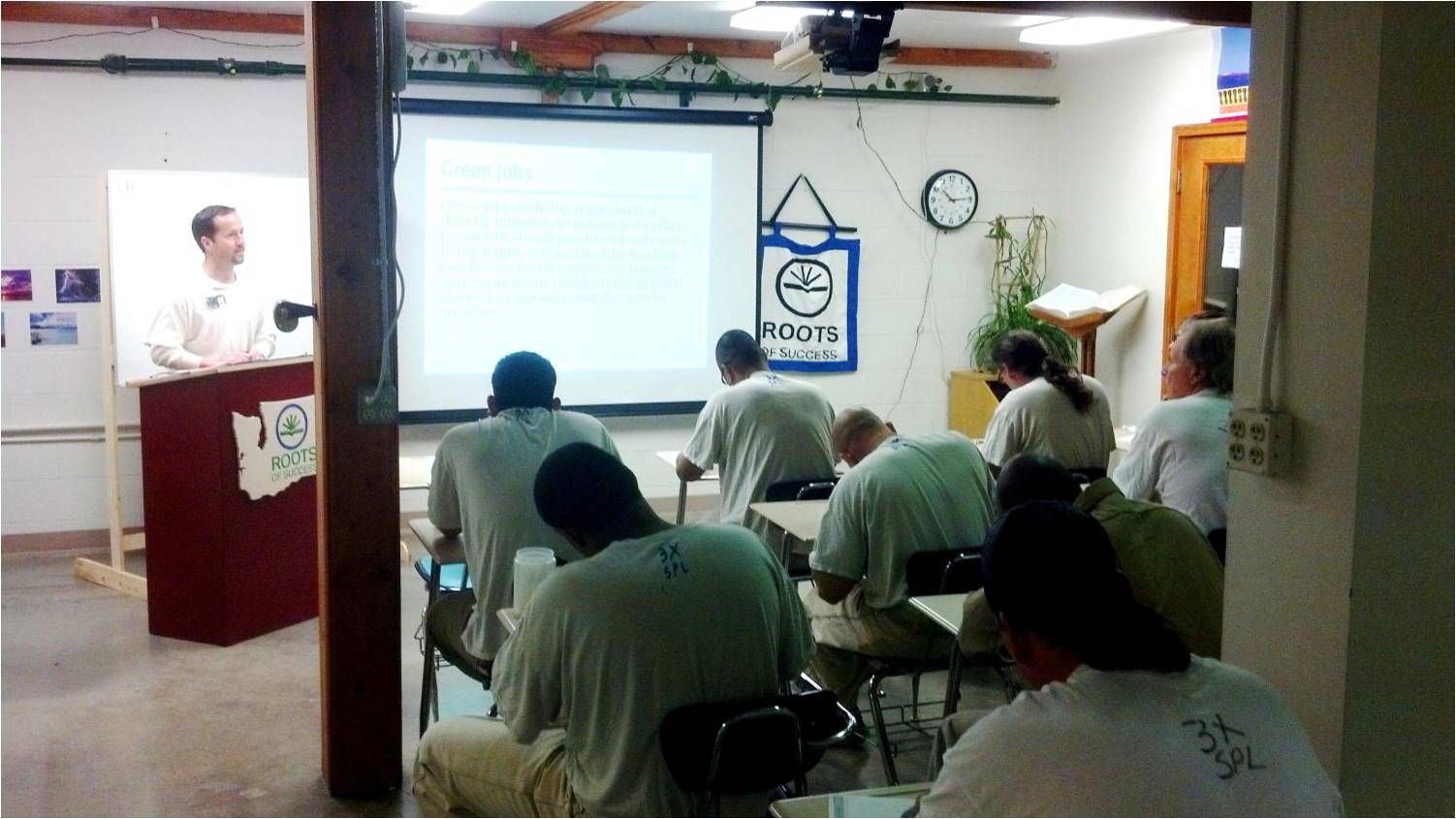
Editor’s note: Today’s blog post was written by an instructor in the Roots of Success program at Washington State Penitentiary (WSP) in Walla Walla. Roots of Success is an environmental literacy curriculum used nationwide that has just been implemented at four Washington DOC facilities, including WSP. Interested inmates are trained as instructors in the curriculum. With staff supervision, they teach classes of their peers about a variety of environmental topics.
“Root View”: My Experience as a new Roots of Success Instructor by Michael Oakes, Roots of Success Instructor
What the heck is “Environmental Literacy” anyway? That’s an expression used a lot in the descriptions of the Roots of Success program. My assumption, as I signed up to become an instructor, was that it was like being “computer literate,” and that turned out to be pretty much on mark. The rest of my assumptions about the program were pretty quickly demolished when I stepped into the day-long instructor course, taught by Dr. Raquel Pinderhughes. I assumed this was likely to be a feel-good icing of basic information dumbed-down to be accessible. In reality, it turned out to be a re-packaged post-graduate curriculum. I assumed we would have a harried mid-level instructor basically providing an official stamp on a diploma-mill, and instead I found a professional, exacting teaching methodology taught to us by Dr. Pinderhughes herself.
Though I was pleasantly surprised and impressed, a question remained: Would inmate students connect with the material? Would this represent nothing more than yet another time sink for people trying to burn time any way they could?
My first indication that I was not alone in seeing the value of Roots of Success was in speaking with my fellow instructors, who came from a variety of backgrounds and had a broad range of views about world politics. Every one of them found some area of the curriculum where they connected and developed genuine passion. That provided some reassurance.
The next milepost came with my preliminary introduction to our students. As we spoke about the curriculum and how it would mesh with the greater sustainability program here at WSP SPL (Washington State Penitentiary’s Sustainable Practices Lab), I heard one guy say, “I never thought I would get jazzed about what earthworms can do.”
The author instructs fellow inmates on the first day of Roots of Success classes at Washington State Penitentiary. Photo by R. Branscum.
In speaking with them about seeking “green” jobs when their sentences are served, more than half of the students were immediately enthusiastic about the idea of work where they might be earning the same wages they are used to, but wherein they go to work every day knowing that they are working toward a cleaner, greener, more sustainable world.
Most of the students come from backgrounds flavored with despair and hopelessness, and the challenges to the environment can sometimes feel pretty desperate indeed. Roots of Success brings that key second component that has been missing in the worldview for most of us. It lights a path toward hope. It paints a picture of a conflict that, for once, is not only winnable, but a conflict that will have no losers at all. In that sense, the first “Root” of success is seeing the difference that even a pretty simple guy can make in a world where earthworms and honeybees are our fellow troops.