By Emily Passarelli, SPP Green Track Program Coordinator
It is with great excitement that I announce: SPP is adding beekeeping certification to our lovely list of programs. Our goal is to bring this program to every prison hosting beekeeping within the next few years. As Green Track Program Coordinator, I have the amazing opportunity to coordinate two programs: beekeeping certification and Roots of Success.
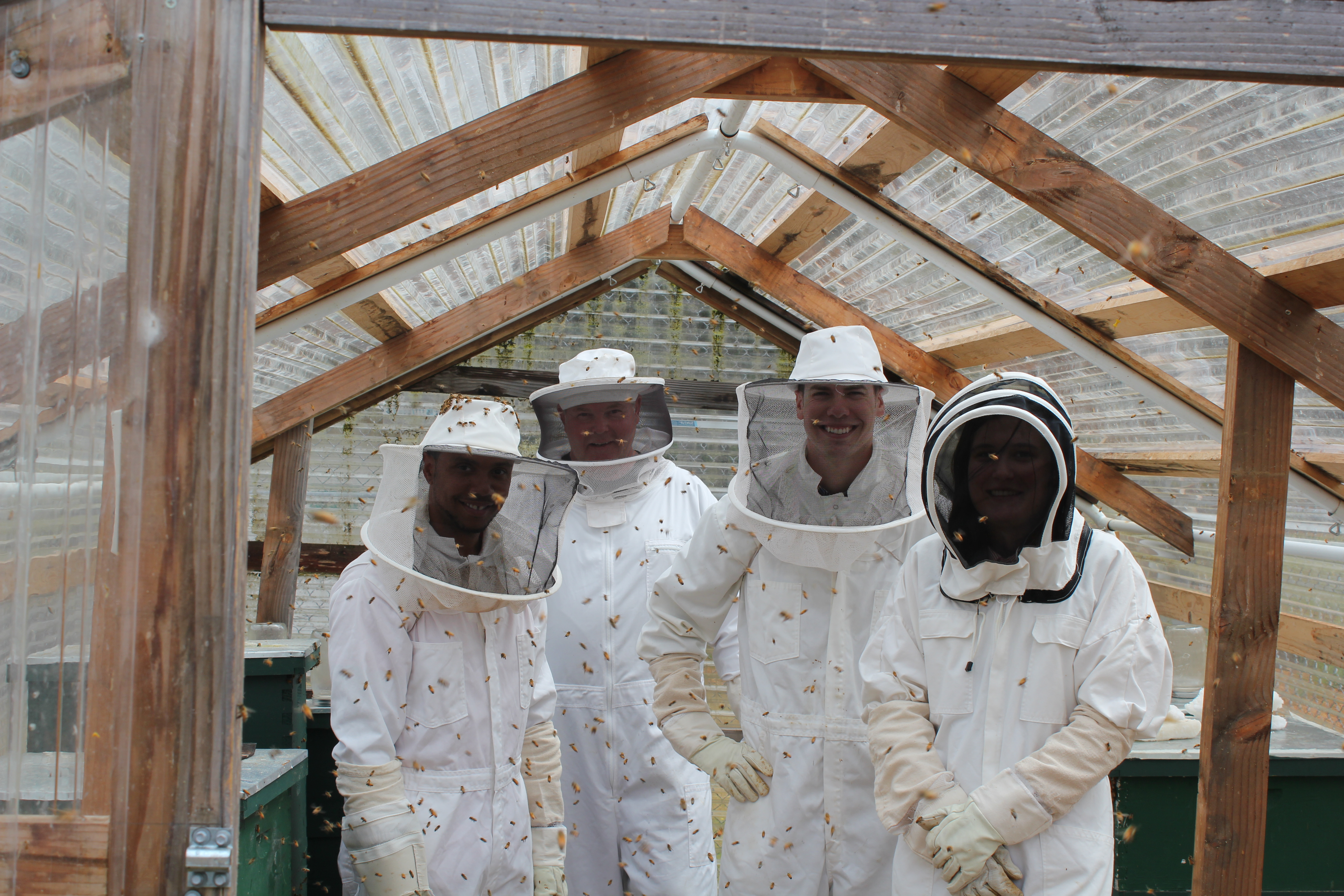
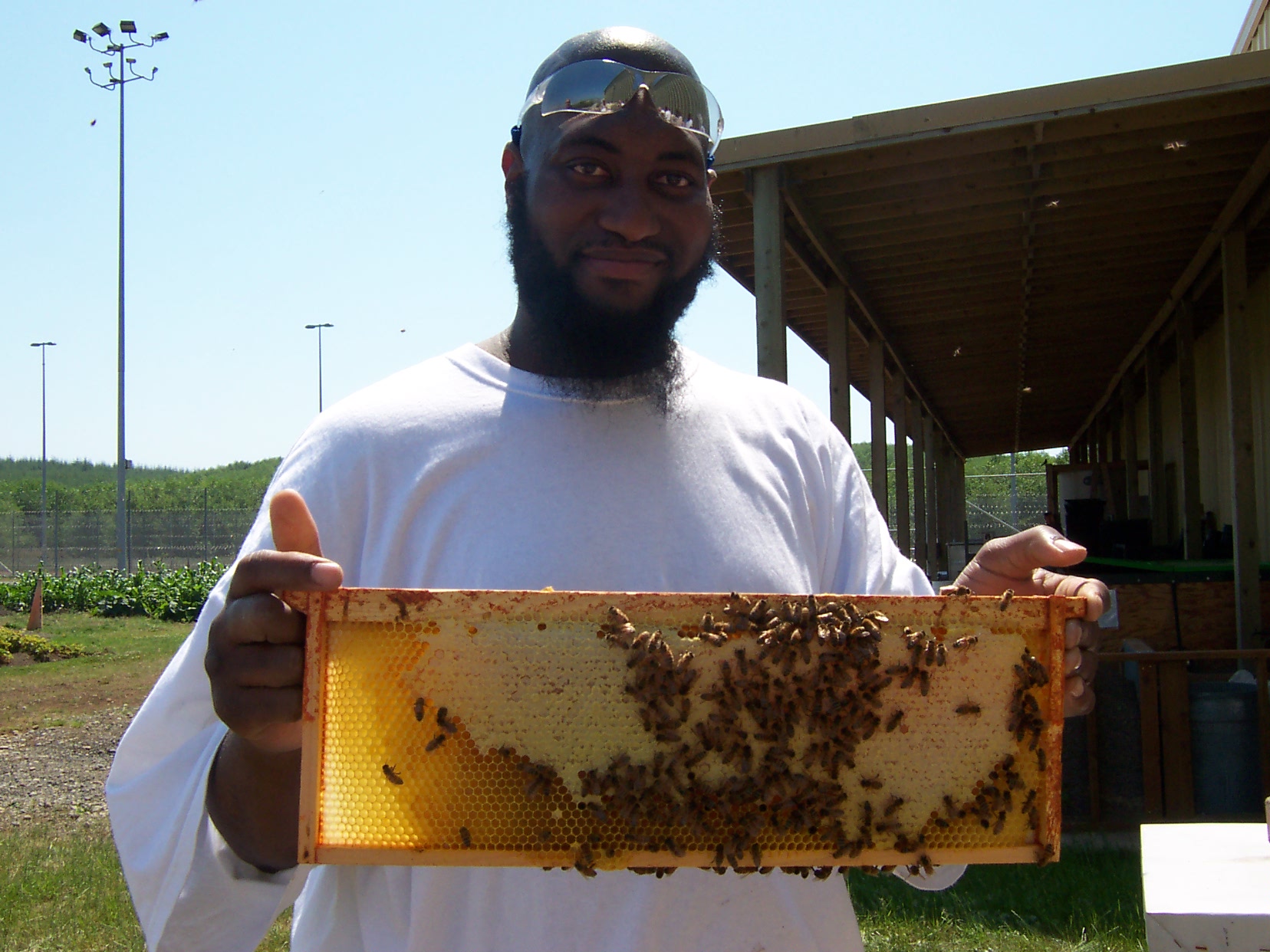
Staff and offender beekeepers take a break to pose for the camera. Photo by SPP.
This beekeeping certification will be a 10-20 hour course taught by a local beekeeping volunteers. Inmates and DOC staff will earn the title of “Apprentice.” If they find that beekeeping is their calling, they have the opportunity to advance to “Journeyman.” If they’re REALLY dedicated they can even advance up to “Master” (though there are only 6 Masters in the entire state of Washington!). This class will be a spectacular opportunity for hands-on experience in a green jobs field. It will also be a great way for our prisons to do more for honeybee Ecological Conservation. We hope that this certification program will give a chance for everyone interested to learn about bees and their amazing life stories. To learn more about these amazing creatures check out Joslyn Trivett’s recent blog or our new beekeeping page!
We have already had two graduating classes at Cedar Creek Corrections Center. That’s almost 45 graduates! Prisons next in line to bring in beekeeping certification are SCCC, WCCW, MCC, WSP, CRCC, and AHCC. We cannot wait to see what the future has in store for our partnerships with bees!
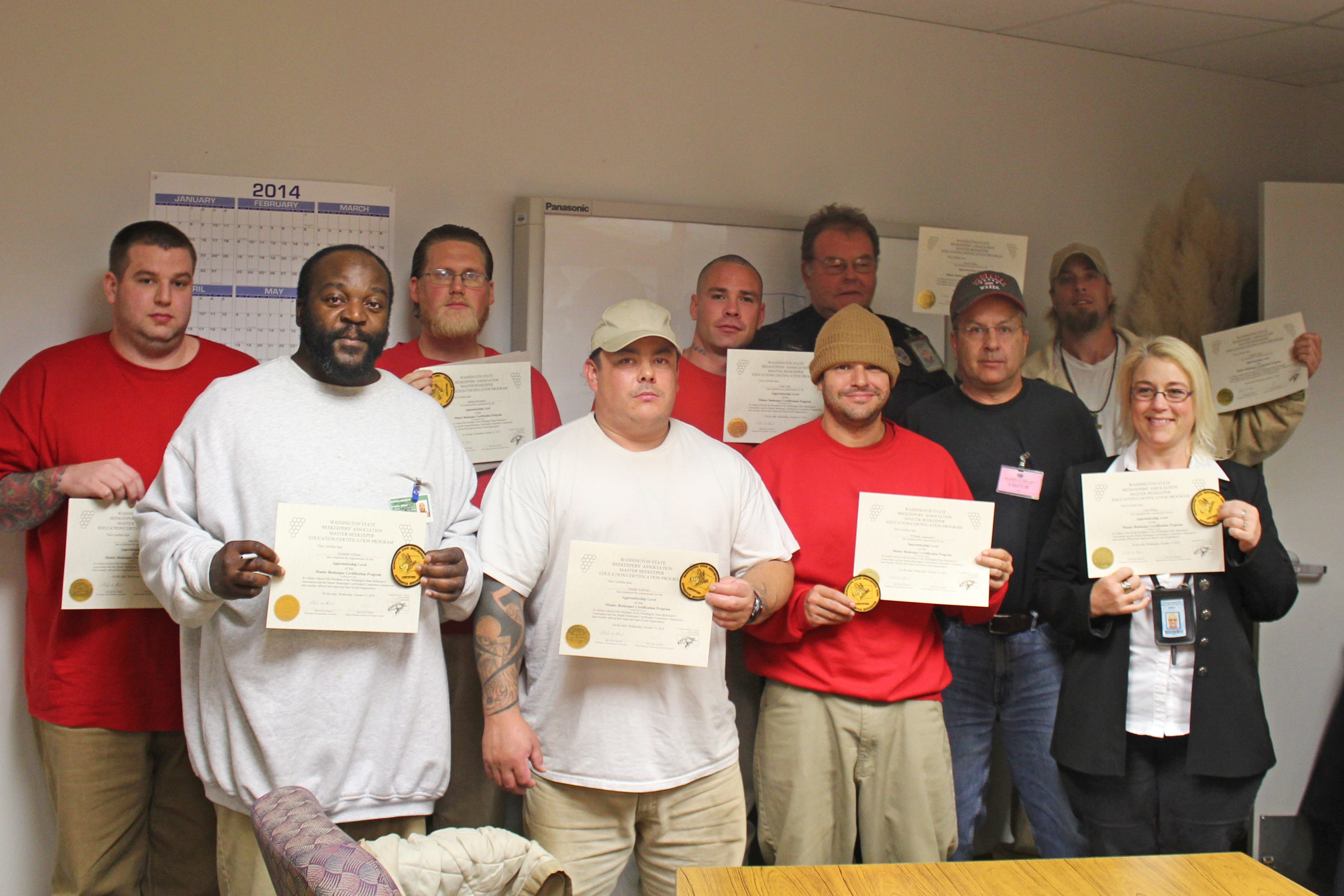
A graduating class of newly certified beekeepers. Photo by SPP Staff.SPP feels very positively about work with honeybees in prisons. Photo by SPP staff.
by Joslyn Rose Trivett, SPP Network Manager
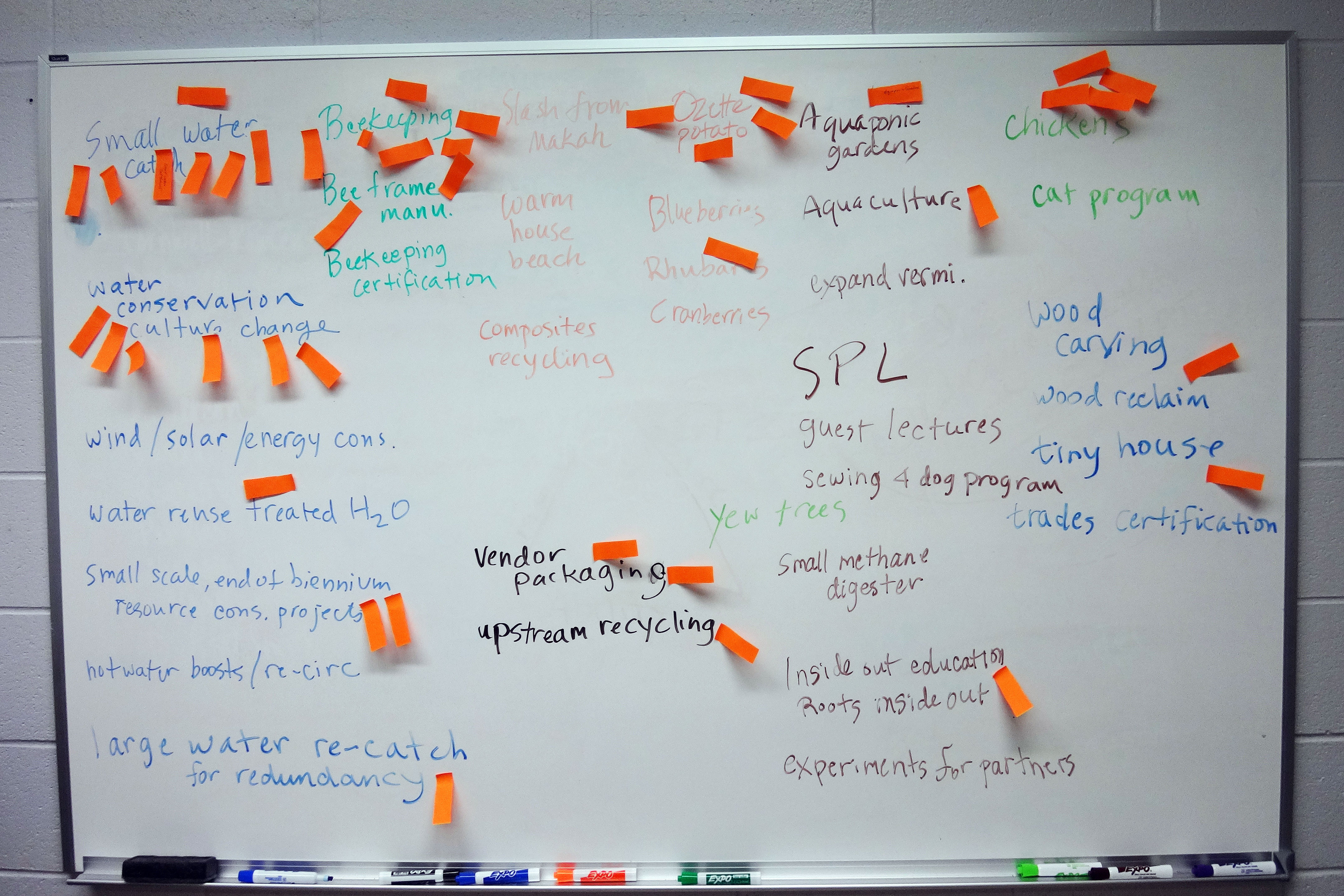
After months of pre-meetings and scheduling, Clallam Bay Corrections Center (CBCC) hosted two days of Action Planning: deciding next steps to expand SPP programs at the prison. The event brought together many great minds and stakeholders: the Director of Prisons Steve Sinclair, prison Superintendent Ronald Hayes, the well-stocked Sustainability Committee, visiting experts on beekeeping, rainwater catchment, and the Makah tribe, SPP managers, and Capitol Programs staff from Headquarters. We were there to plan for two or three new sustainability initiatives.
There was no shortage of excellent ideas in the room. We explored the merits of many, many programs and strategies. Narrowing our focus was a real challenge—so many contenders, so many promising avenues toward sustainability, how to pick which are the very best?
At the end of Day 1, we held a vote, and it was a relief to see a few clear winners emerge.
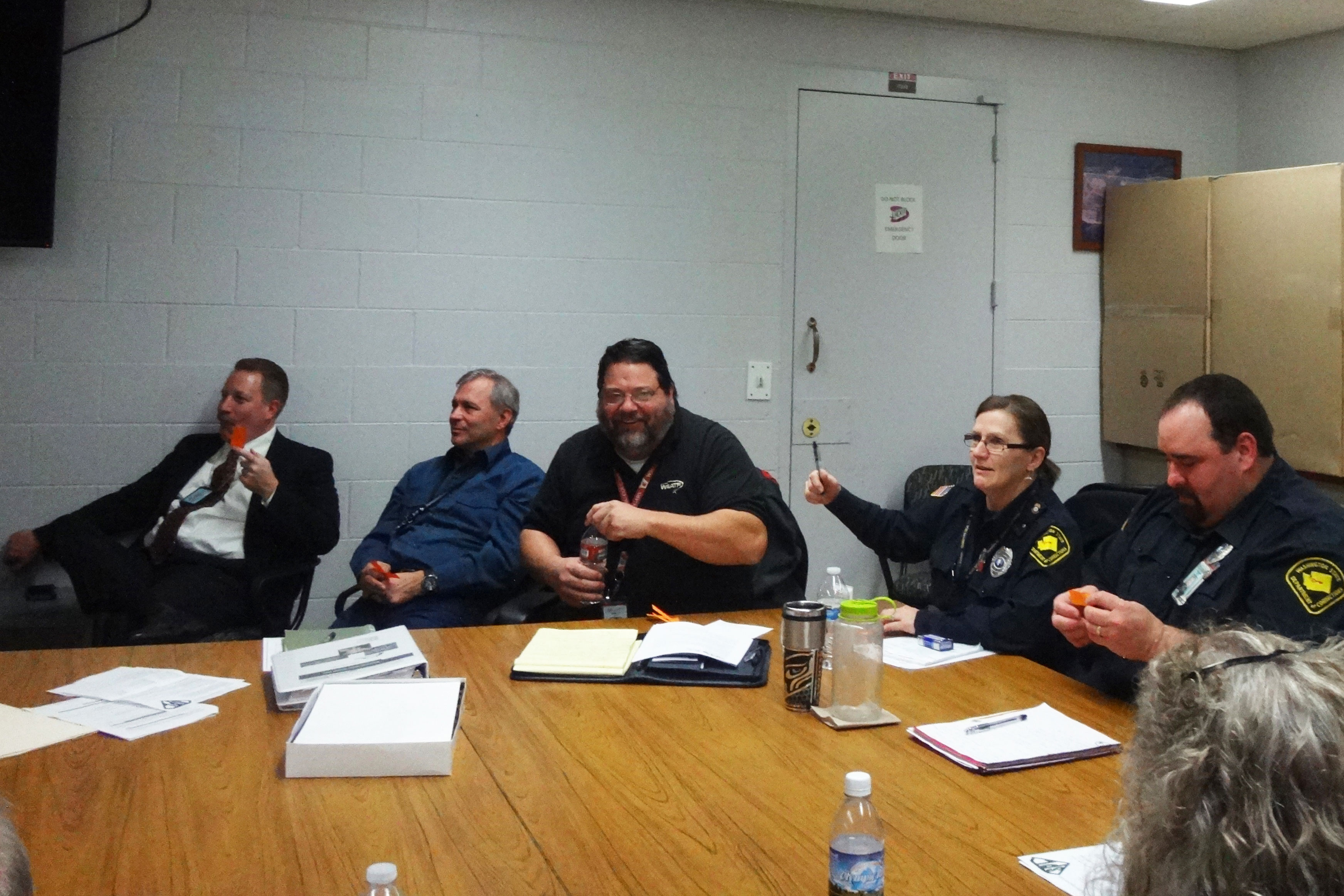
After a day of good-natured debate over CBCC’s sustainability priorities, the group gets ready to vote.When the votes were cast, the clear winners were water Ecological Conservation/culture change and beekeeping.
Culture change through water Ecological Conservation
The top choice was a hybrid focus: water Ecological Conservation and culture change. At a prison where it rains 95 inches a year (that’s really wet), and pulls water from a salmon-bearing stream, the group was determined to use less tap water and catch more rainwater. Promoting these changes seemed an ideal way to promote sustainable choices in general.
To achieve this goal, we decided on several action items, including:
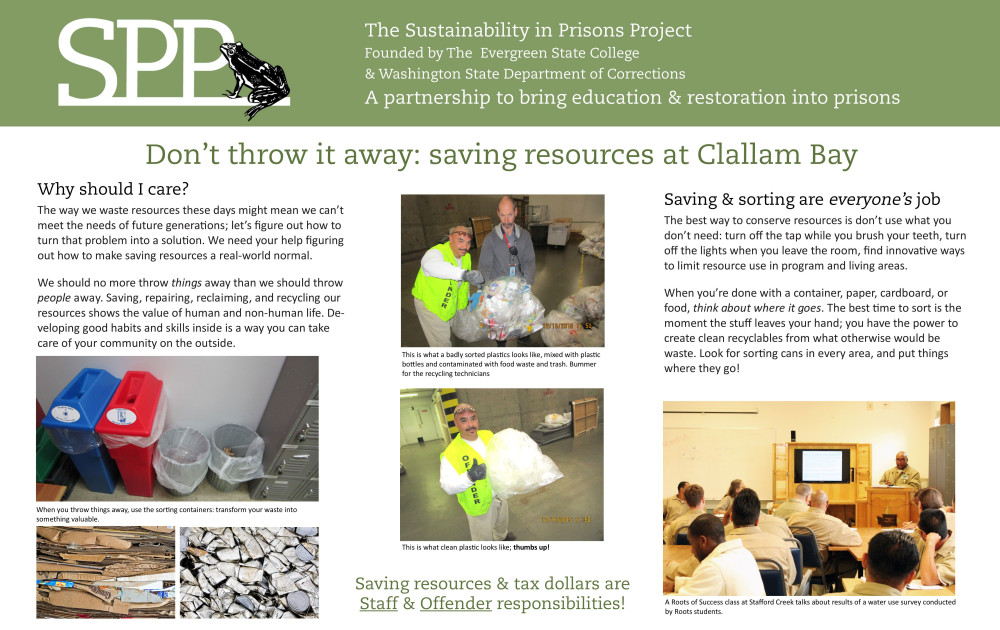
create posters to display throughout the facility (see example below)
publish and distribute sustainability newsletters, with versions for inmates and staff
in each housing unit, hold Town Hall sustainability meetings
This poster promotes saving resources at the prison, with an inmate audience in mind; the version for staff is slightly different.
Beekeeping
The other winner was beekeeping—all agreed that a honeybee program could bring numerous rewards to the prison. Corrections staff and inmates could gain recognized education and certification. In-prison beekeepers could enjoy calming, meditative work with the hives. The hives could contribute healthy bees to pollinate the prison’s organic gardens and bolster local honeybee population. All involved could help build the international effort to restore the pollinators on which we depend.
We settled on these actions to bring beekeeping to CBCC:
Create beekeeping posters
Write and submit a proposal to the prison Captain, identifying planned costs, siting, and safety protocol
Consult with the North Olympic Peninsula Beekeepers on how best to offer certification program at the prison
All in all, we were impressed by how much we were able to plan in two days. The actions taken since also attest to Action Planning’s worth: we have been busy as bees turning those plans into reality.
by Joslyn Rose Trivett, SPP Network Manager
I am dangerously allergic to yellowjacket stings. I have been stung by yellowjackets many times, and I fear and avoid them.
As a good ecologist, I know that honeybees are very different than yellowjackets, but I still wanted to stay away from them. Even the thought of bees, wasps, and hornets has been enough to scare me. I tolerated SPP’s honeybee programs because I supported them in principle, but never wanted too get too close.
A few weeks ago, I suddenly realized that I’ve changed: I have learned to love honeybees. It happened by accident—I didn’t set out to change my mind, but changed it is!
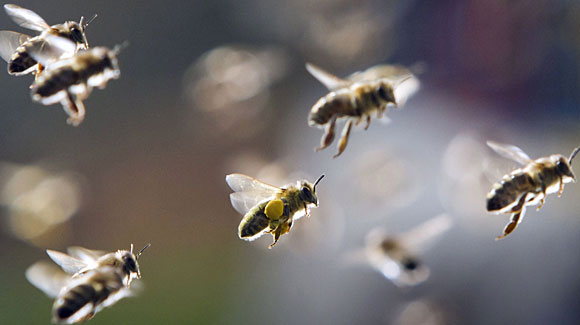
I love this photo of bees in flight; on the central bee, you can clearly see one of her “baskets” full of pollen. Image from organizedchaos.com.
I think the shift started last summer, working on King 5’s story on beekeeping. Mr. Anglemeyer, Mr. Boyson, and Officer Epling’s enthusiasm and praise for the program must have been infectious. It was also the first time I met Laurie Pyne of the Olympia Beekeepers Association, and she radiates excitement about honeybees. Last fall, her guest lecture on honeybees had my rapt attention, and I memorized parts of her presentation without even trying.
Also during recent months, we have heard more and more beekeeping interest from prison staff and inmates. Cedar Creek has graduated their second class of Apprentice Beekeepers. Stafford Creek Corrections Center, Washington Corrections Center for Women, and the Penitentiary also have hives. For the prisons that don’t have honeybees yet, we keep hearing that they want them: Clallam Bay Corrections Center, Airway Heights, Coyote Ridge, and Washington Corrections Center all want honeybees too…time for me to get with the program! Luckily, seems I already have.
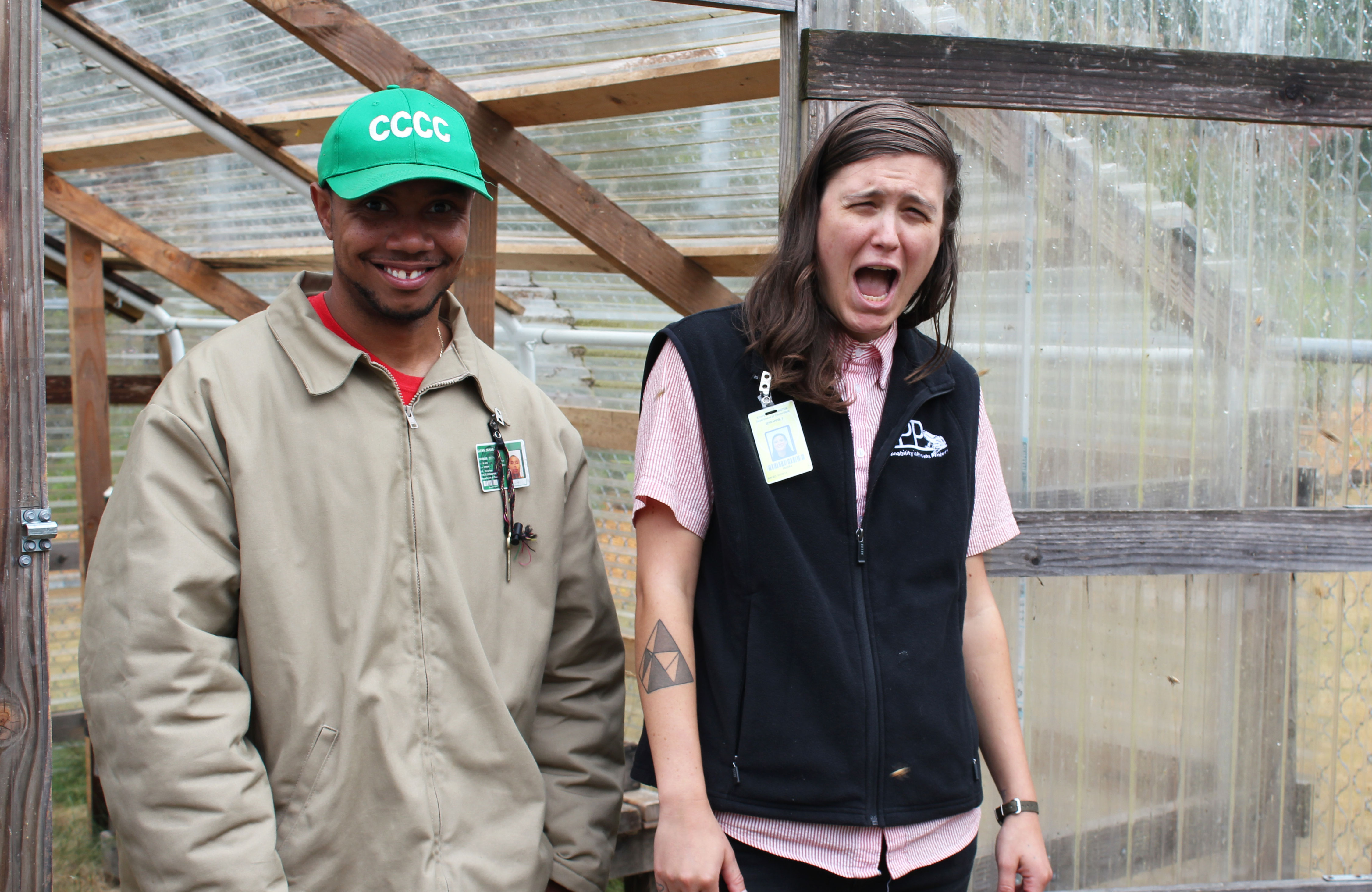
If I stood right next to a hive, I might still feel like screaming.
Jamar Glenn and Fiona Edwards stand among honeybees flying to and from their hives. Photo by SPP staff.
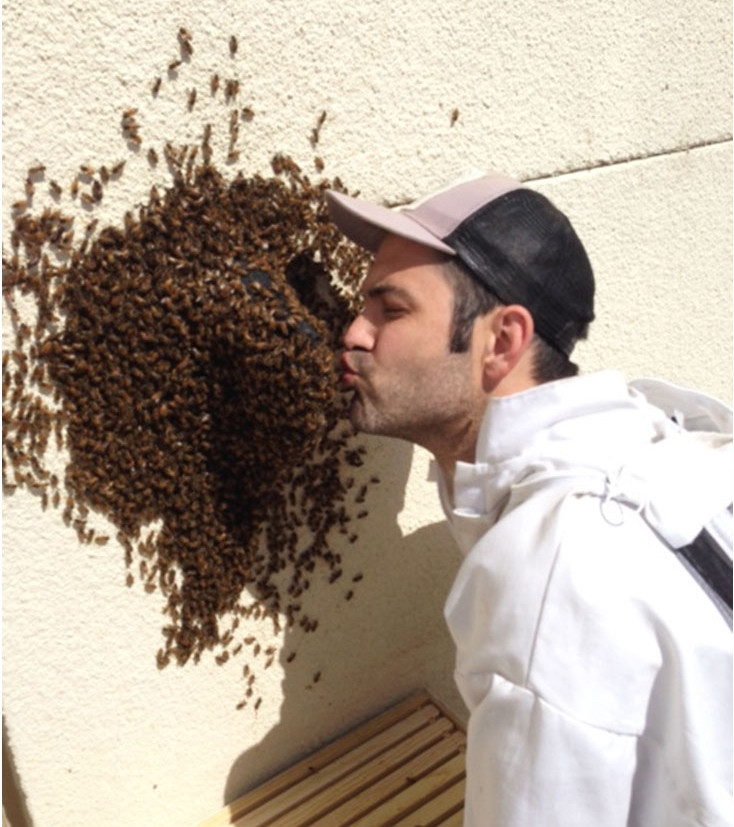
But it seems more likely that I would feel like this:
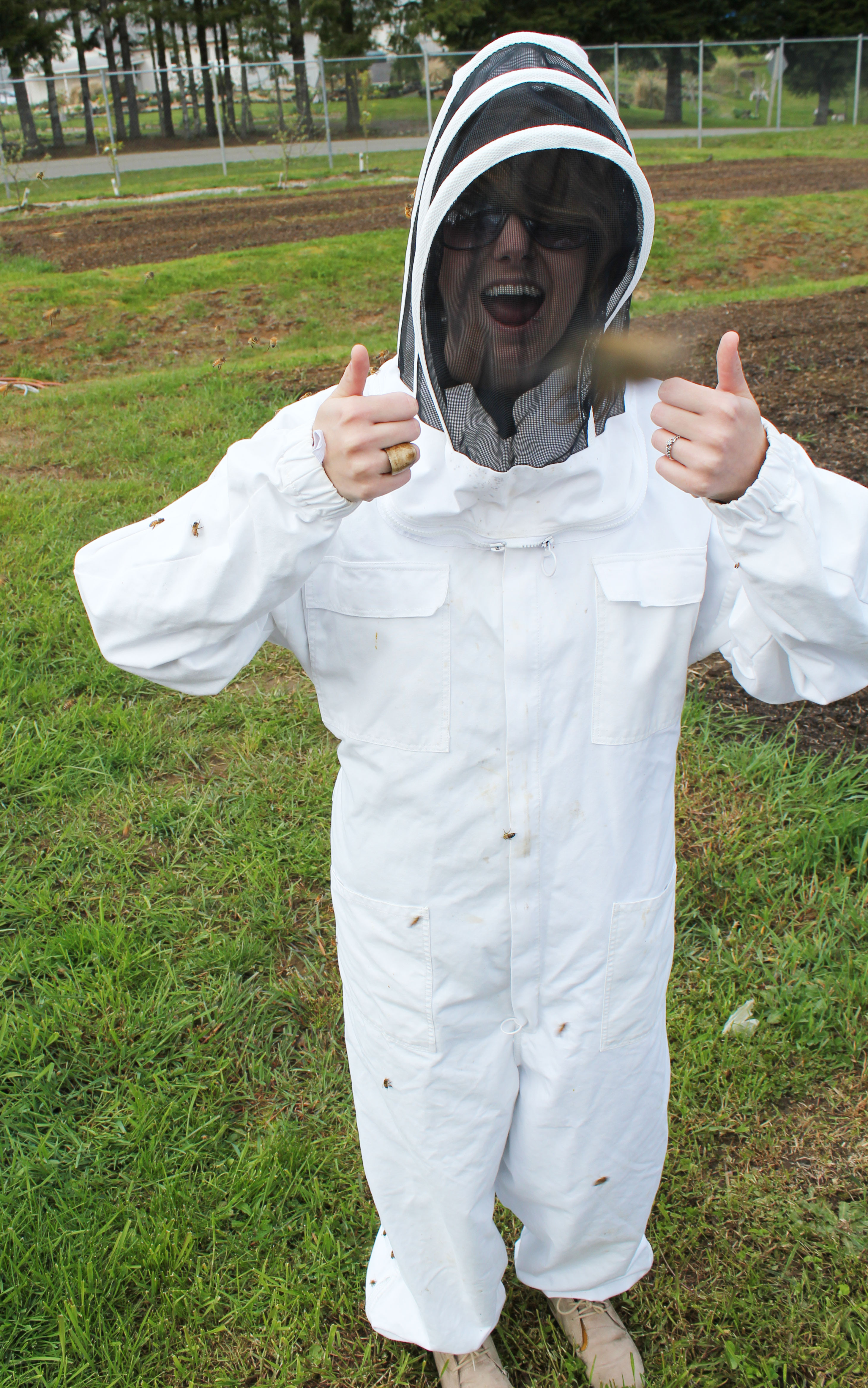
A beekeeper at Washington State Penitentiary shows his love for a honeybee swarm. Photo by DOC staff.
Thanks for being patient with me, honeybees. I’m your new biggest fan.
by Joslyn Rose Trivett, SPP Network Manager
Master Beekeeper Renzy Davenport of the Olympia Beekeepers Association and the Pierce County Beekeepers spent six Thursday evenings with a class of inmates and staff at Cedar Creek Corrections Center. At the seventh meeting, he certified all students as Apprentice Beekeepers. As far as we know, this is the first in-prison beekeeping certification program in Washington state, and we hope it will be the first of many.
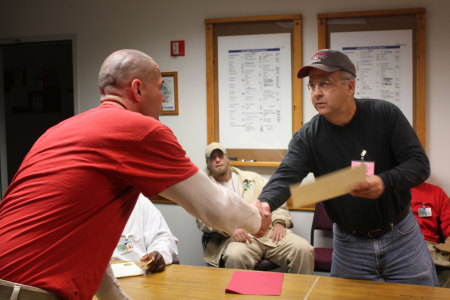
A newly-certified beekeeper receives recognition from Renzy Davenport of the Olympia and Pierce County Beekeepers Associations. Photo by Fiona Edwards.
The classes conveyed all the fundamentals of beekeeping, including how to build up colonies without buying more bees. Renzy provided practical guidance on how to turn beekeeping into a business. At an earlier class, the students sampled several varieties of honey and learned how to create the more tasty varieties—no one was very interested in how to achieve a “buckwheat honey,” as they thought it smelled like wet dog, but the raspberry and wildflower varieties were popular!
For those at Cedar Creek in the spring, they will have the chance to work with the in-prison hives. During the winter months, the bees are quiet and cannot be disturbed, but starting in April there will be plenty to do to care for the bees and their hives.
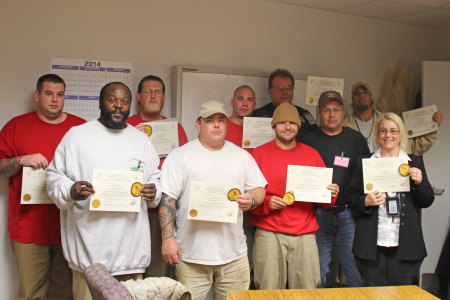
The first class of certified beekeepers at Cedar Creek Corrections Center pose with their certificates. Photo by Fiona Edwards.
Many thanks to Renzy for donating his time to teach the program, and to all the students and administrative support at the prison. Thanks to Fiona Edwards for attending the certification ceremony so we could help celebrate this first beekeeping class.
Blog post written by Michael Nelson, an inmate at the Stafford Creek Corrections Center (posted by Project Manager Jeff Muse as Washington State offenders do not have Internet access):
In the summer of 2009, the Sustainable Prisons Project sponsored beekeeping classes at the Stafford Creek Corrections Center (SCCC) in Aberdeen, Washington. I participated in the program which maintained four beehives inside the prison: three alongside the prison’s vast vegetable garden and one inside an “observation hive” in a commercial, cold-frame greenhouse. The program was remarkable in several respects.
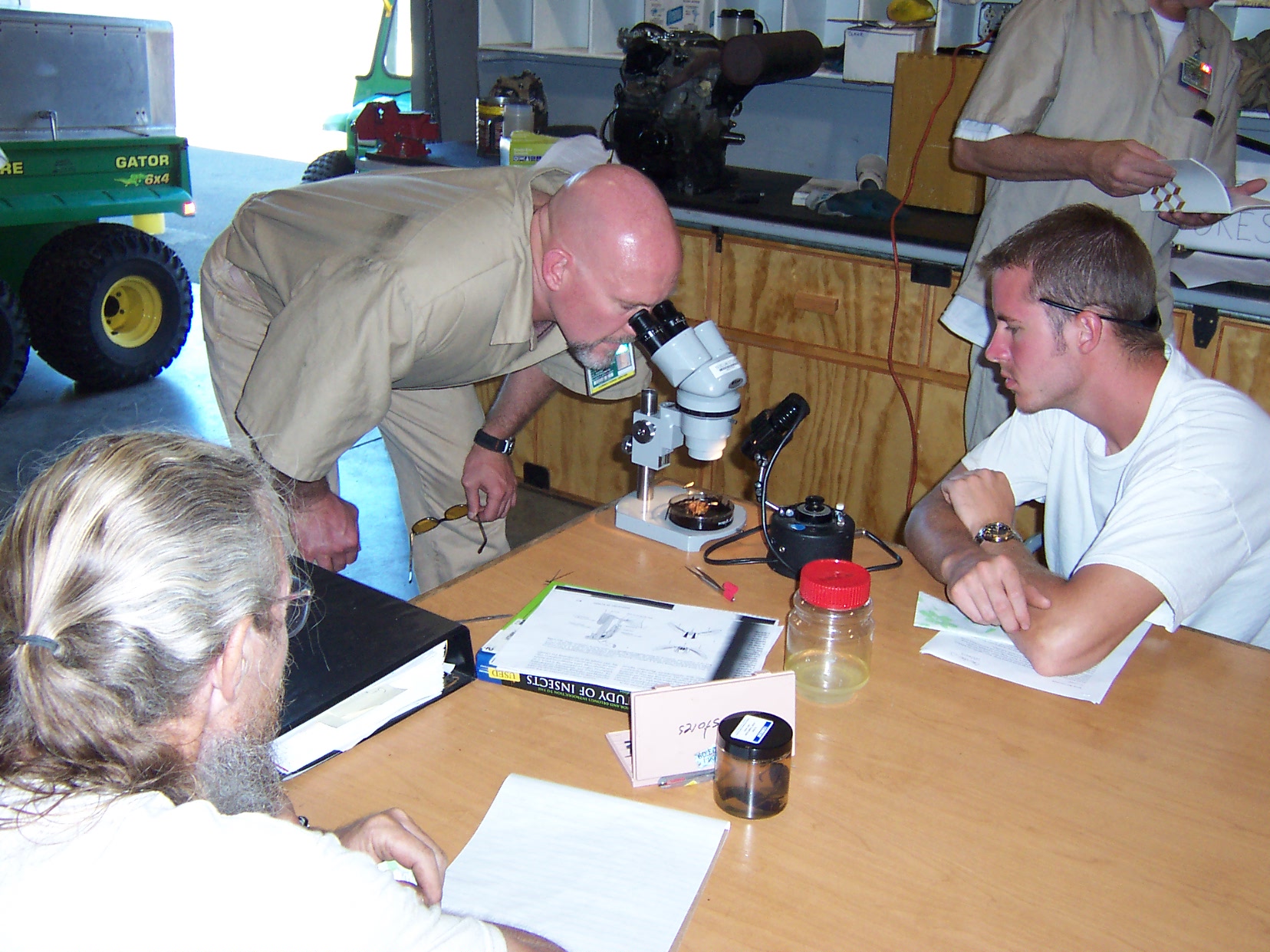
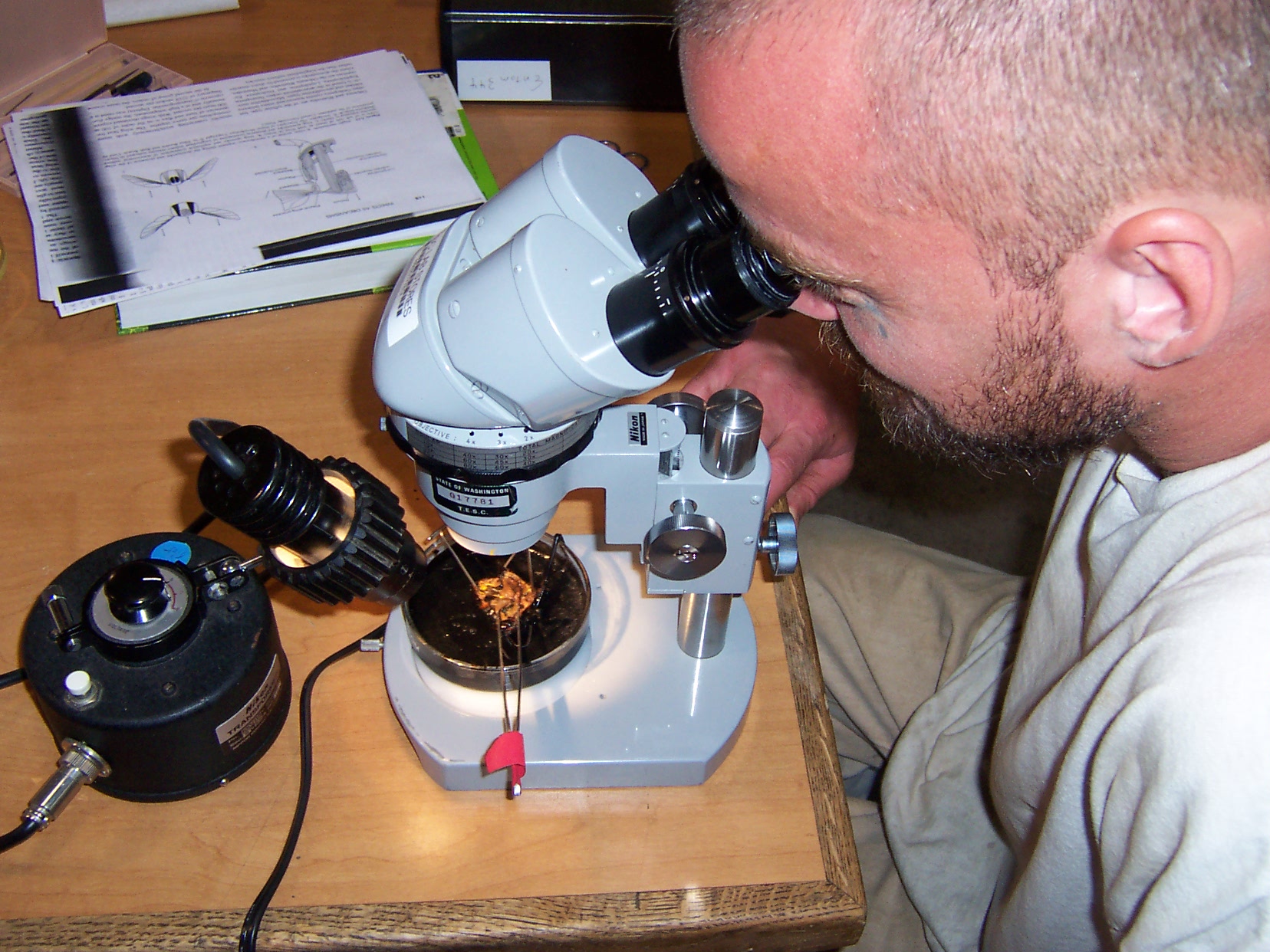
Michael Nelson (center) examines the anatomy of bees during a class at the Stafford Creek Corrections Center. Photo: Doug Raines.
My 11 years of confinement taught me prison’s hostile captor/captive dynamic. Our prisons isolate criminals — not just from the communities in which they’ve committed their crimes, but from nature, and from normal, healthy relationships. The type of “outside the box” thinking that spawned the Sustainable Prisons Project holds great promise for prison reform in ways most free-world people can’t understand. I’ll try to explain.
For two months each Wednesday at noon, entomologist Sam Hapke met with about 10 of us in SCCC’s V Building. On our first day, after some instruction, we went out to inspect the hives. Our initial fear of being stung had a weird affect on us — the “fronts” we put up as prisoners fell away in a sort of humble awe amidst the force of nature the bees represented.
It’s impossible to maintain a “tough guy” facade when handling bees. Pretense falls away in the symbiotic relationship between man and bees — things can go wrong quickly if you’re not on your best behavior. And it did cultivate our best behavior. Without our being told, we picked up on our interdependence with the bee. The larger message of our interdependence in society — which the bee is an important part of — was also immediately apparent, despite our not being told.
To me, there is something folkish about beekeeping. Perhaps my ancestors were among those early colonists who brought Apis melliflora (the “white man’s fly”) to North America. It was almost as if some Jungian collective memory was triggered in me. I felt quite at home dismantling and inspecting hives, engulfed within the swarm of bees whom I trusted somehow not to sting me. And I was never stung, despite my never wearing protective gear. I’m not afraid of being stung anymore.
I am hooked on beekeeping. From my perspective, every other prisoner in the program was affected in a similar way. The value of the program became apparent when I considered what it would be like if more prisoners were participating. You should consider that, too.
I propose a permanent relationship between agricultural researchers and inmates in Washington State. We could call the program “Apicultural Research in Prisons.” Since our civilization is utterly dependent on bees for its agriculture, and since bees are presently threatened by widespread colony collapse disorder, it would benefit us to form such partnerships with university agricultural extension services.
What better place than prisons for this kind of work? The controlled environment of facilities like SCCC lend themselves to reliable statistical research that can help scientists examine our most pressing environmental problems. It’s a natural fit, one that benefits researchers, prisoners and society.
— Michael Nelson, Stafford Creek Corrections Center, August 27, 2009
Blog post by Project Manager Jeff Muse:
In the summer of 2009, more than a dozen offenders at the Cedar Creek and Stafford Creek corrections learned skills in beekeeping. Led by Evergreen scientist Sam Hapke and correctional staffers Vicki Briggs and Doug Raines, our part-time program involved both classroom study and outdoor work with hives in each prison.
While working in the garden, a Stafford Creek inmate cares for the prison's beehives as part of a training program led by Evergreen scientist Sam Hapke. Photo: Doug Raines.
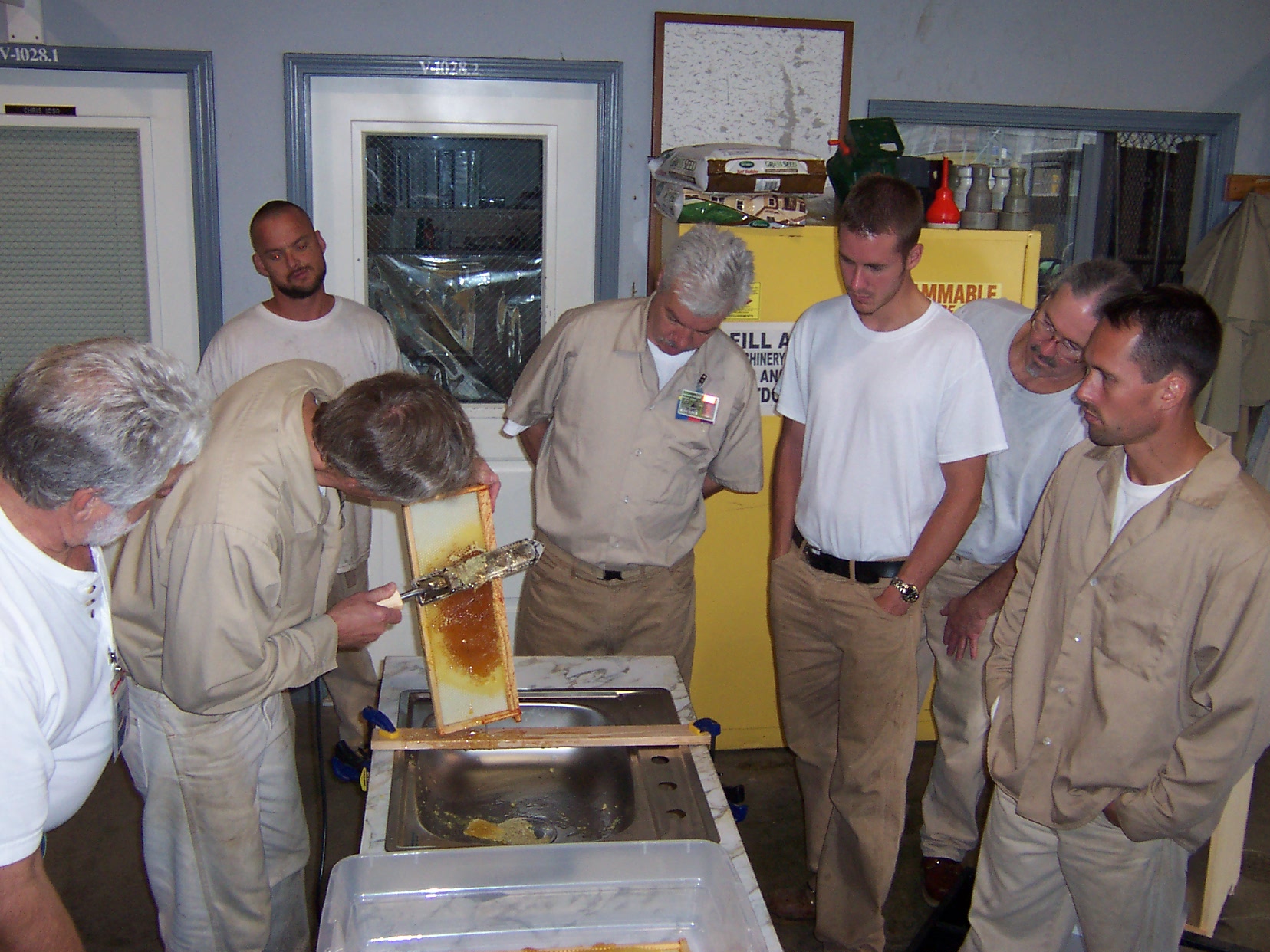
Offenders learned about bee biology and behavior, hive construction and maintenance, beekeeping equipment and commercial business practices — profitable skills for a post-prison career, be it in honey and beeswax production or pollinating fruits and vegetables in orchards and farms.
After collecting honey from the prison's beehives, Stafford Creek offenders learn how to create products such as lip balm and hand lotion. Photo: Doug Raines.
Under Hapke’s guidance, next year we hope to design and conduct inmate-led research projects with publishable results, not only advancing science, but also modeling this training program for other institutions. Often located in rural areas, prisons are uniquely positioned to support the pollination of wild and commercial plants while helping scientists study the alarming threat of bee colony collapse.
A Stafford Creek inmate learns how to use a microscope for biological study. Photo: Doug Raines.
Blog post by Graduate Assistant Sarah Clarke:
There are opportunities that come along only once in a lifetime, and I experienced one this week. Project Manager Jeff Muse and I visited the Cedar Creek Corrections Center (CCCC) to debrief offenders involved in our pilot beekeeping program with biologist Sam Hapke. When we arrived, I spotted five inmates preparing a multitude of hives for the coming autumn. Jeff suggested that I get in the middle of the action, and before I knew it I was in a veil and gloves, standing among honeybees.
Unexpected opportunities like this make my job that much more unique and special. What an experience to have thousands of bees buzzing about me, enveloping my hand as I touched their hives. There are times when you glimpse that there are much larger things at work in the world than you and your affairs. This was one of those awe-inspiring moments.
Later, while seated as a group on the prison’s lawn, Jeff and I assessed the beekeeping program through evaluative surveys and a taped discussion with the offenders and Sam Hapke. One of the most important reasons for our work is to introduce inmates to useful skills in science and sustainability while engaging their minds and inspiring positive attitudes and behaviors. Our intimate conversation revealed that beekeeping is hitting the mark. The offenders indicated that they are learning marketable skills for their lives after release, be it in commercial beekeeping or by starting their own hives at home. Plus, they regard the activity as a therapeutic tool, helping them grow through hands-on problem solving and a sense of responsibility for a world beyond the prison’s fences.
From standing among swarms of bees to hearing first-hand how lives can be changed through education, I can honestly say that there is never a dull day for me at the Sustainable Prisons Project. Indeed, it’s changing my own life.



Once a year, SPP reports on all things sustainable happening in Washington State Prisons.