Text by Kay Heinrich, Associate Superintendent, Airway Heights Corrections Center (AHCC)
Photo by AHCC staff.
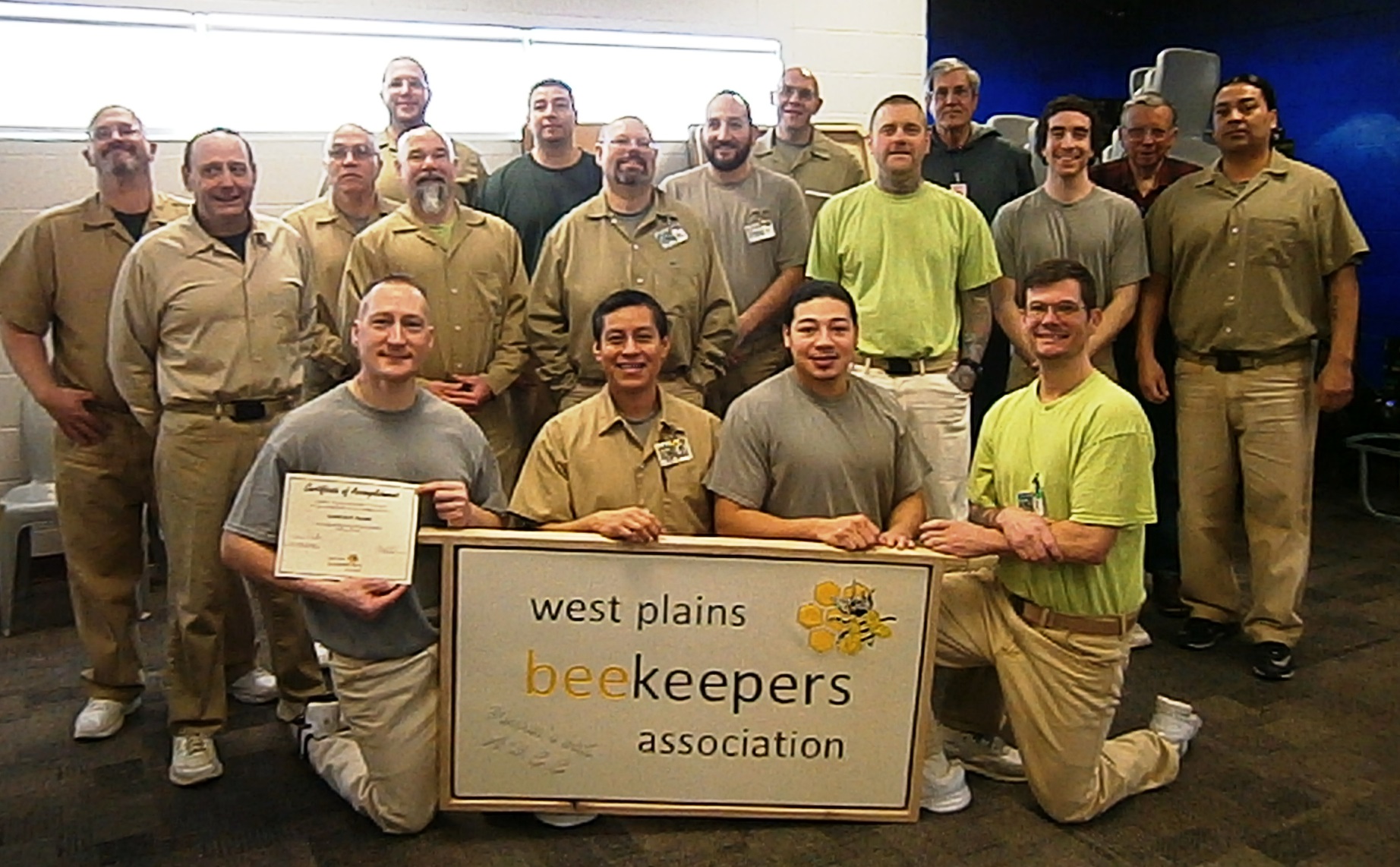
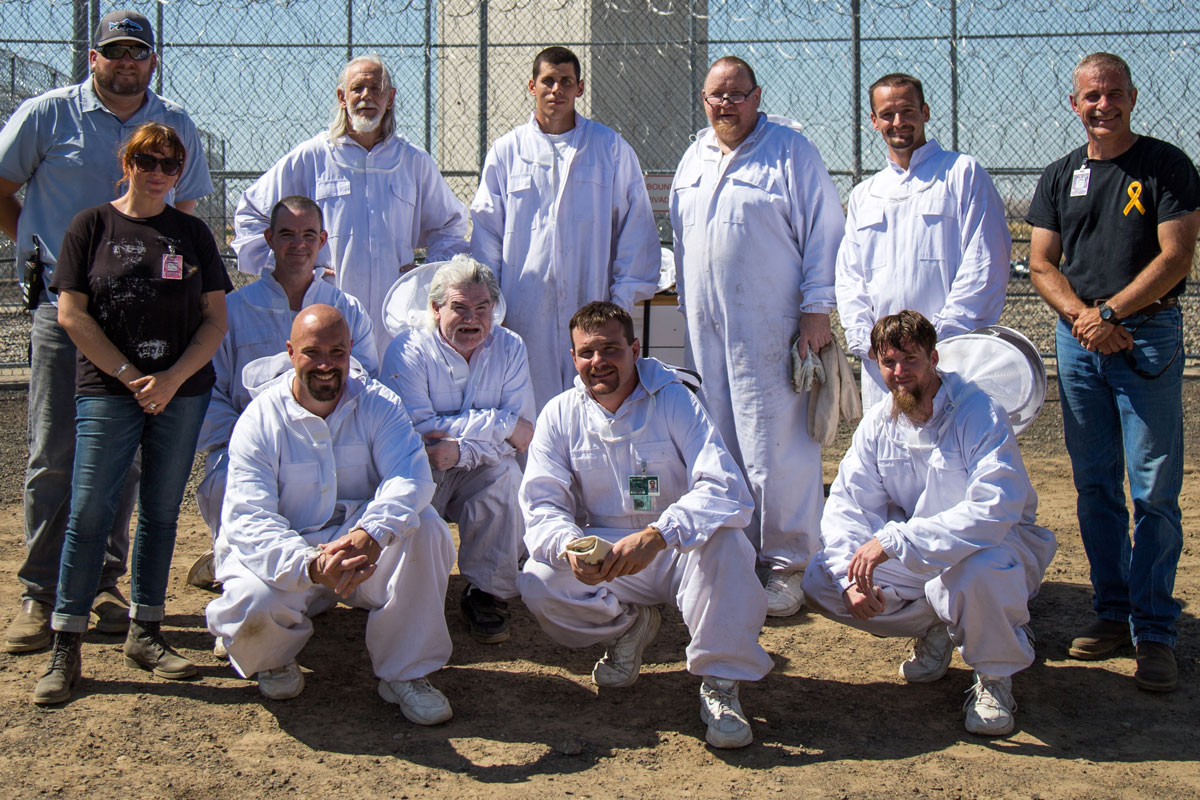
Graduating class from AHCC.
Airway Heights Apiculture is Preparing Apprentice Beekeepers to Become Journeyman and to Raise Queen Honeybees!
About fifty inmates at the Airway Heights Corrections Center (AHCC) have successfully completed an apprentice course and are certified Apprentice Beekeepers through the Washington State Beekeepers Association (WASBA). Of those, approximately fifteen are on their way to becoming Journeyman-level Beekeepers through the WASBA Master Beekeepers program. The inmates who are pursuing Journeyman status have formed a beekeeping club named Airway Heights Apiculture (AHA). This is possible because of the administration’s support and expert tutelage of Master Beekeeper Jim Miller. Also, the class of students itself has helped to develop test and training materials, creating a training curriculum that fits the needs of a corrections environment (more about that from club members, below). The AHA club is a subsidiary of the West Plains Beekeepers Association, a nonprofit organization.
On 2/15/2018, the Bee class graduated its first Journeyman Beekeeping class. We had a celebration for the gentlemen who graduated to celebrate their hard work that was well attended.
Behind The Scenes: Writing from members of AHA
After several months of club meetings, serious discussions began to take place regarding the future of the beekeeping program and possible means to advance educational and organizational objectives. Jim mentioned that he would like to replace the existing Journeyman Beekeeper training manual currently in use in the beekeeping community. Would the AHA club be up for the challenge of expanding on Jim’s outline for a new journeyman manual and developing an entire training curriculum to be implemented at AHCC?
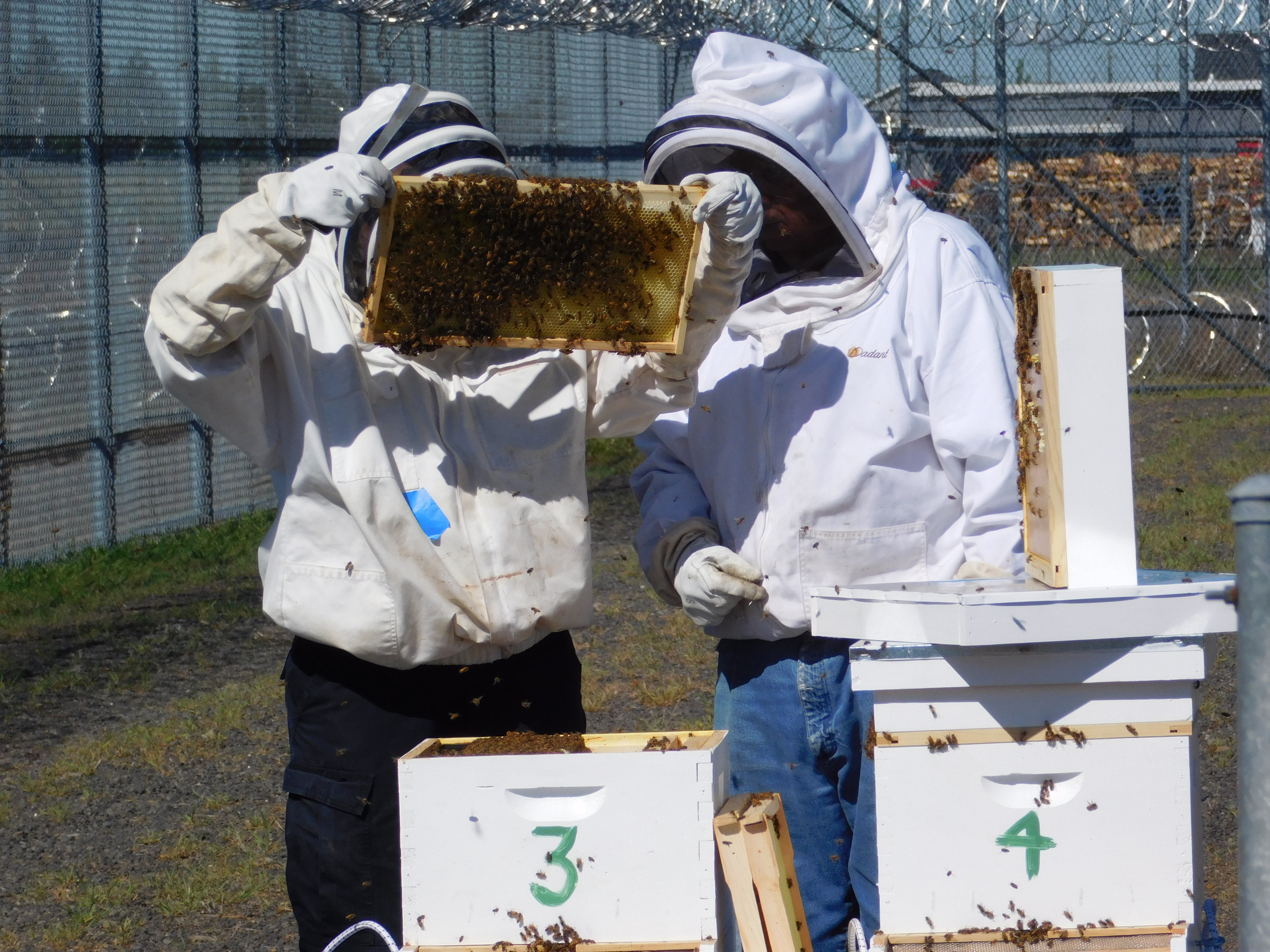
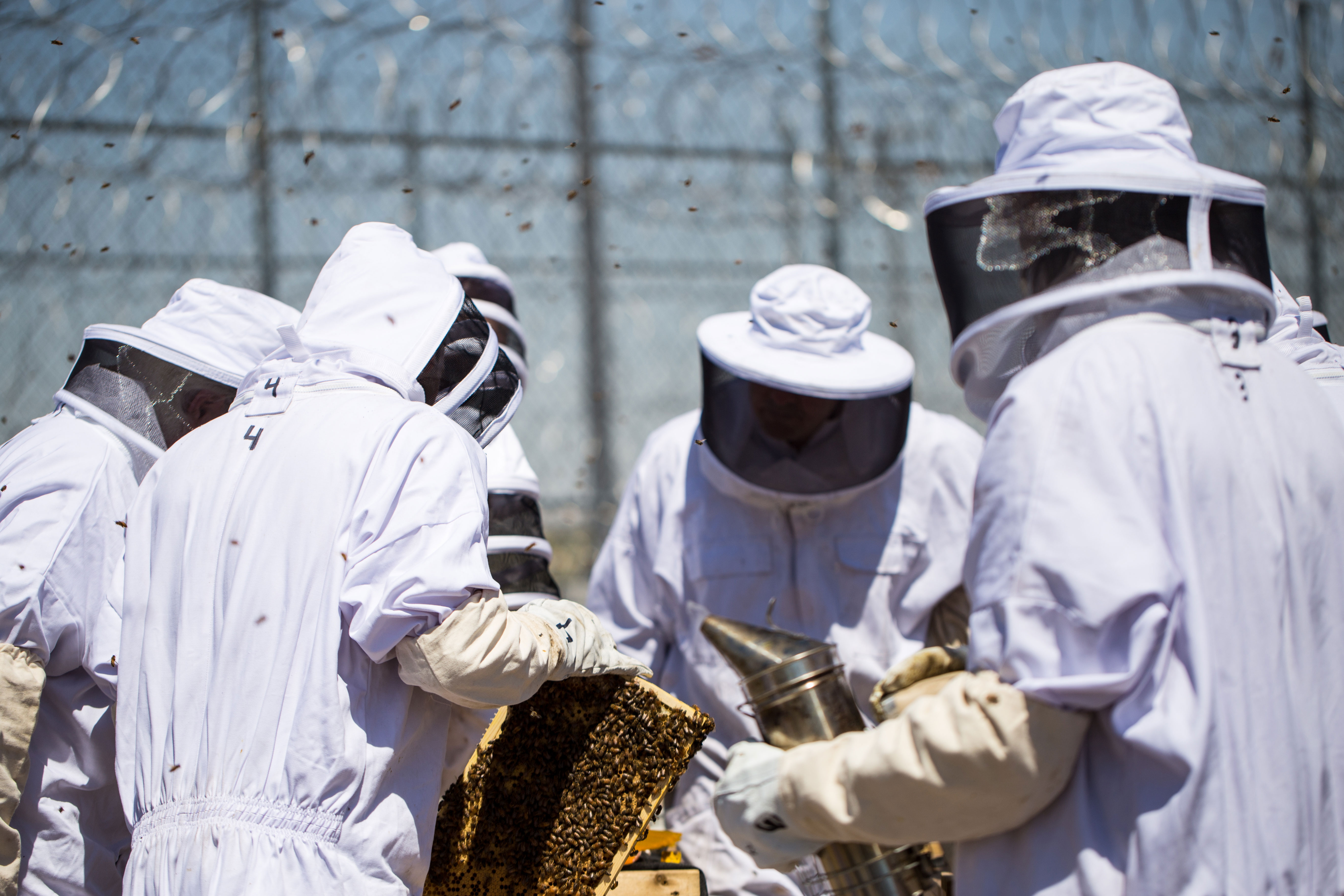
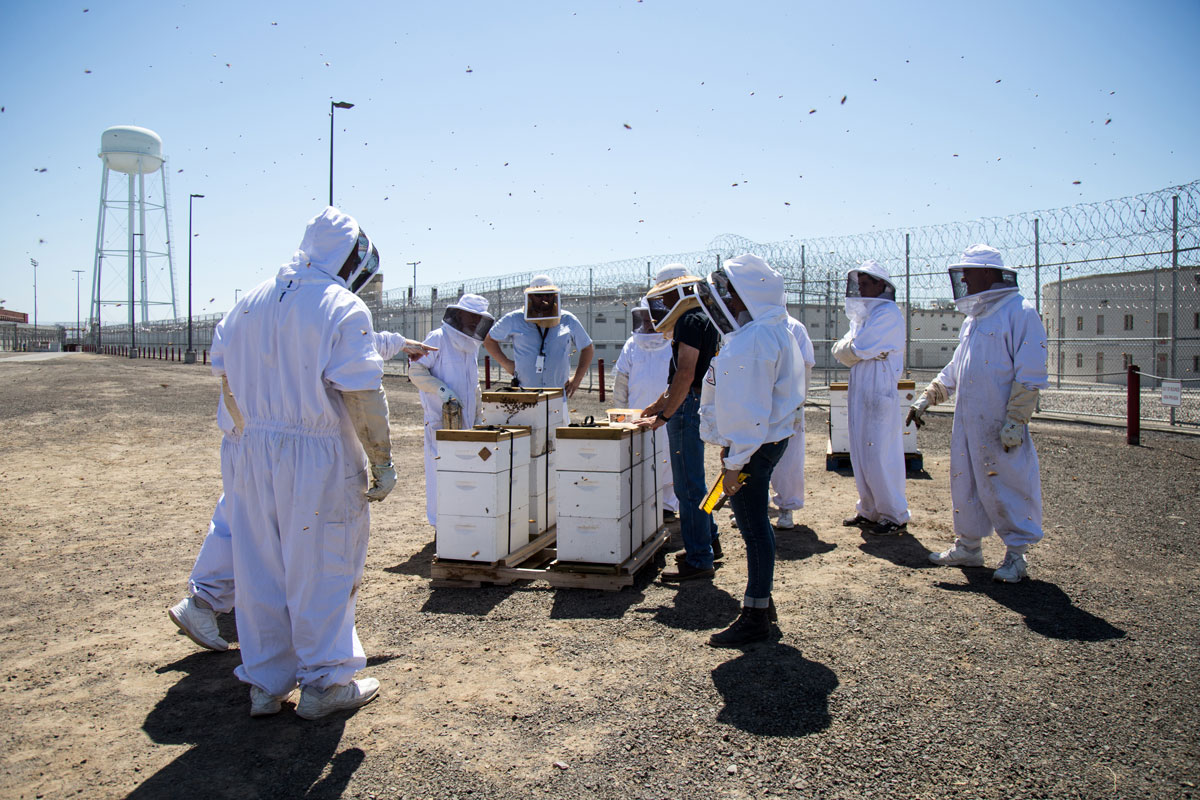
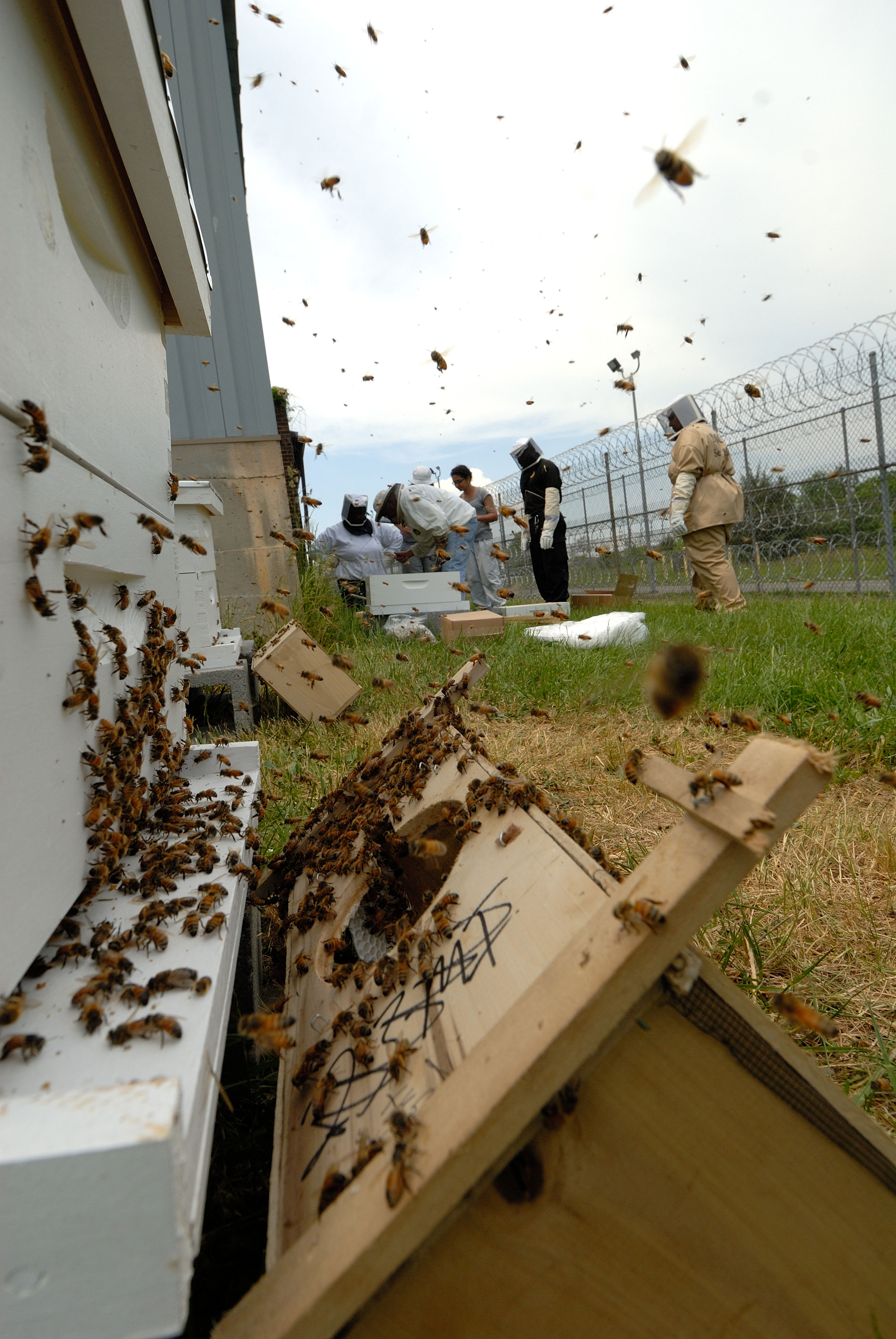
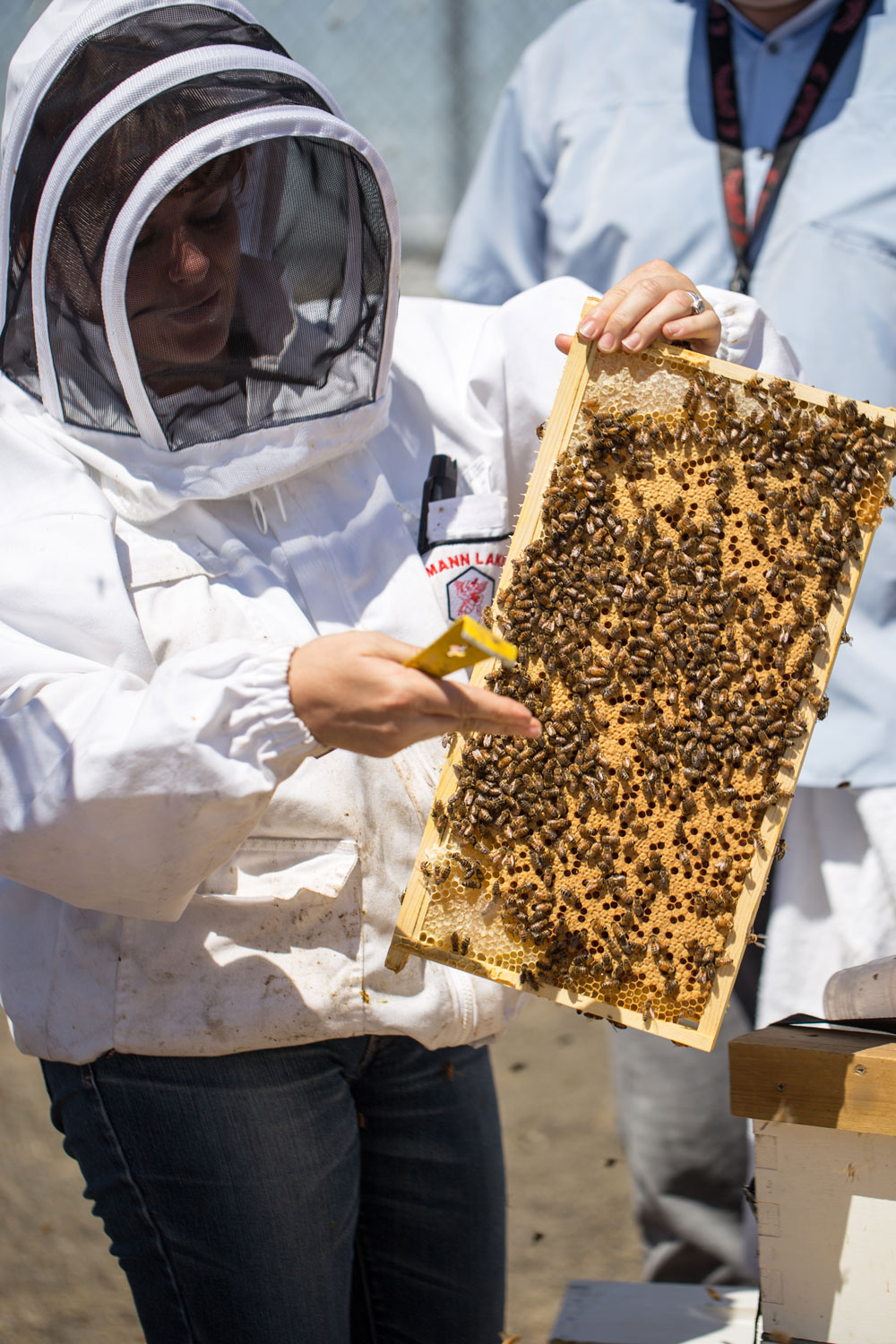
Beekeepers at AHCC check on a hive. Photo by DOC staff.
Of course! The club members had wanted to do something meaningful and have a lasting positive impact; their creation would be greater than themselves and would survive long after their release back into the community.
The project was simple enough: ten chapters based on a pre-existing outline by Jim, 20 questions for each chapter, and PowerPoint presentations for each of the lessons. Ten club members accepted the challenge. Following several weeks of writing, revising, and debate over the details of educational objectives, the booklet was finally complete. Club members worked together well and overcame apprehension and doubt. Now they can see the results of their hard work. A few weeks later they finished development of PowerPoint presentations and the first Journeyman class was ready to begin.
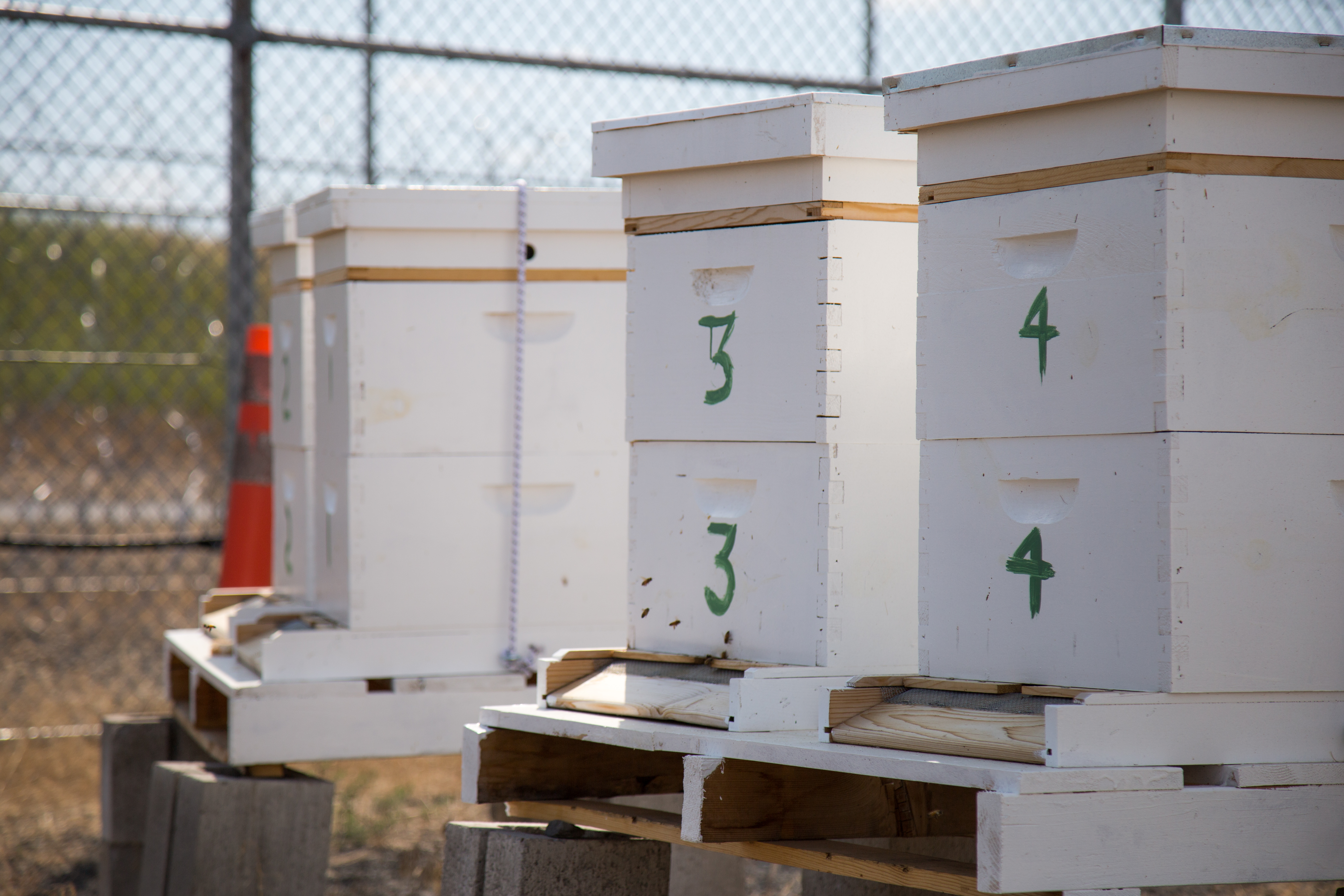
Hives next to the prisons largest garden. Photo by Ricky Osborne.
Roughly 15 eager and enthusiastic students signed up – all graduates from the first three Apprentice classes. The aspiring Journeyman who developed the presentations did an excellent job facilitating the classes and helped set the standard for future classes. Students will have to pass a test spanning 100 questions. They must also pass a practical field exam to show their knowledge of beekeeping by demonstrating setting up hives, using hive tools, and inspecting frames. Students who graduate will be that much closer to their goal of becoming a Journeyman Beekeeper. Each student will still have to serve as an apprentice for three years, earn 30 service points, maintain a hive journal for a year, and mentor a new beekeeper.
Queen-Rearing: A Crowning Achievement!
Another exciting stage of progress is coming to AHCC – queen-rearing is about to be implemented by AHA and the time couldn’t be better! One of the long term goals which stated by administration is to advance sustainable beekeeping to other institutions in Washington. Queen-rearing at AHCC would help to provide queen bees to the various beekeeping programs throughout the state. This will advance beekeeping efforts to be self-sustaining and would provide additional education to inmates aspiring towards the level of Master Beekeeper. In addition to facilitating training for new apprentice and journeyman beekeepers, inmate beekeepers would be responsible for maintaining the activities of the queen-rearing program with the continued assistance of community sponsors and the support of administration.
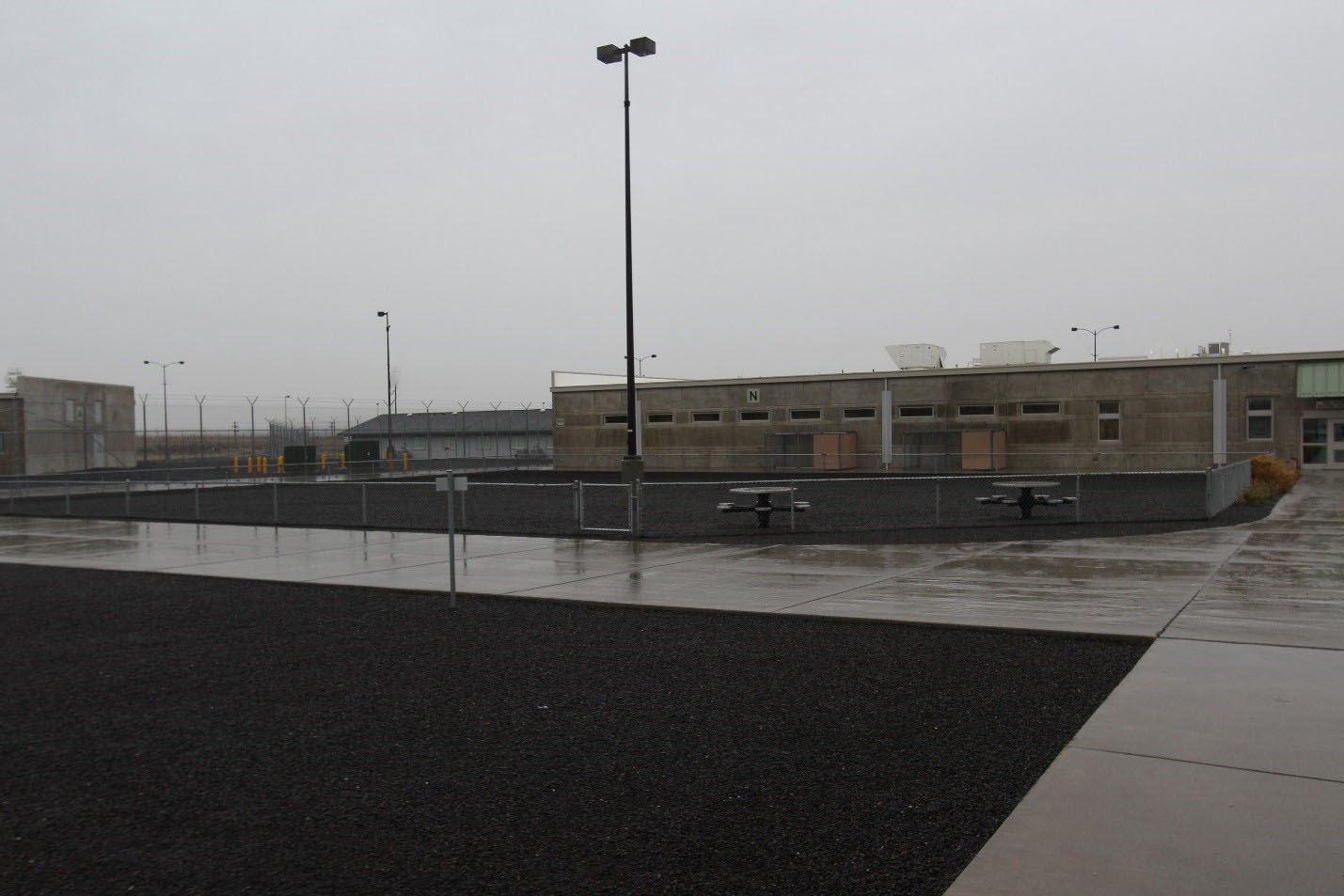
At first glance Coyote Ridge looks very gray. This was especially true when I visited in overcast, rainy weather.
I visited the prison in late November, and had the chance to tour the programs and meet with partners. The Sustainable Operations of the facility were highly impressive, but even more impressive were the staff who work there and the inmates who have dedicated their lives to learning, education, and environmental activism. I met with the instructors for Roots of Success and we talked about the program, the facility’s annual Environmental Awareness Day, and the many hopes they have for advancing sustainability programming at Coyote Ridge.
I am continually impressed by the people I get to work with, and the inmates and liaisons at Coyote Ridge are exemplary program representatives. I asked what could be done to improve their program and the inmates unanimously agreed “more books and readings about the environment, the sciences, sustainability, environmental activism, and any other subject along those lines.” They want to learn as much as they can and are utilizing every resource they have access to.
Coyote Ridge has developed a “Sustainability Passport” to track and recognize participation. As incarcerated individuals complete a program, they get a stamp on their “passport.” A regular offering is the prison’s Sustainability Lecture Series, similar to the Environmental Workshop Series at two prisons west of the Cascades. They bring in outside experts to deliver lectures and seminars on environmental issues and sustainability. Guests have come from organizations like the Department of Ecology, the local beekeeping association, and experts on the Hanford Site.
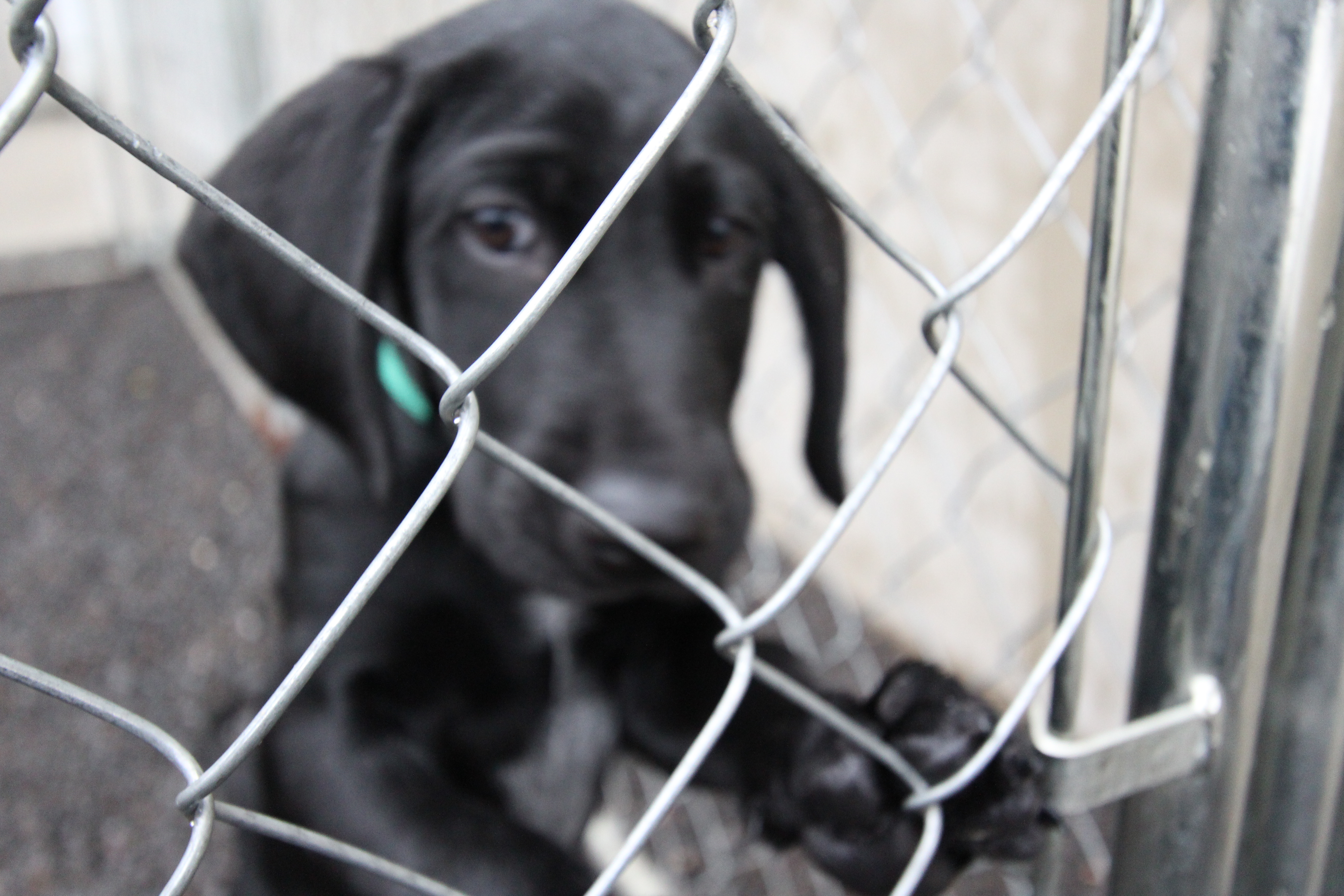
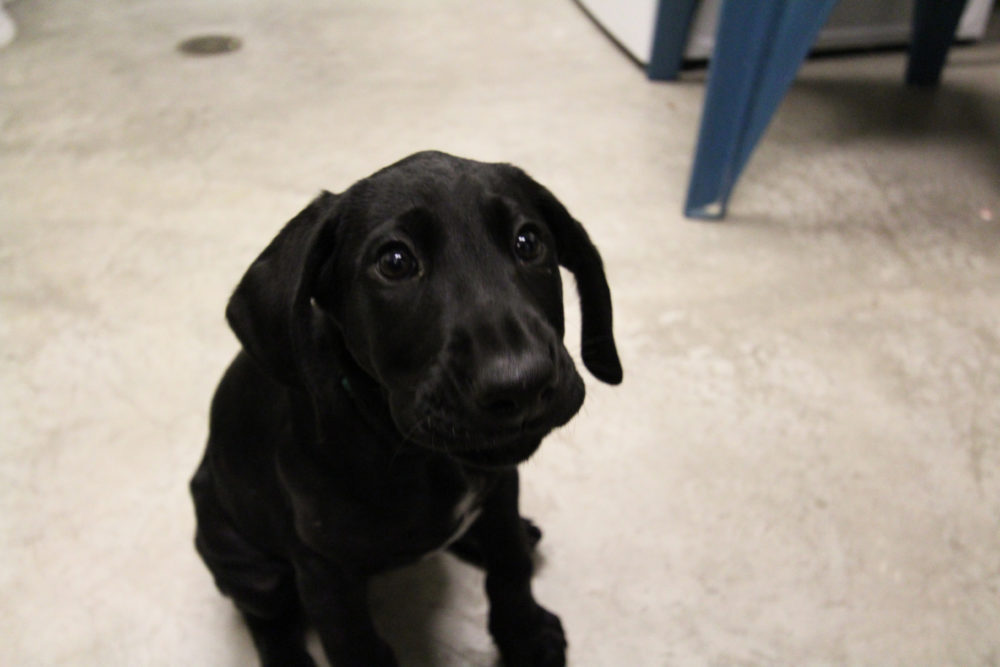
This is Bentley. He is a handsome, energetic, lab mix puppy that was brought to the prison with the rest of his litter to be raised and trained by inmate dog handlers. He and his litter-mates have already been adopted, and some by staff members at the prison. Many staff members adopt shelter dogs that the inmates train because they get to know and love the dogs during their time at the facility.
Coyote Ridge hosts a beautiful, thriving dog program. Incarcerated individuals have played a greater leadership role in this program compared to other prison pet programs we know. The dogs that come to the facility are from Benton Franklin Humane Society and Adam County Pet Rescue. They come to the prison because the local shelter doesn’t have the space or time to care for the dogs; because it’s a pregnant dog that can receive inmate handlers’ attention 24 hours a day; or because the animal has been abused and needs extra-gentle care and attention to learn to trust people again. The dogs work with a variety of trainers while they’re at the facility so that they learn to listen and be comfortable around different people.
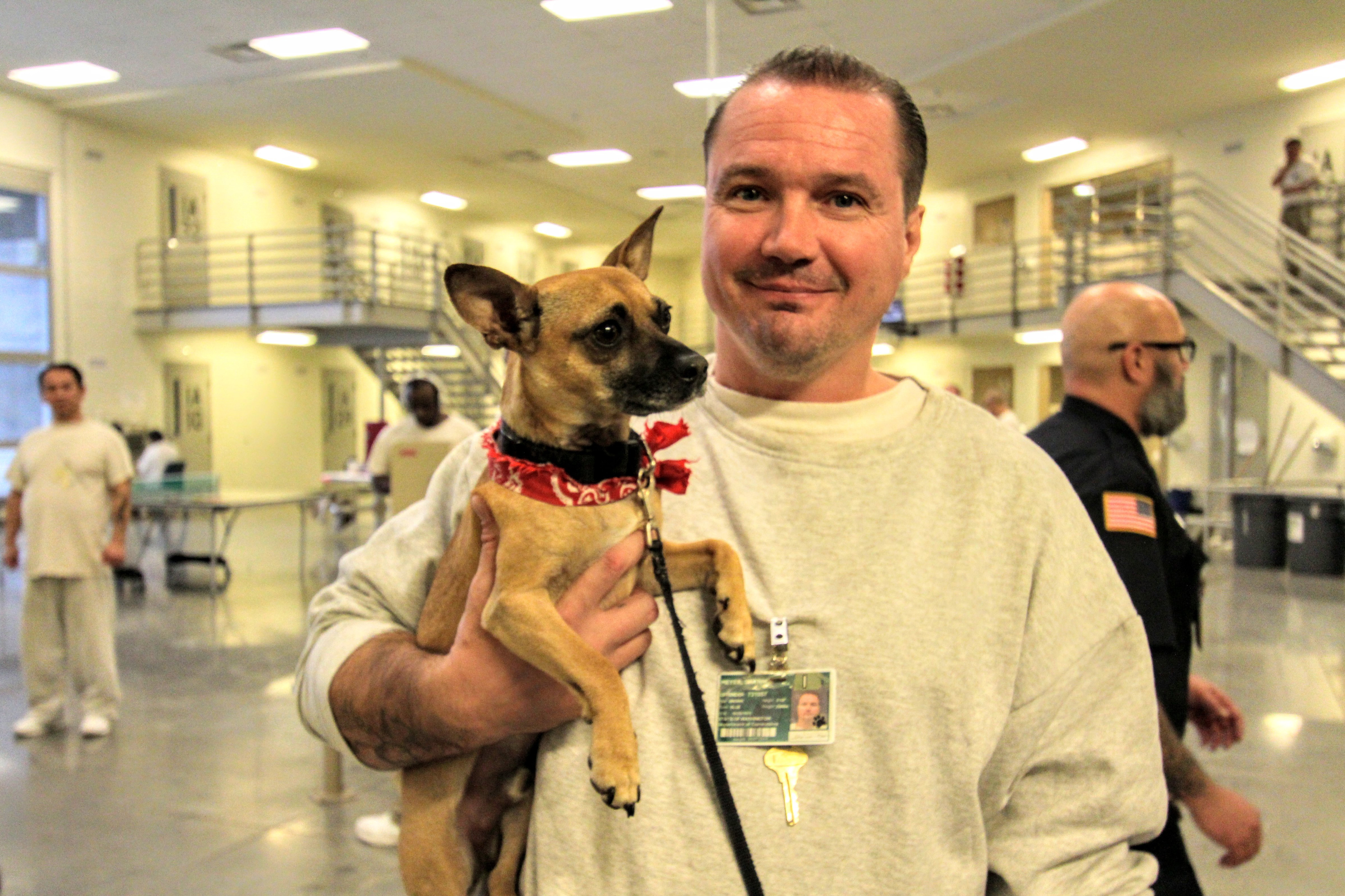
This is Shannon Meyer. He is one of the inmate dog handlers at CRCC and this was the current dog he’s working with, Rocky. When Rocky came to the prison he wouldn’t let anyone touch him and would get aggressive easily. Mr. Meyer has been working with Rocky for several weeks to get him to trust people and is pleased with his progress. Rocky’s red bandanna signals that he may not respond well to being pet or held by anyone other than his handler, but he happily let me pet him – proof of his progress.
The handlers at CRCC look like they love what they do and see the value in their work with the dogs. One of the handlers, Mr. Meyer, had this to say: “When I got here (in prison) it was just about doing my time, but now, with my dog, everything is about taking care of him and my life is about him.”
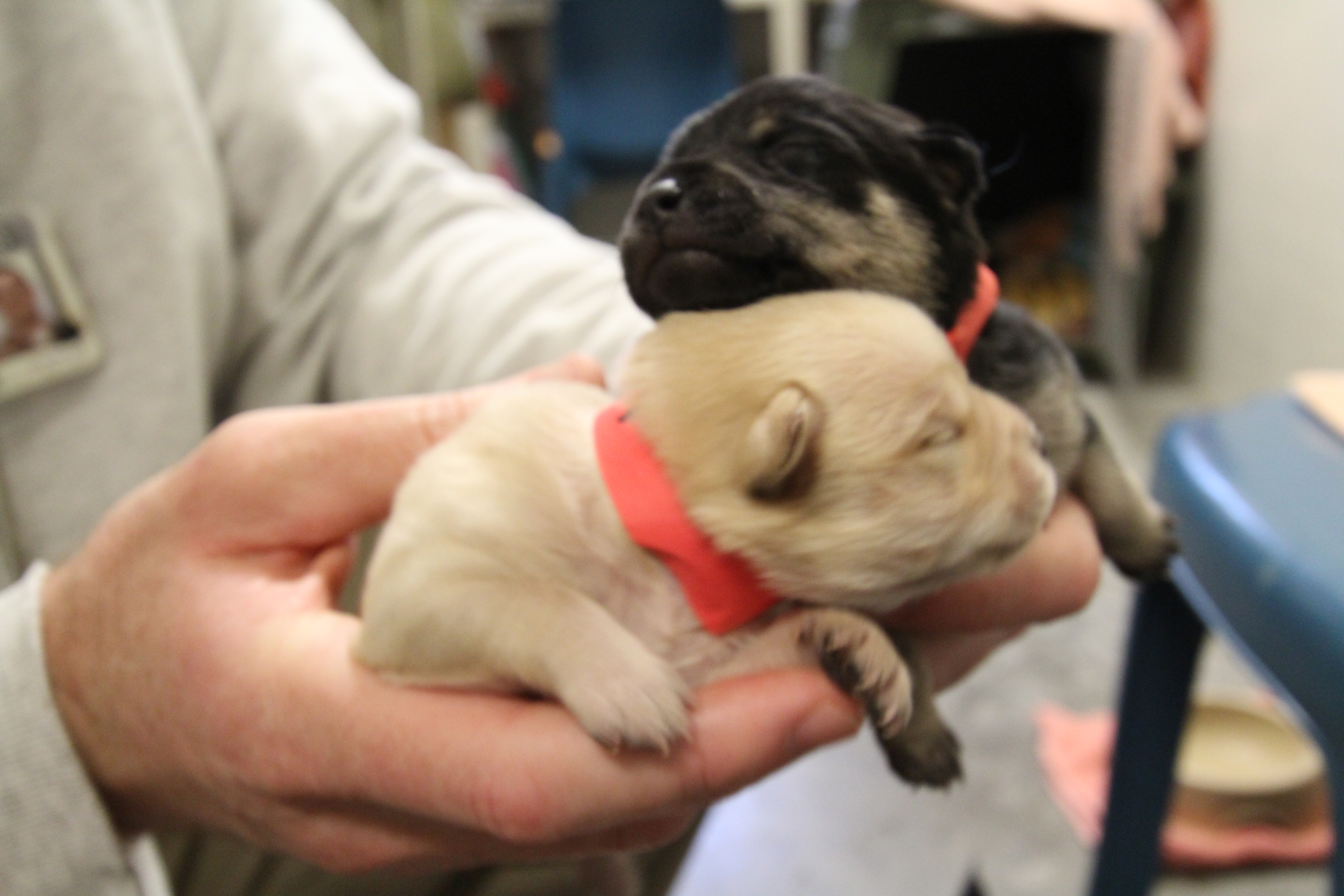
I also met these 8-day old puppies who were born in the prison. Their mother came to prison pregnant and gave birth to her puppies in the handler’s cell. Her handler, Mr. Archibald, will care for her and her puppies until they are ready and able to be adopted.
On all fronts, I was impressed by the greenness of programming and attitudes at the prison. Keep up the excellent work, Coyote Ridge!
CRCC during the summer. The picture is looking at some of the units and the courtyard with a rock garden in the center. The gardens at CRCC all feature native plants and rock designs. Photo by Ricky Osborne.
Text and photos by Bethany Shepler, SPP Green Track Coordinator
Class photo of beekeeping apprenticeship students with Ed Baldwin (far left) and Duane McBride (second from the left).
The bees may have turned in for winter, but beekeeping students at Stafford Creek Correction Center (SCCC) are still hard at work. Their first beekeeping apprenticeship course is almost done and we are impressed and thankful.
I had the pleasure of sitting in on the last class in the series at SCCC, taught by Duane McBride from the Olympia Beekeepers Association. The students came well prepped for class and full of thoughtful questions. Ed Baldwin, a Grounds Specialist at Stafford Creek, is taking the class as well. Ed hopes to continue to expand the beekeeping program—it has been in place since 2009, but is doing better than ever with the renewed attention and education.
Duane McBride answering questions about a test the students took in an earlier class.
Students that go through the beekeeping apprenticeship course graduate as certified beekeeping apprentices and can put those skills to further use upon release.
Since last spring’s Beekeeping Summit, we have seen beekeeping programs booming statewide – adding nine programs in only six months! We are thrilled by all of the support and enthusiasm surrounding the beekeeping programs. Beekeeping is really taking flight within Washington State prisons and we can’t bee-lieve how fast the program is growing. Keep up the hard work, Stafford Creek!
Students chuckle at a beekeeping pun during the class…we were buzzing with bee puns.
A student looks up something for reference as Duane McBride talks about hive care.
Students listen as Duane explains hive care techniques.
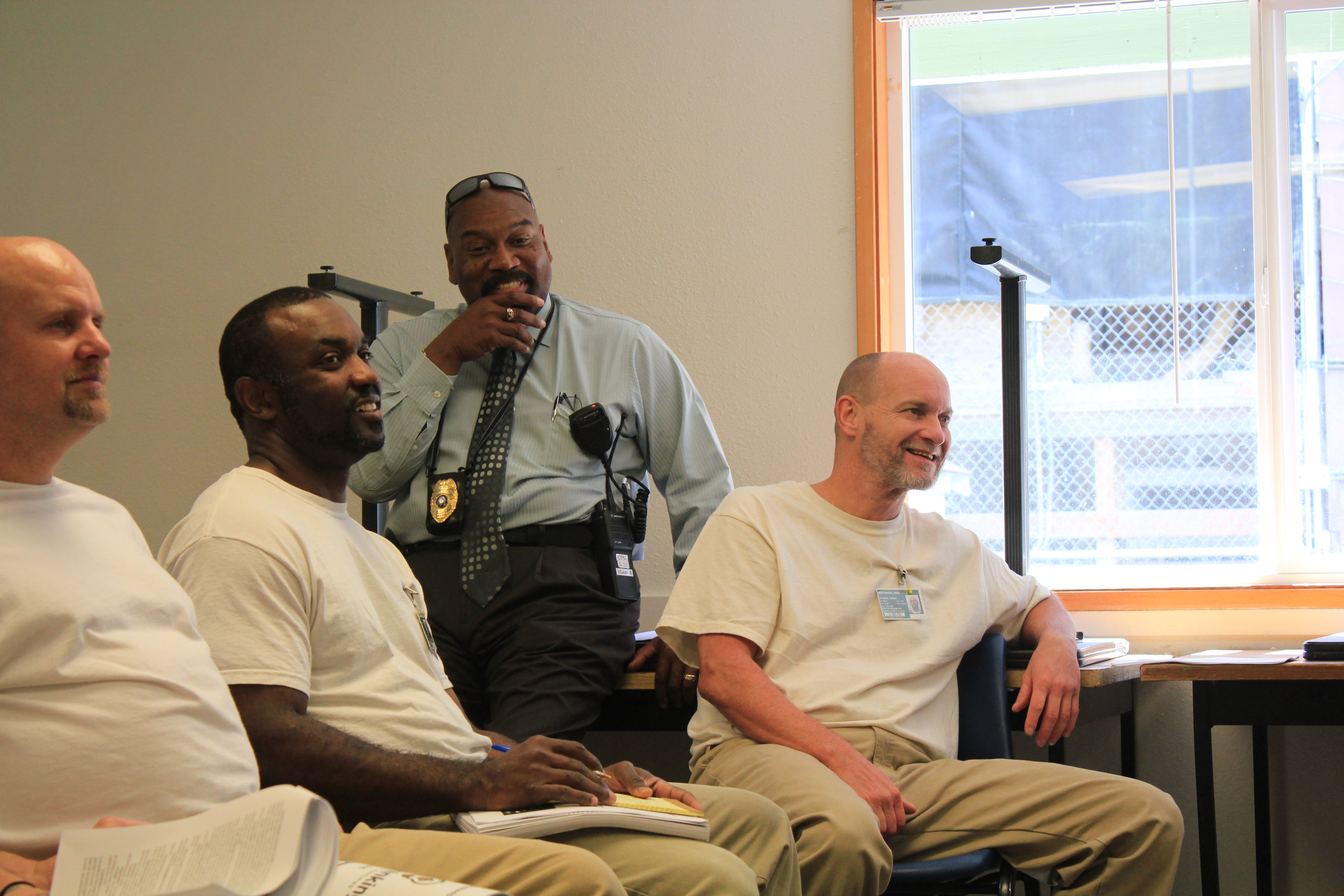
As class wraps up, students talk and laugh a little before returning back to their normal activities.
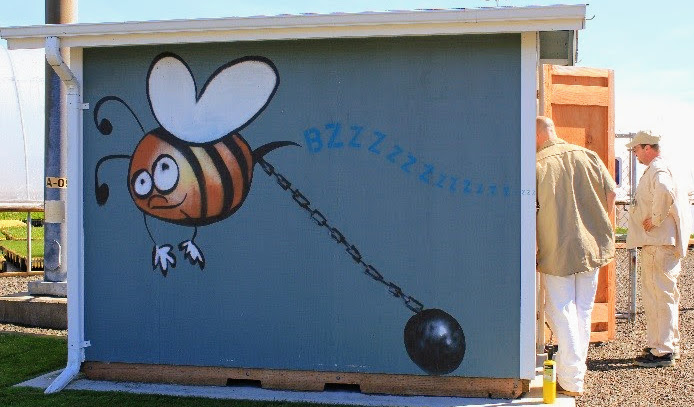
This is where the bees are housed at Stafford Creek. The inmates constructed the shelter, painted it, and made the beehives that now homes for two healthy hives.
By Bethany Shepler, SPP Green Track Coordinator
Group photo of program sponsors Jonathan Fischer and Ron Benjamin, professional beekeeper Mona Chambers, and a class of inmate beekeepers. Photo by Ricky Osborne.
Amid the razor wire and blocky buildings of the Washington State Penitentiary, you might be surprised to see beautiful blooming flowers and thousands of bees busily bumbling through their work. From catching feral swarms, to breeding their own queens, the beekeeping program at Washington State Penitentiary (WSP) has established themselves as a successful and inspirational model.
The program began about 5 years ago when three feral hives were discovered on the grounds. Some of the staff was interested in raising bees and contacted Rob Coffee, an experienced beekeeper. Unfortunately, those first few hives didn’t last the year, but still it was enough of an introduction to catch the interest of staff and inmates.
Over the years, there have been staffing changes and many generations of bees have come and gone. Rob Jackson, now Associate Superintendent, first pushed for the bee program when he noticed those feral hives on site. These days the program is run by Jonathan Fischer and Ron Benjamin, both corrections staff and experienced beekeepers. Last year, a professional beekeeper and founder of See the Bees, Mona Chambers, donated her time to come teach a class of beekeepers at WSP; since then she has kept in contact with them monthly and has supported program innovations such as natural, effective ways of mite control. The program also receives some input from the same Master beekeeper (from Millers Homestead) who supports the beekeeping program at Airway Heights Corrections Center.
A class at WSP working with bees. When asked about the beekeeping course, one student said “I love it. It’s so exciting. Honored to be a part of it, really. If they were going to transfer me next to my family, I’d tell them to wait until this was done.” Photo by Ricky Osborne.
Jonathan and Ron teach WSP’s class to certify inmates as apprentice beekeepers has 15 slots, and clearly this isn’t enough to meet demand – there were 90 inmates who wanted to take the class this year! The course is split between in-class sessions and hands-on working with hives. Their goal of the program is for inmates to gain sufficient experience and journeyman level-certification so they could teach the classes themselves. Even in the early days of the bee program, staff wanted this to be a program that inmates could be fully involved in and eventually run.
Currently, WSP has 12 healthy hives, and that’s even though only 5 made it through the winter. To boost their numbers, they catch feral swarms or buy packages of bees. The one thing that WSP won’t buy are queens—they can rely on Ron Benjamin’s experience as a commercial beekeeper in which he learned how to breed queens. By breeding their own queens, they can choose to favor certain traits and genetics beneficial to their environment.
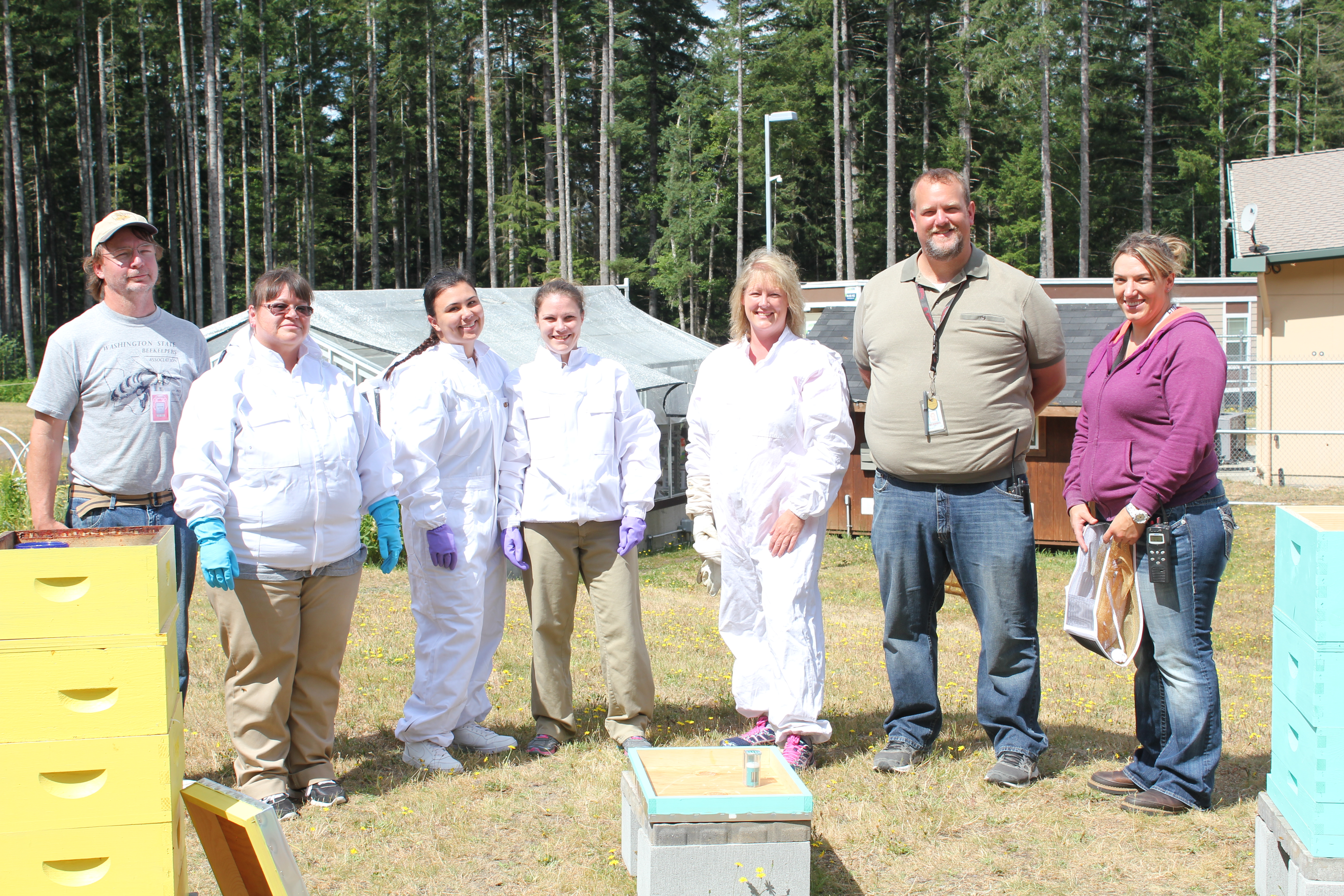
A class of students, program sponsors Jonathan Fischer and Ron Benjamin, and professional beekeeper Mona Chambers inspect the hives before opening them to check on WSP’s bees. Photo by Ricky Osborne.
The WSP beekeeping program’s main goal is to help incarcerated individuals build skills as productive members of society, but they have many other things they want to accomplish, too. They want to educate inmates and staff about the beekeeping crisis on the west coast, and do their part to reverse the bee shortage; they want to give inmates opportunity to experience the serenity that comes with beekeeping; and—above all—teach inmates a marketable skill to have when they’re released.
As the season wraps up, WSP will harvest their honey and package it in jars that are decorated in a seal designed by this years’ graduated beekeepers. Once they finish harvesting, they will begin to wind down for the winter. We at SPP look forward to more continued success and inspiration from the busy beekeepers of WSP.
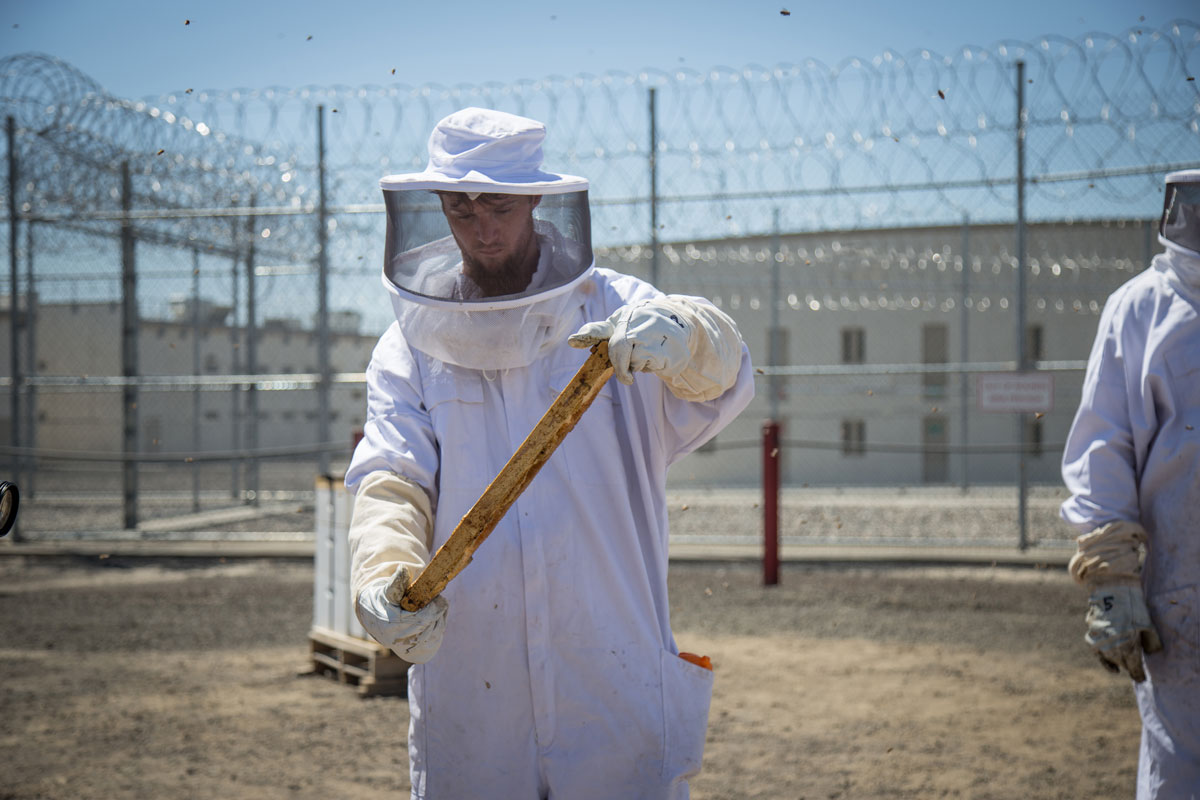
An inmate beekeeper inspects a frame outside of a hive at WSP. Photo by Ricky Osborne.
Photos and text by Emily Passarelli, SPP Green Track Coordinator
A special congratulations to Mission Creek Corrections Center for Women! This past Wednesday, they received two live hives donated with help from West Sound Beekeepers Association instructor, George Purkett. George is currently teaching 5 incarcerated individuals how to become beekeepers. I was present to see the first time the new beekeepers inspected the hives. They PET HONEYBEES (yeah, actually pet bees with a bare hand!), checked for mites (thankfully, no mites), and labeled the queens with a special marker. The photo gallery tells more of the story!
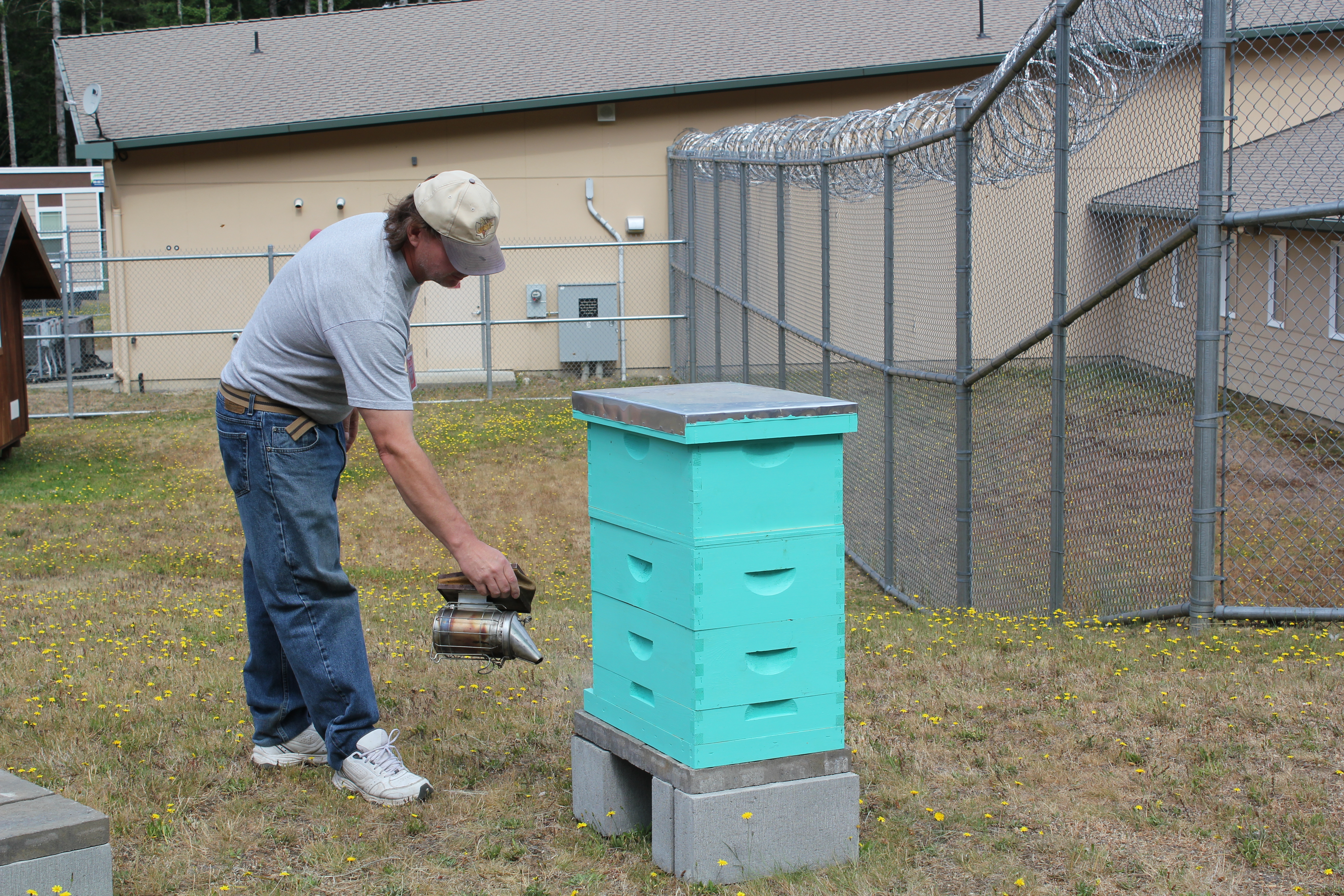
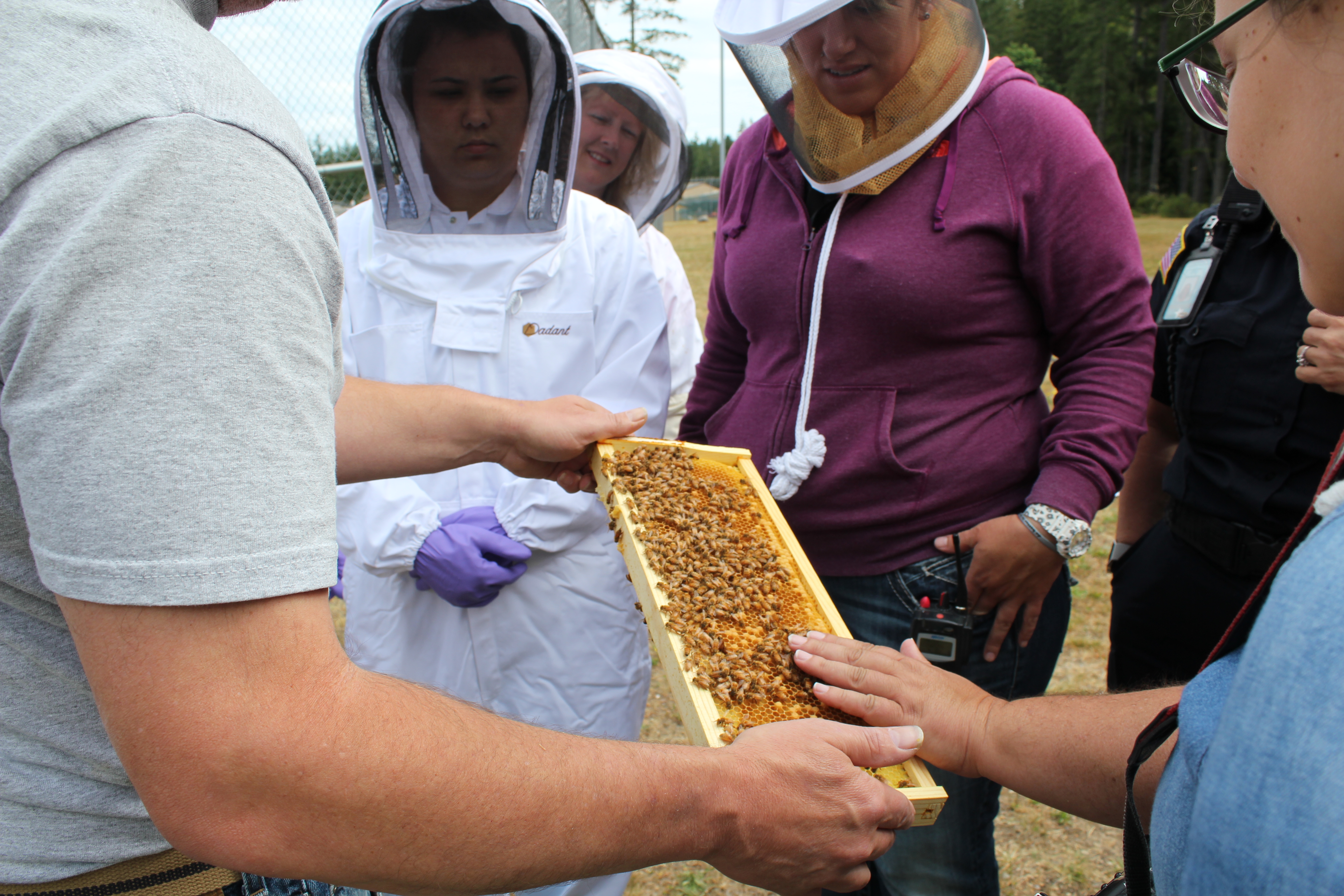
West Plains Beekeeper George Purkett uses the smokers to calm the bees before opening the hive.
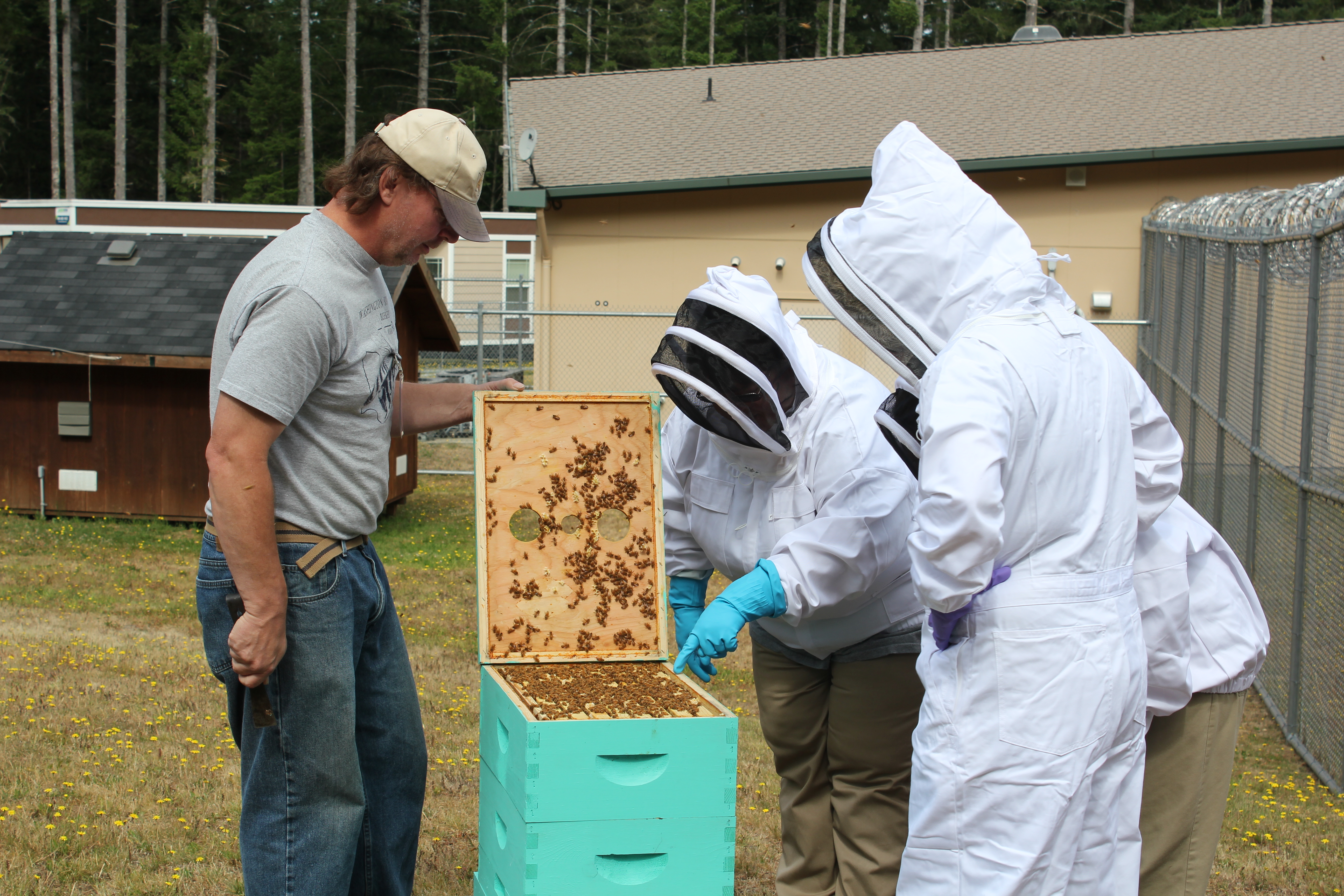
Beekeeper George Purkett quizzes the incarcerated beekeepers on the health of the bees (the bees are doing great!).
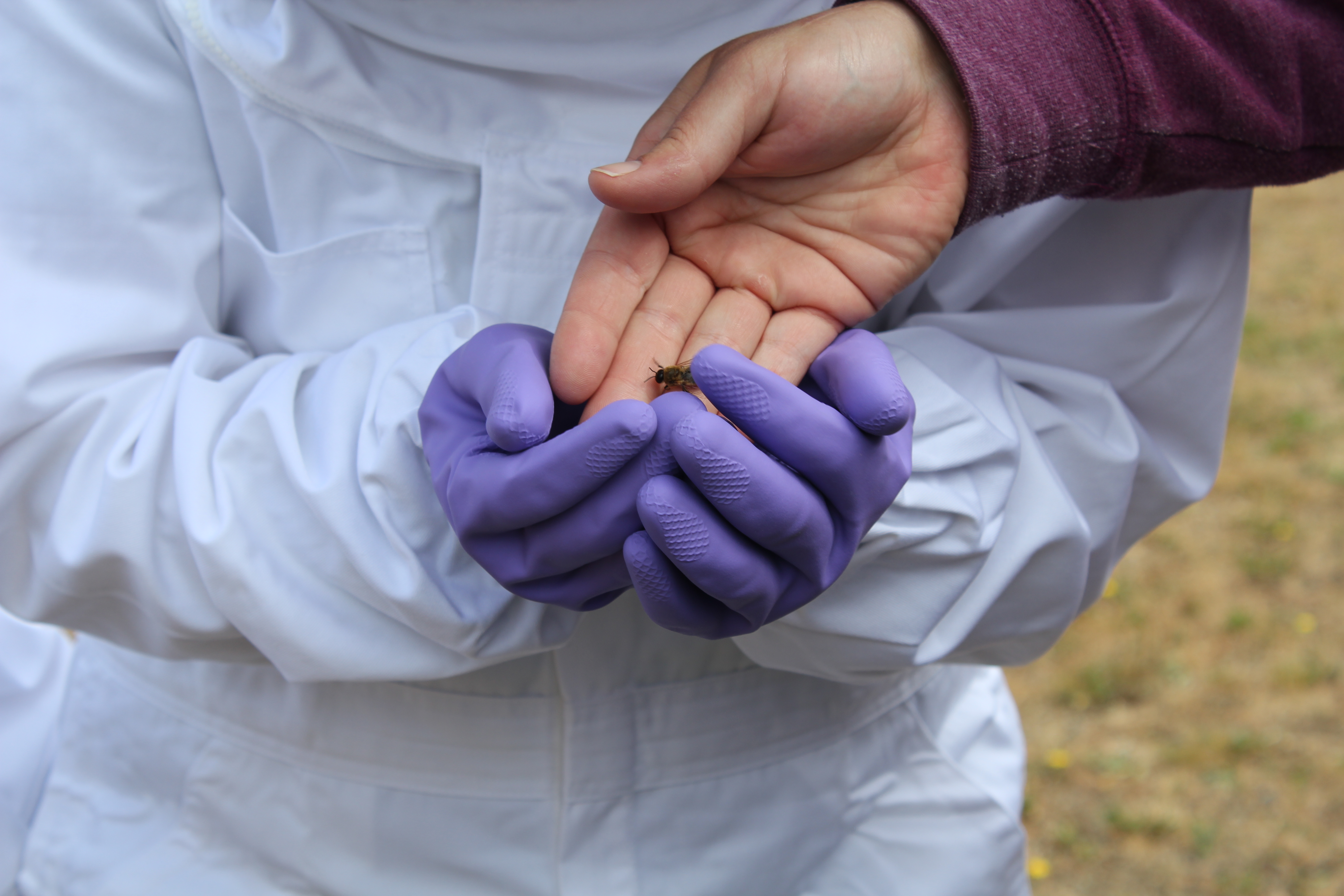
Honeybee drones don’t have stingers, so they’re safe to hold without gloves! Photo by Emily Passarelli.
Honeybees are so docile you can pet them! They were warm and fuzzy.
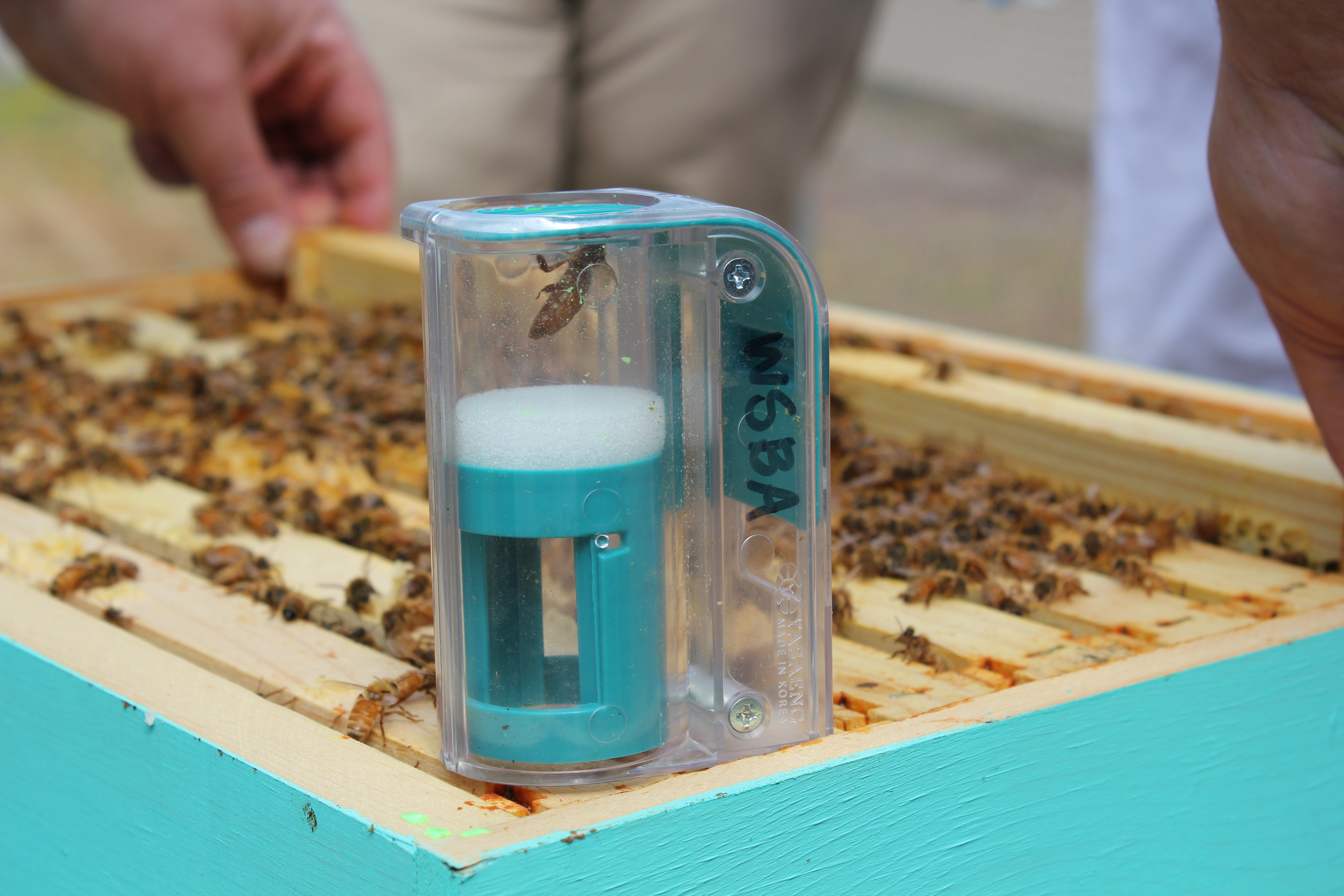
After finding the queen, Mr. Purkett marked the queen with a special marker. She had to stay in the queen bee holder until the ink marking dried.
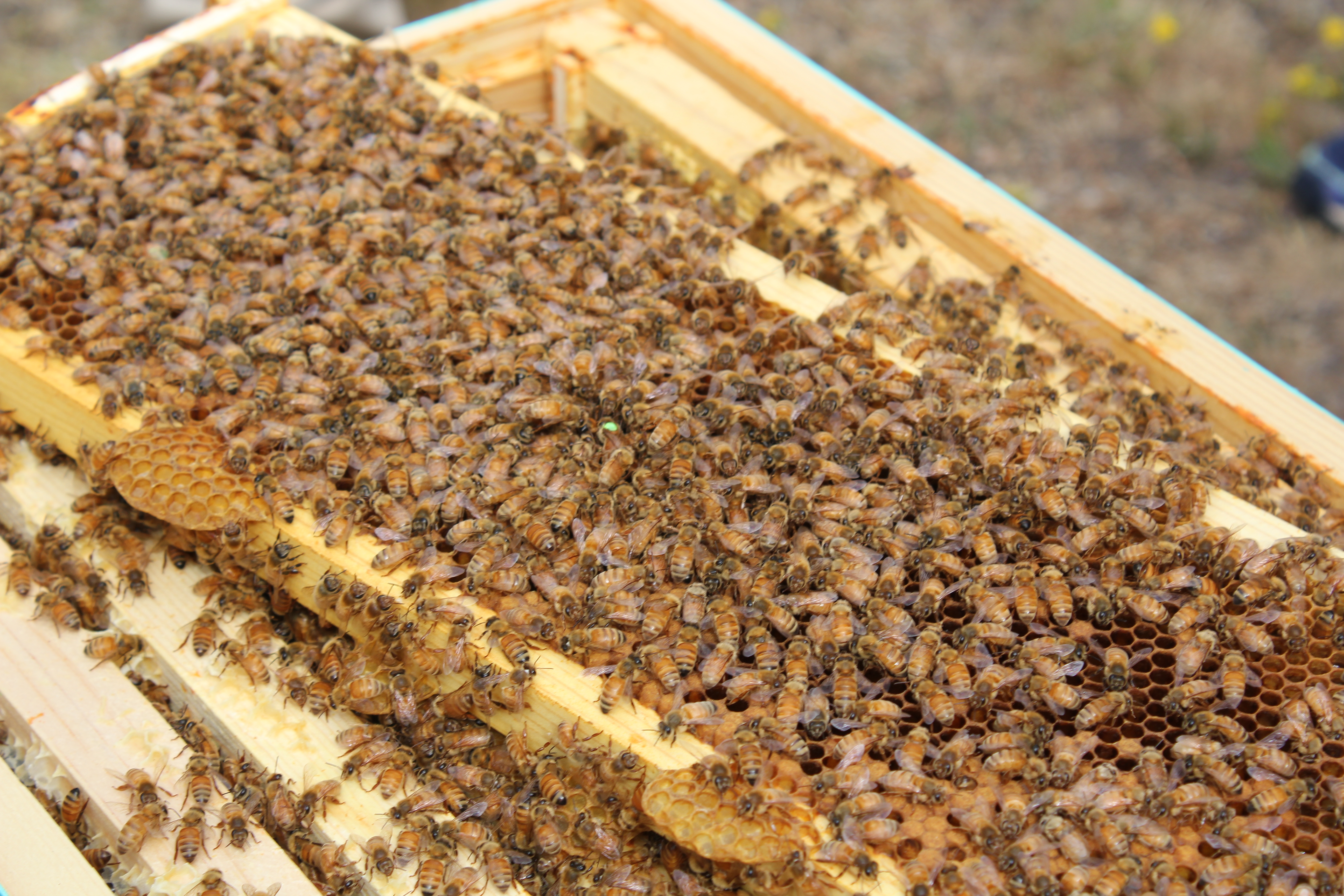
After the queen was released, the other bees surrounded her. Can you see her?
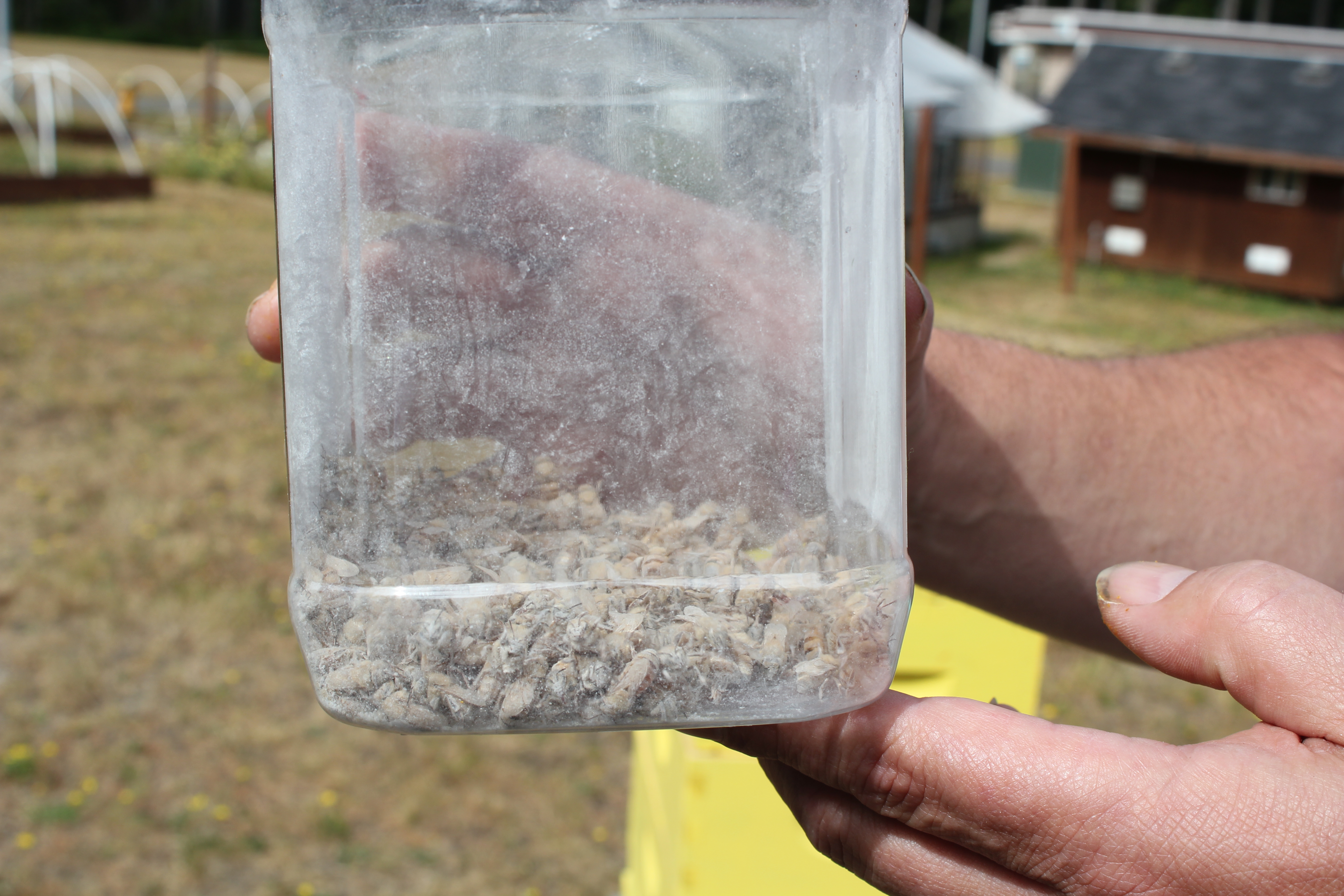
Varroa mites are one of the major honeybee killers. To test for them, George took about 200 bees and shook them with sugar. (Later, the bees enjoy cleaning and eating the sugar off their bodies!) The sugar pops the mites off. Thankfully, this hive is clean from mites!
Congrats to the newly certified staff and incarcerated beekeepers!
Text and photos by Emily Passarelli, SPP Green Track Program Coordinator
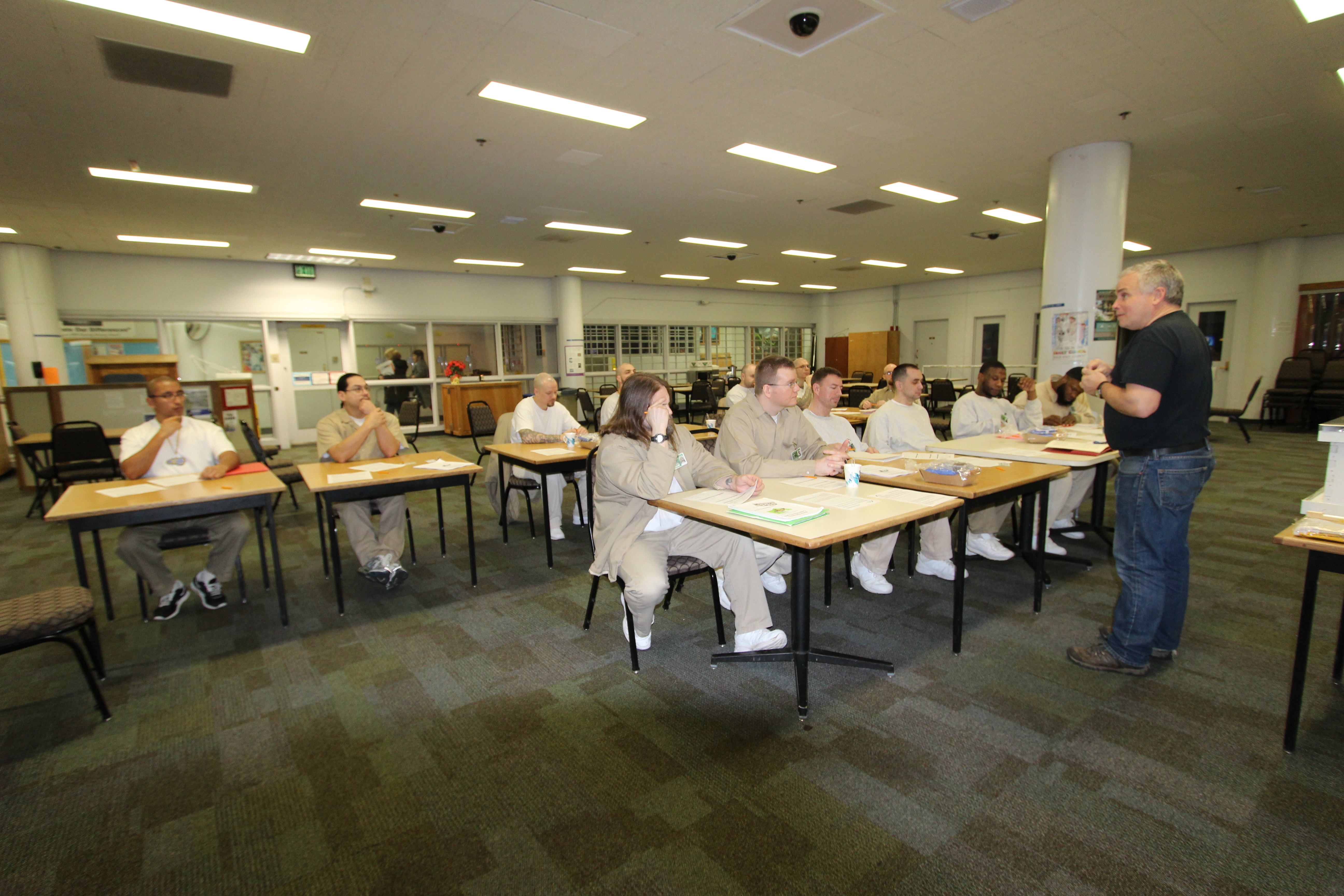
Mark Urnes taught a two-day intensive class to 12 incarcerated individuals. I had the pleasure of sitting in on Mark’s class in March and impressive is an understatement! Students took a series of 10 tests over two days to become certified as Apprentice Level Beekeepers. However, to prepare for the two-day intensive class, the students studied hard for months with the support of Corrections Officer Faye Nicholas. They brought excellent questions to the class and every student passed the required tests. CBCC is expecting to have bees for them to take care of by late April!
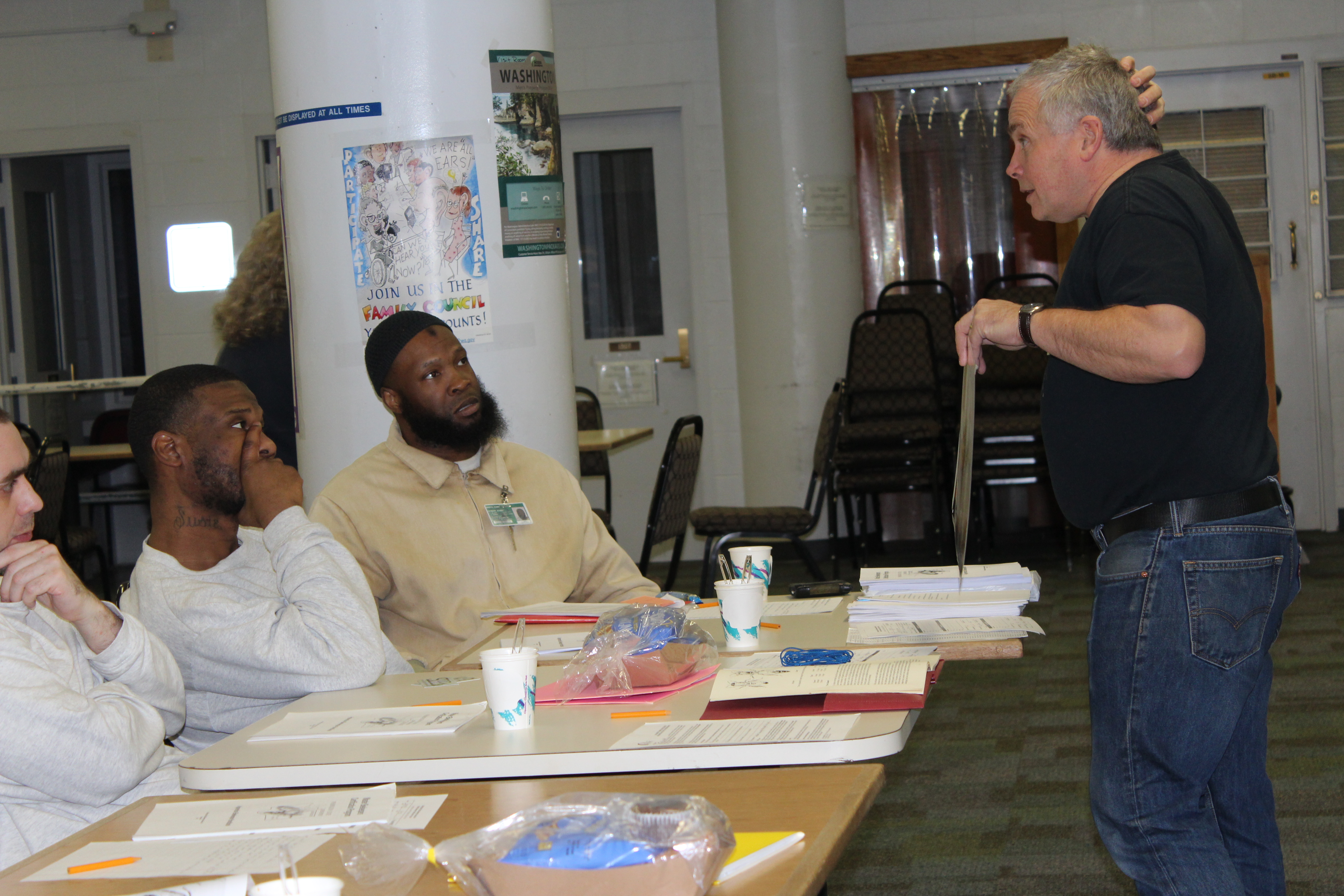
A student asking Mark Urnes a beekeeping question.
Special thanks to Mark Urnes for his generosity and for sharing his time and knowledge. Also to Faye Nicholas for making beekeeping at Clallam Bay possible. Thank you both for everything you do!
Lastly, CONGRATULATIONS to the first CBCC Beekeeping Class!
Text by Dr. Jody Becker Green, Acting Secretary, Washington State Department of Corrections, and Joslyn Rose Trivett, SPP Education and Outreach Manager
Photos by Ricky Osborne
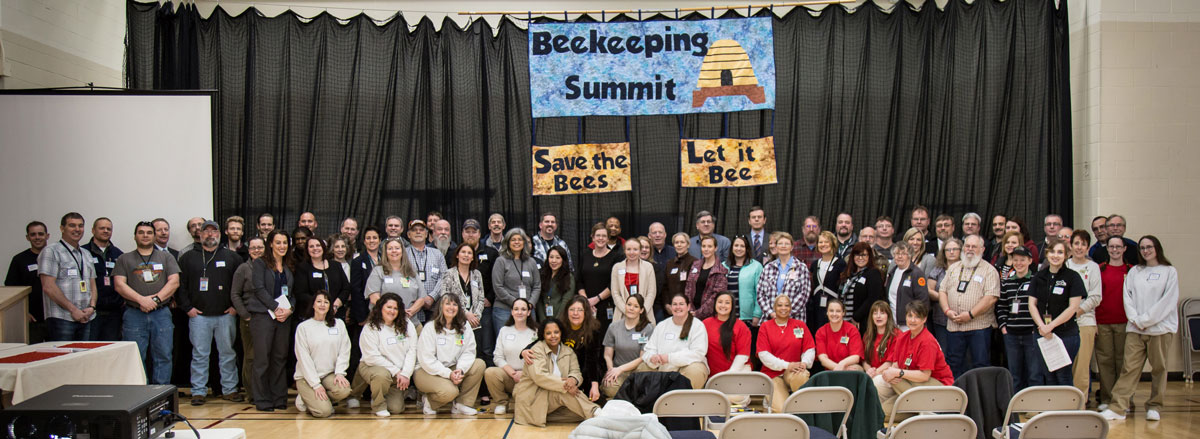
Between sessions, Bee Summit participants posed for a group photo.Superintendent Dona Zavislan welcomed the summit guests to Washington Corrections Center for Women (WCCW).
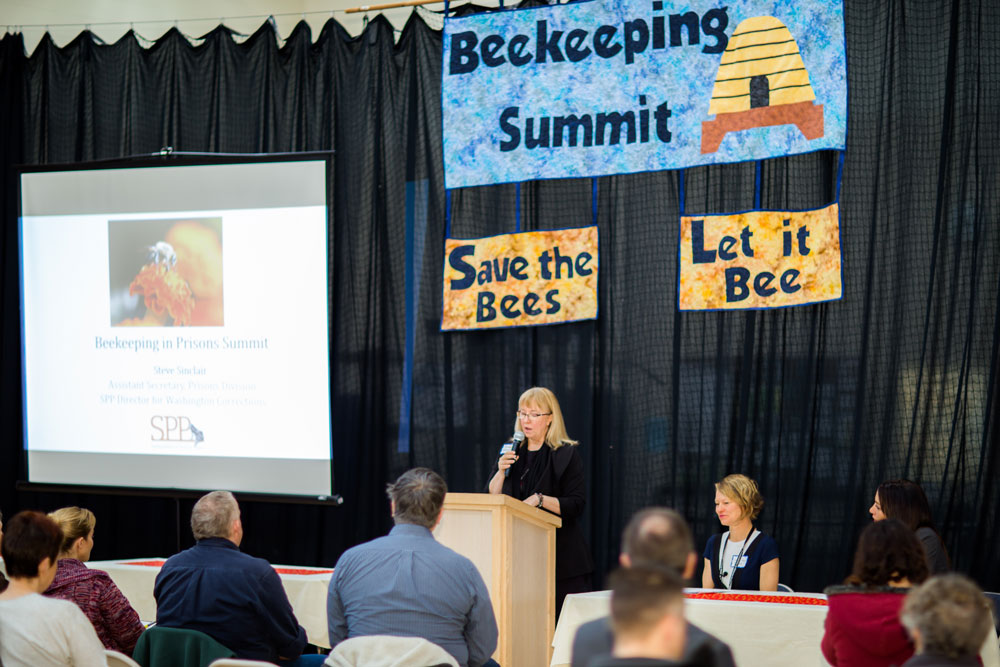
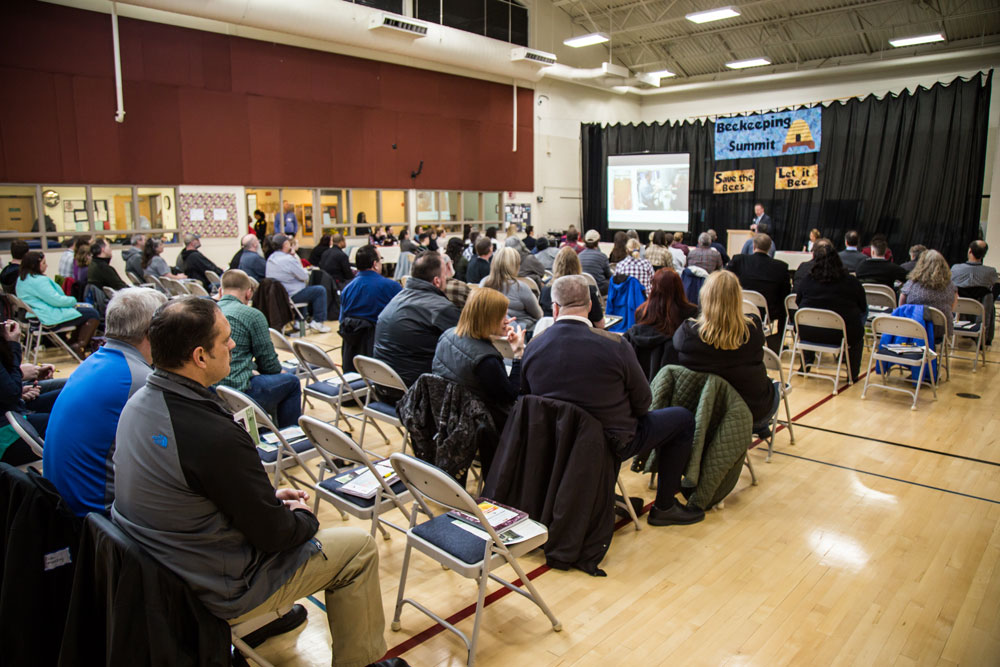
On Friday March 3, SPP partners filled the gymnasium at Washington Corrections Center for Women for a summit on beekeeping programs in prisons. About 125 expert, apprentice, and novice beekeepers spent the day sharing best practices for rebuilding pollinator populations. We also shared the delights of working with honeybees and other pollinators; these social insects and plant-pollinator relationships served as lovely metaphors for productivity and mutual support.
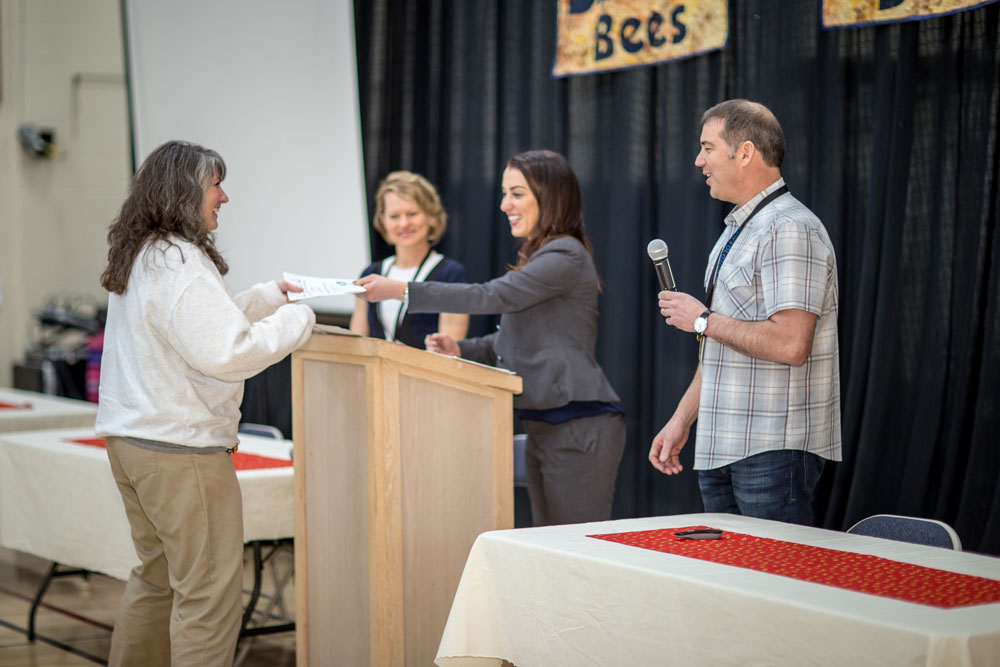
During the summit, eight beekeeping students received their apprentice-level certification. The host prison offers beekeeping education within the Horticulture program taught by Ed Tharp (pictured with microphone), and as a complementary program instructed by Carrie Little, the founder of Mother Earth Farm. The apprentice beekeeper shown is Candace Ralston.
The agenda was packed, and covered everything from equipment safety to food justice to native pollinator habitat needs. Other highlights are described in photos throughout this article.
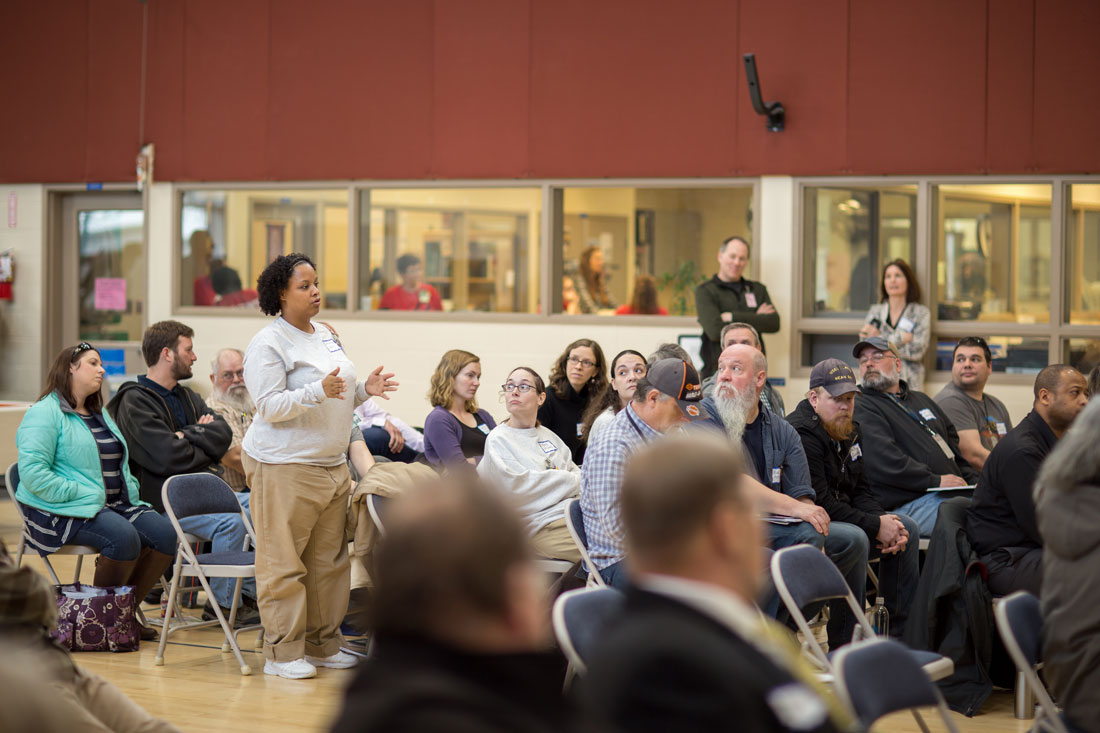
Lonniesha Veasey, an incarcerated beekeeper and Horticulture Teaching Assistant, shares her thoughts and questions during the summit.
The day ended with spring rain pounding on the gymnasium roof, and generous outpourings from incarcerated beekeepers, expert beekeepers, and leadership from the Washington State’s Department of Corrections (WA Corrections). Anticipating release in just a few days, an incarcerated woman reflected on her years in prison: she said that horticulture programs had become her reason to get up in the morning, and meant that she now has plans for her future. SPP’s co-director Steve Sinclair praised the event, and said, “We invited magical people here, so let’s go make magic!” A Massachusetts beekeeper, Susan Goldwitz, told the group that we are like bees, turning dust into sweet, liquid gold.
Staff came from all 12 WA Corrections’ prisons, and were joined by experienced beekeepers from across the state, incarcerated beekeepers, SPP-Evergreen staff and students, biologists, and other community partners and topic experts.
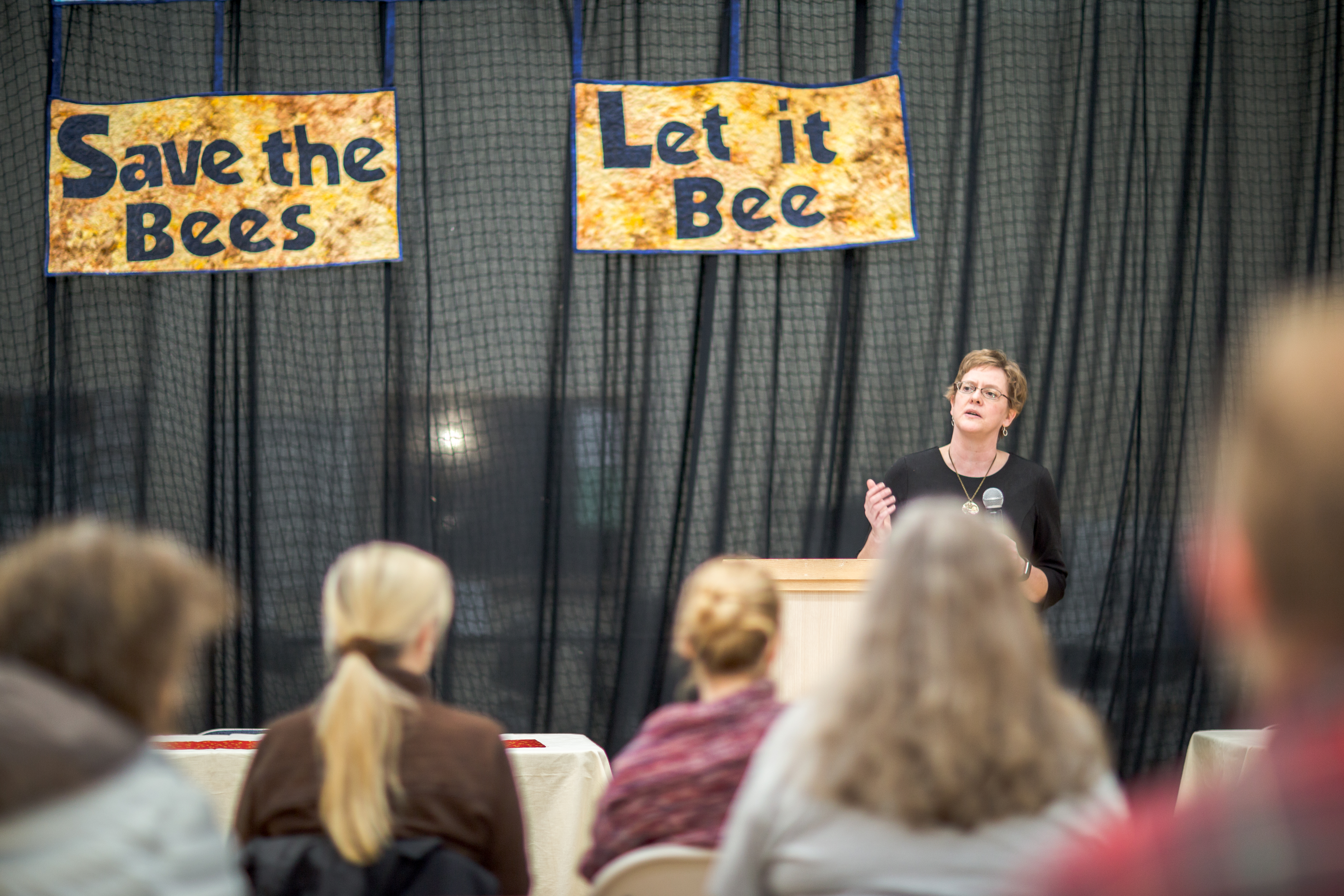
The current head of WA Corrections, Jody Becker-Green, gave final remarks. She thanked everyone in the room for the part they played in the summit, and in developing and offering pollinator programs in prisons. She described her own love of beekeeping, and the feeling in the room while she spoke was transcendent. An excerpt is offered here.
I am probably the last person you want up here doing closing remarks for this summit because I could talk about bees and beekeeping for hours!
I offer my deepest gratitude and appreciation to all of you, for the travel and schedule coordination it took to give a day to this event. Your generosity of time and spirit is remarkable. The only way programs like these are possible is through the many contributions each of you is willing to make. The fact that you keep showing up with your ideas, optimism, and creativity is an incredible gift to the prison community, and to the communities beyond the fence as well.
Acting Secretary Dr. Jody Becker-Green shared love for honeybees—their many impressive and amazing attributes—and brought a beautiful closing to the day’s events.
As we have learned today, bees are quite simply amazing creatures, whether they are the little solitary bees, living their relatively simple lives, or honeybees, thriving in incredibly complex, interwoven and democratic societal structures.
Next to humans, honeybees are perhaps the most widely studied creatures in nature. Throughout the years, research has demonstrated that a honeybee colony is instinctively able to organize itself into a super-efficient society. Honeybee colonies provide profound lessons in democracy, communication, teamwork, and decision-making that we may all be wise to learn from. I know that I have learned a lot from watching and studying the bees that make their home on my property and try to apply those lessons to leading a complex agency.
One of my favorite books, Honeybee Democracy, written by Thomas D. Seeley, describes how honeybee colonies make decisions both collectively and democratically. Seeley says that every year, faced with the life or death problems of choosing and traveling to a new home, honeybees stake everything on a process that includes collective fact-finding, vigorous debate and consensus building. The level of sophistication, communication, trust and connection that occurs within a hive is almost hard to comprehend.
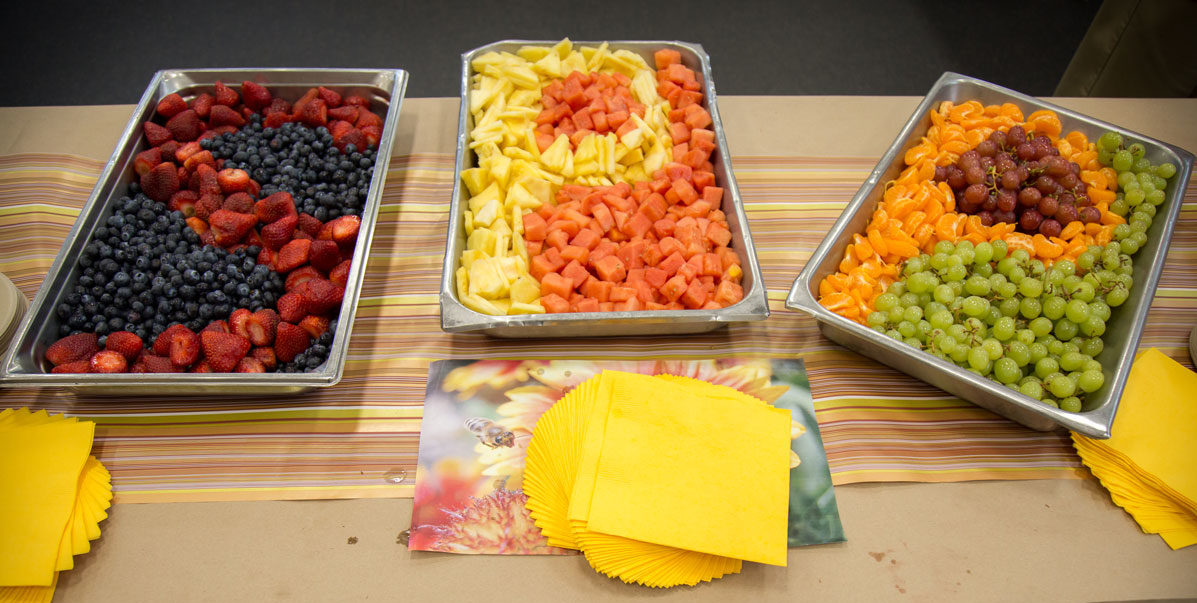
Fruit trays spelled out SPP appreciation and, so fittingly, displayed fruits that rely on pollinators for reproduction. The summit was well supported by WCCWs event crew and staff members who provided a delicious and gorgeous spread of snacks, and decorated the gymnasium with flowers and banners.
My love for bees began about eight years ago after making a visit to Cedar Creek Corrections Center (CCCC). At the time, I was working for the Department of Social and Health Services and was interested in learning more about the sustainability efforts underway within the Department of Corrections. After spending a great deal of time with the beekeepers at CCCC, I was hooked. It was only a matter of months before I become a beekeeper and achieved my certification.
Throughout the years, bees have become highly symbolic for me. I have found a much deeper meaning in the art of beekeeping beyond the ecological value they have in sustaining our ecosystems. Let me share just a few examples of this meaning with you.
Bees enter the world with distinct roles and commitment to the greater good. The spirit of the bee has a strong work ethic as they literally will work themselves to death, however, they also know the importance of stopping to smell and enjoy the flowers —they are able to find the delicate balance between the two. With competing demands and priorities balance between work and life, balance is not always easy to attain and maintain. I constantly remind myself and others of the importance of balance for overall personal and professional health and well-being in order to be the best version of self in all that we do.
Bees play a very specific role in nature pollinating other plants. This is necessary to the on-going life cycle of many crops. An end result of pollination is the provision of honey and wax that is enjoyed by many, thus adding to their value. Einstein believed so deeply in the importance of bees to the ecosystem that he predicted if bees disappeared humans would not survive more than four years afterward.
The pollination process also symbolizes our social nature of interdependency and mutual benefit. Bees live and work as a community. As they go from flower to flower, that progression enriches the world.
SPP Co-Director Steve Sinclair acknowledges the composting crew at Washington State Reformatory as an example of the creativity and excellence achievable in a program.
Bees work with a spirit of cooperation, working cohesively for the good of their community. They show us the importance of both teamwork and communication in their day-to-day lives.
Bees are also strong protectors and defenders of that which is important to them. They are willing to give their life in defense of whatever mission prevails. As humans, we are anchored in core values and beliefs and will also defend that which we hold to be true in our words, actions and deeds.
Finally, while bees struggle with daunting environmental challenges, they show us about perseverance and resiliency. They support each other to overcome adversities, and it is that bravery, trust, and effort, that makes us—and much of the life on earth—able to depend on them.
Most of the funding for the event came from a generous donation from the Seattle Foundation to partners at The Evergreen State College. The Seattle Foundation has supported SPP annually for multiple years, and their support has made a real difference in what programs are able to achieve.
Numerous partners helped make the event a success. From left to right: Evergreen graduate students covered presentation IT and note taking; WCCW’s event crew (red t-shirts) were our logistical hosts, ran the sound system, and made the space beautiful and functional; Felice Davis and Joslyn Rose Trivett MC’ed and coordinated the program, and Jeremy Barclay worked with KOMO 4 to produce a video about the summit.
More coverage of the summit and beekeeping in prisons programs:
Partner Andrew Satterlee’s recent article in Corrections Today
Three expert and influential beekeepers share a moment at the conference. Beekeeping associations have given essential support to prison programs, and tell us that incarcerated beekeepers are invaluable to pollinator recovery in the state. From left to right: Gary Clueit, President of Washington State Beekeepers Assocation (WASBA); Laurie Pyne, Master Beekeeper and President of Olympia Beekeepers Association; and Ellen Miller, Vice President of WASBA.
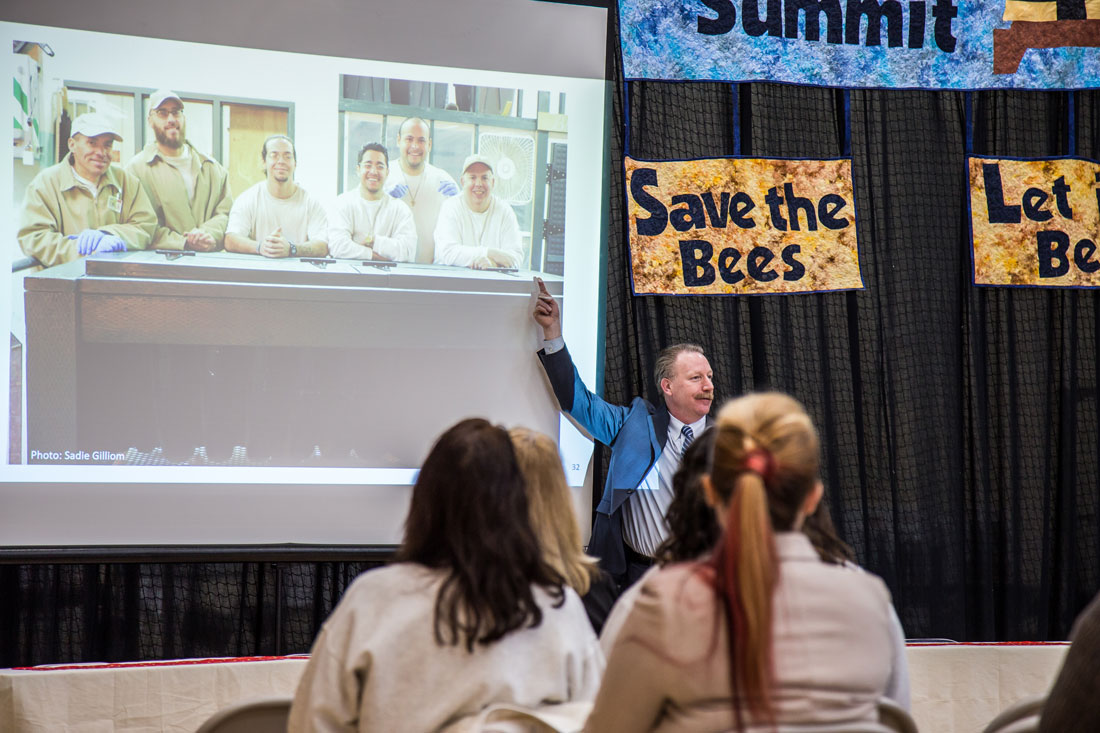
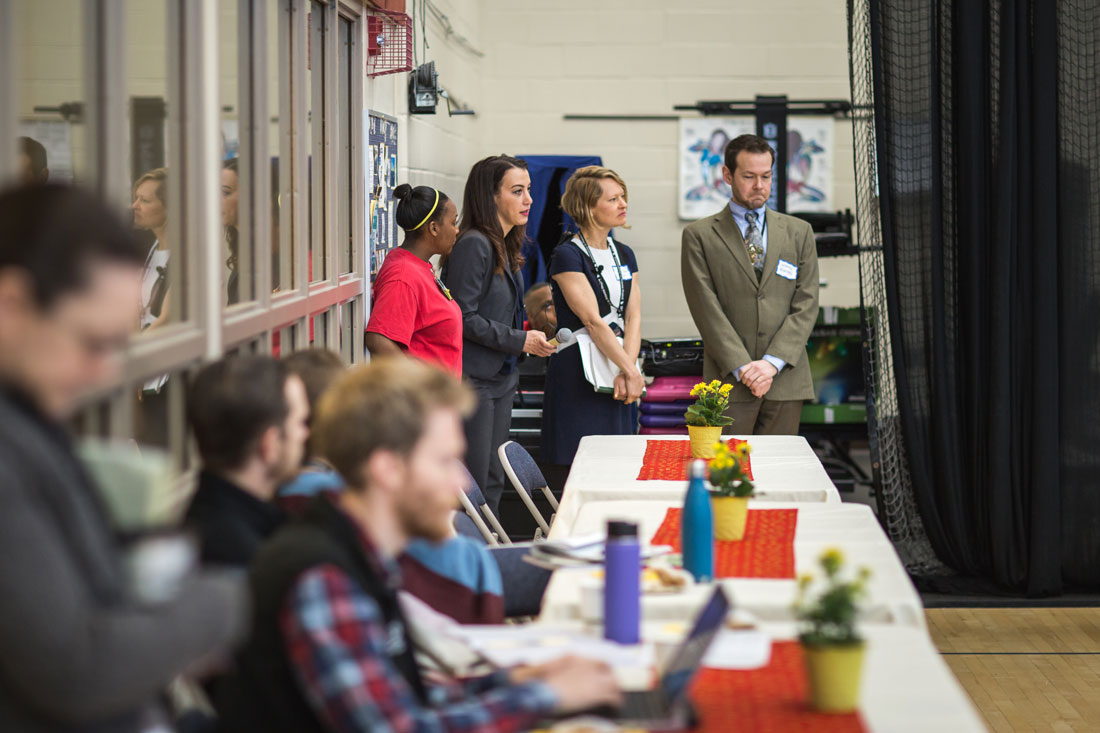
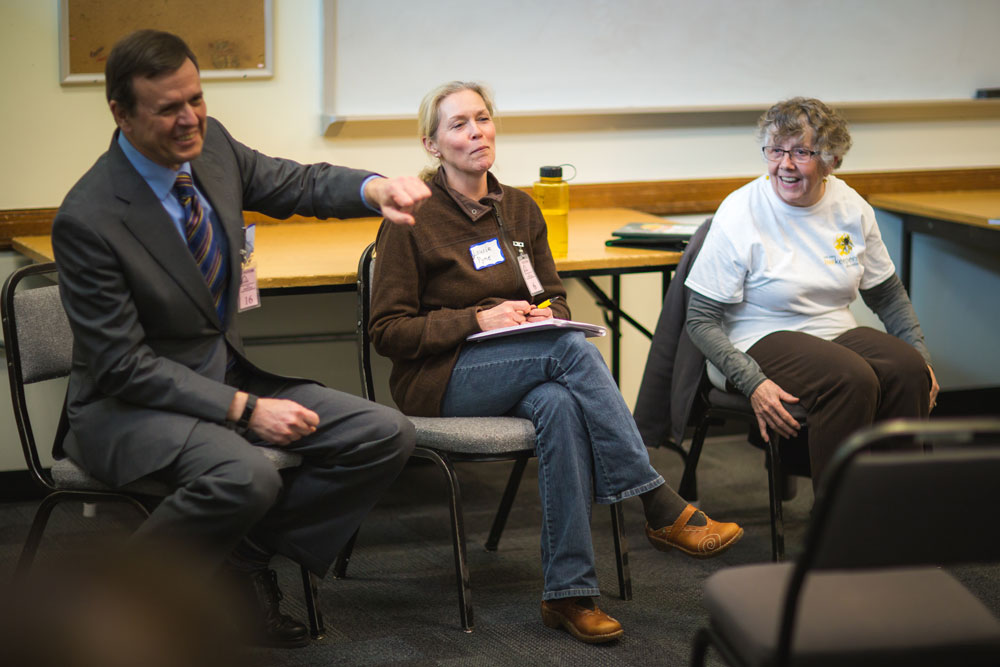
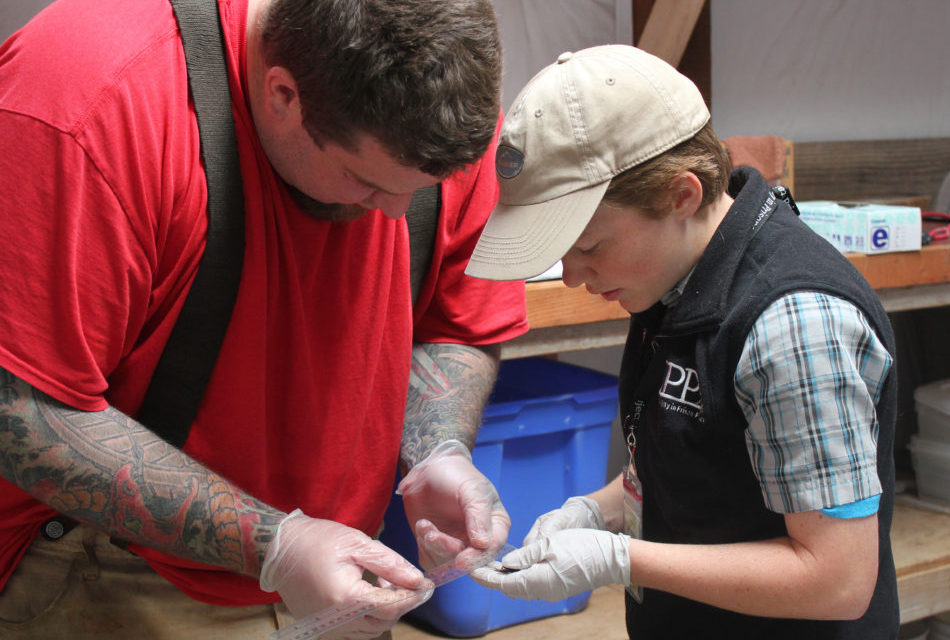
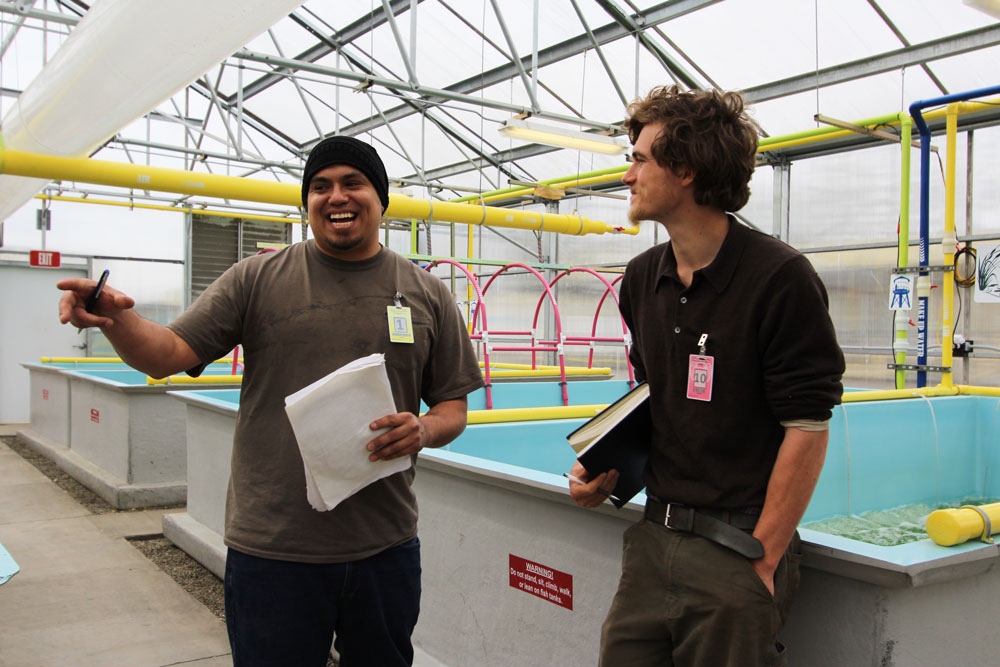
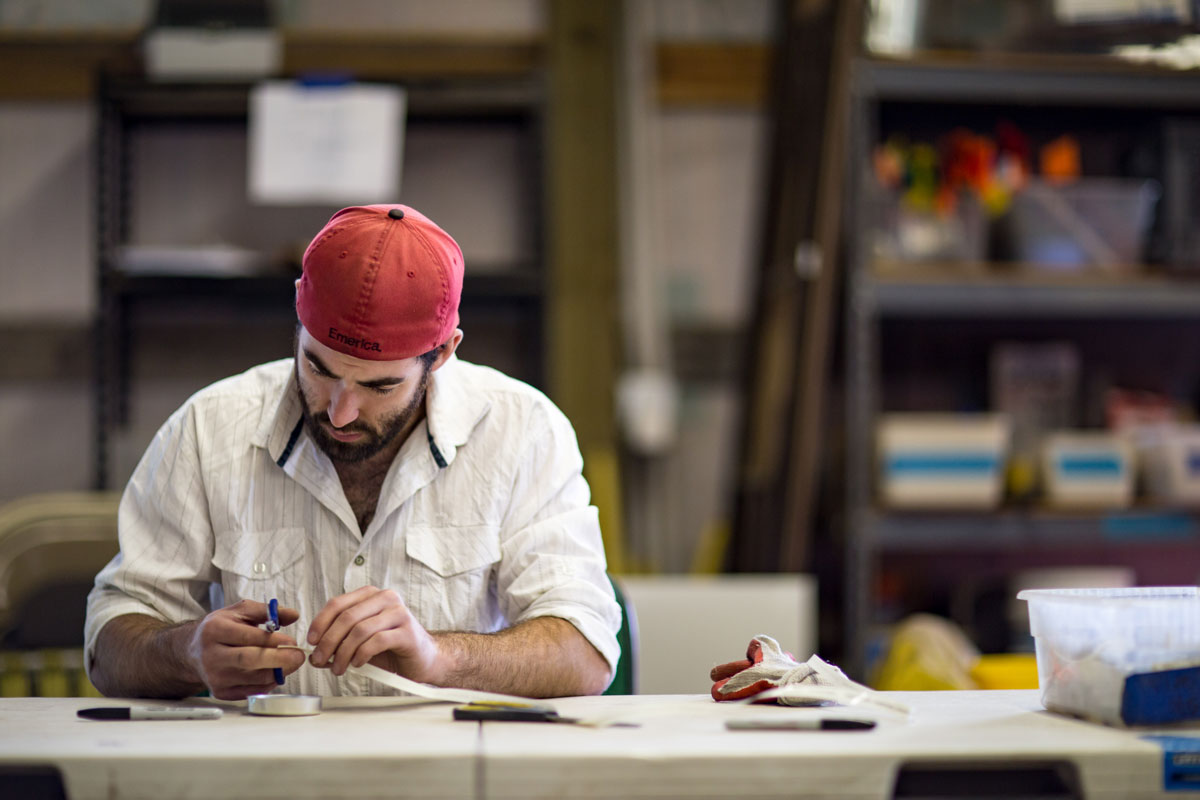
Photos clockwise from the top left: Sadie Gilliom (ball cap), Ricky Johnson, Daniel Cherniske, Conrad Ely, and Lindsey Hamilton working in prisons. Photo of Conrad by Ricky Osborne.
By Joslyn Rose Trivett, SPP Education and Outreach Manager
Our winter newsletter is about the many, wonderful students who work for the Sustainability in Prisons Project (SPP). SPP could not be what it is without them.
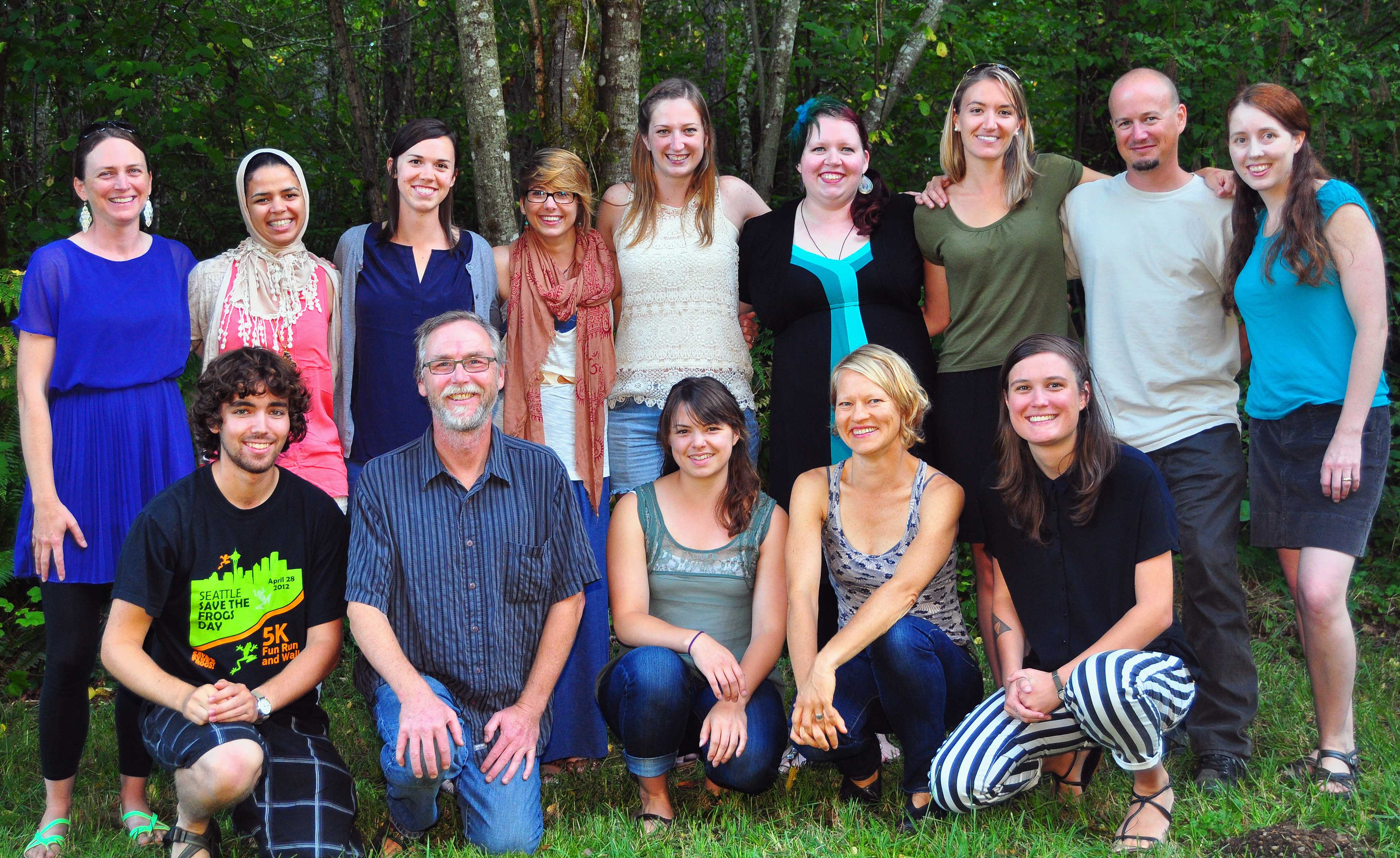
SPP-Evergreen team, 2011. Unknown photographer.
SPP’s founding director at The Evergreen State College hired graduate students to support prison programs beginning in 2008; that was when SPP was gaining traction as a more formal effort, and was growing in scale and scope (more about history here). At first, the workload demanded just one or two students at a time, and those individuals worked broadly—for multiple programs—to build partnerships and disseminate results. Over time, the number and complexity of programs being coordinated by SPP-Evergreen increased resulting in the current model: a student coordinating each Ecological Conservation and environmental education program.
SPP-Evergreen graduation party, 2013. Photo by Tony Bush.
We rely on student-staff Program Coordinators in myriad ways. They are the ones most often going into the prisons. They serve as the face of a program, and the leads for communicating details—large and small—that are part of the program’s successes. They continually add to the educational breadth of each program in many forms: formal presentations, seminars on scientific papers, hosting a partner-scientist’s visit, recommending readings, and countless conversations about programs’ plans, impacts, and larger context. Students also study SPP programs; they help track and evaluate the quality of each program, and ten have conducted formal research on SPP topics (a few examples here). Each student brings a unique perspective to SPP, and our programs are enriched by their energies and cutting-edge ideas.
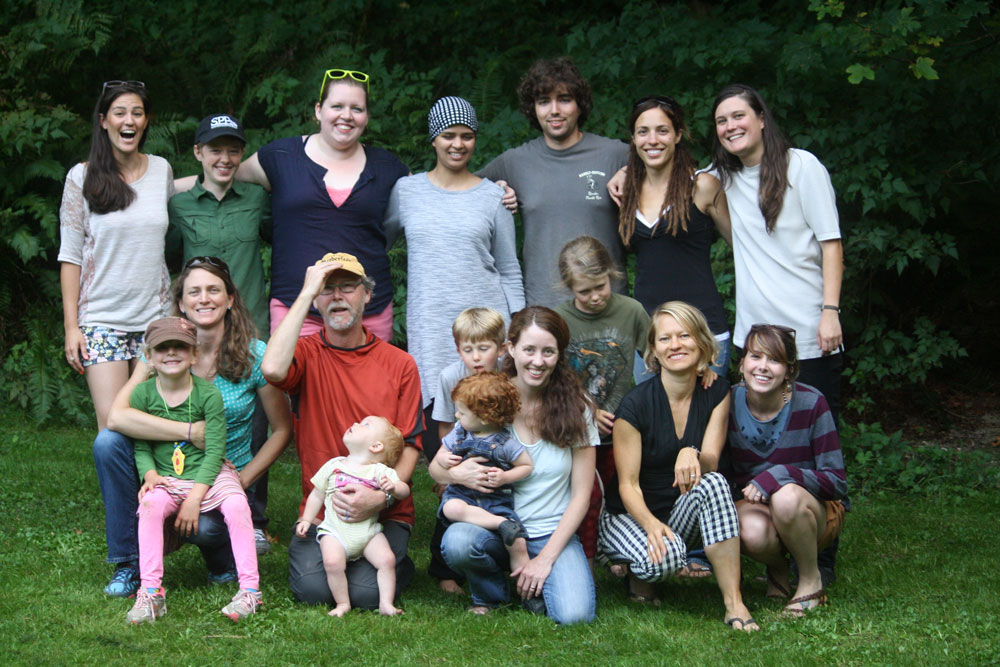
Graduation brings an end to student-staff employment. Each coordinator trains their successor, which is as much about introducing them to the culture and ways of thinking as it is about program policy and protocols. Each turnover is bittersweet. We have to say good-bye to someone we have relied on and invested in, and it is painful to see them go.! At the same time, we get to welcome someone new, and their fresh perspectives helps SPP to continually improve; we can’t get stale! Also, there is the satisfaction of seeing SPP alumni go on to new and valuable endeavors, and we take pride in supporting their ongoing careers and aspirations.
Choosing just a few students to highlight in this newsletter means not highlighting most, and that is hard to do. Thirty-eight Evergreen students have worked for SPP so far. All have brought something important and enduring to our programs. You may learn more about most of them on our staff page. We hope that the following articles will serve to illustrate the range and diversity of their character, expertise, and strengths. These are wonderful humans, and it is such a pleasure to celebrate them!
DOC staff, Evergreen staff, and student-staff pose following a successful frog release, October, 2015. Photo by Woodland Park Zoo staff.
By Emily Passarelli, SPP Green Track Coordinator, and Joslyn Rose Trivett, SPP Education and Outreach Manager
A WSP Beekeeper gets geared up and ready to check on the hives. Photo by Ricky Osborne.
You might think that beekeeping in prisons is a nice idea, but not a big idea: maybe it’s a small, fanciful project that would crop up here or there. Not the case!
In Washington State prisons alone, we already have seven beekeeping programs up and running, and at least three more are in the works. Beekeeping is also in the prison at Joint Base Lewis-McChord, and many corrections facilities nationwide, including Georgia, Maryland, Illinois, Oregon,Florida, Nebraska, and LA County. Beekeeping programs can also be found in foreign prisons like England, New Zealand, Italy, and France. We’ve been contacted by prisons interested in beekeeping in Massachusetts, Albania, and Canada!
Three Maryland facilities host honeybee programs to provide training for inmates and boost the local population of pollinators. These hives are at Maryland Correctional Institution for Women. Photo by Anthony DePanise of Maryland Department of Public Safety and Correctional Services.
Outside of prison, reentry programs, like Sweet Beginnings in Chicago, offer meaningful work experience. The founding executive director of Sweet Beginnings, Brenda Palms Barber, found that “Fewer than 4% of Sweet Beginnings participants go back into the criminal justice system, compared with the national average of more than 65% and the Illinois average of 55%.” How amazing is that?
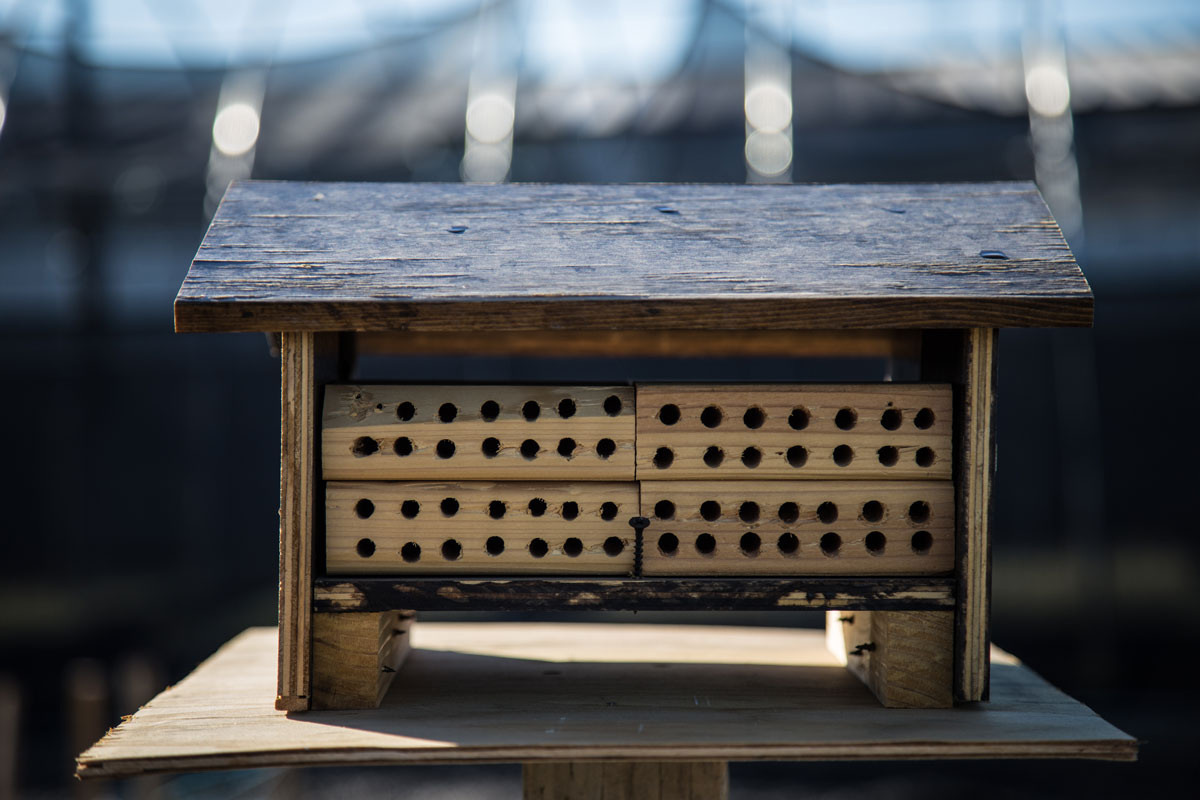
Adding to the honeybee focus are countless prison gardens that are accessible to many types of pollinators: beds of flowers and herbs, small-scale vegetable production, and full-scale farms. Corrections facilities typically don’t use any chemical pesticides, so don’t contain the systemic poisons that threaten foraging pollinators; prison plantings are helping to rebuild pollinator habitat by offering a safe food supply. Some prisons add habitat structures for native pollinators, such as mason bee boxes at Coyote Ridge Corrections Center (see photo) and a literal-log delivered to the retention pond at Airway Heights Corrections Center.
A home for mason bees, a native pollinator, at Coyote Ridge Corrections Center. Photo by Ricky Osborne.
These programs tap into the many therapeutic benefits of working with nature, which has been widely documented in scientific research. Working with honeybees is particularly soothing; it’s impossible to get good results with bees without calming down. Both inmates and staff sorely need relief from prison stresses, and nature programs can be a place of refuge and recharge.
Also these programs provide a way for inmates to “give back ” to communities and the environment. In recent decades, pollinators have been dying at a frightening rate, putting our food sources in jeopardy: we depend on pollinators for more than 30% of human food and drink. Generally, nearly all plants with flowers need pollinators; 85% depend on insects for their reproduction! We need healthy hives to conserve and restore bee populations. In 2015, pollinator health was declared a national priority; as a hobby or career, beekeeping is has societal recognition and value. This is no fanciful endeavor—weneed bees to thrive so thatwecan thrive.
A professional beekeeper devoted her summer vacation to teaching about bees in a prison; how cool is that. Photo by Ricky Osborne.
In Washington, we are ramping up to a full-day Summit for Beekeeping in Prisons, to be hosted by Washington Corrections Center for Woman on March 3rd. More than 100 people are registered, and they will come from all 12 Washington prisons, the Evergreen State College, various non-profits and community groups, and multiple beekeeping associations, including the statewide association that oversees beekeeping certification. A major bonus of holding the summit inside a prison is that incarcerated beekeepers will be able to participate. All partners will share best practices, future prison beekeeping plans, safety ideas, community outreach plans, and pollinator health knowledge. We can’t wait to hear what great ideas and thoughts come from our many, fantastic partners!
Each program depends on partnerships among incarcerated individuals, corrections staff, and expert beekeepers. They are united in learning about and tending to something beautiful, complex, and a little bit scary…until it becomes second nature.
Written by SPP Liaison and Classification Counselor Shawn Piliponis.
Larch Staff and students enjoying the Bee Thinking lecture. Photo by Emily Passarelli.
Inmates and staff who participated were genuinely interested in learning about bees and beekeeping, but were understandably concerned about the potential of being stung by bees. Rebekah Golden and Gabriel Quitslund from Bee Thinking in Portland, Oregon, taught how bee colonies work, which alleviated a lot of the initial fear, and those who participated walked away feeling more educated and comfortable about LCC’s new beekeeping program.
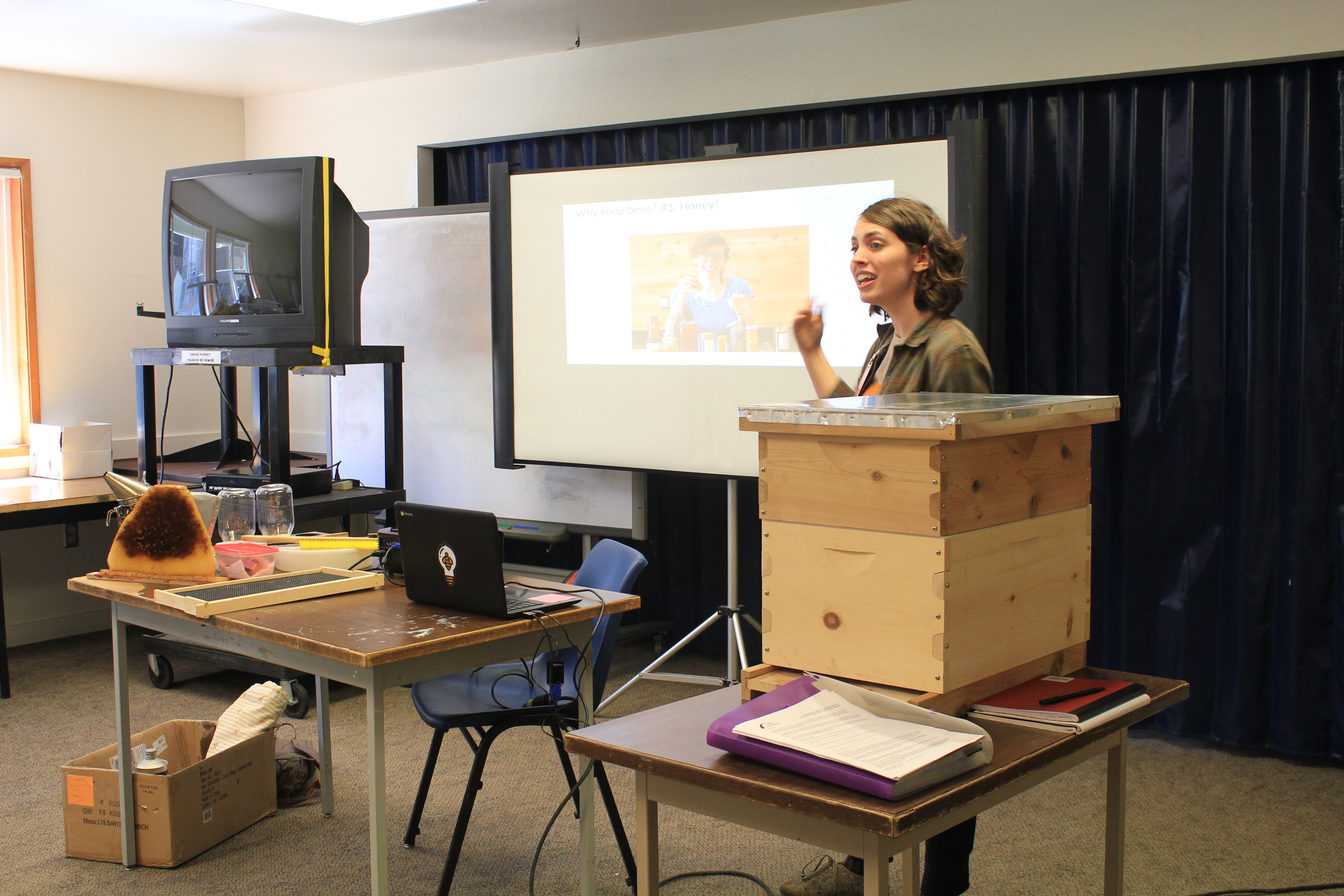
Bee Thinking’s Rebekah Golden teaches a class of staff and incarcerated students about beekeeping. Photo by Emily Passarelli.
“I want to help the offender population think outside the box by showing a variety of employment opportunities available to the offenders upon release,” said Classification Counselor Shawn Piliponis, LCC’s sustainability liaison. “My primary goal for this program is to coordinate with other organizations like SPP and Bee Thinking to provide official Beekeeper Apprentice and Master Beekeeper certifications to the offender population before they release.”
It was a voluntary class, and an instant hit among all who attended. A total of 11 inmates and 11 staff, volunteers, and contractors participated, and already there is demand for more classes from both staff and inmates.
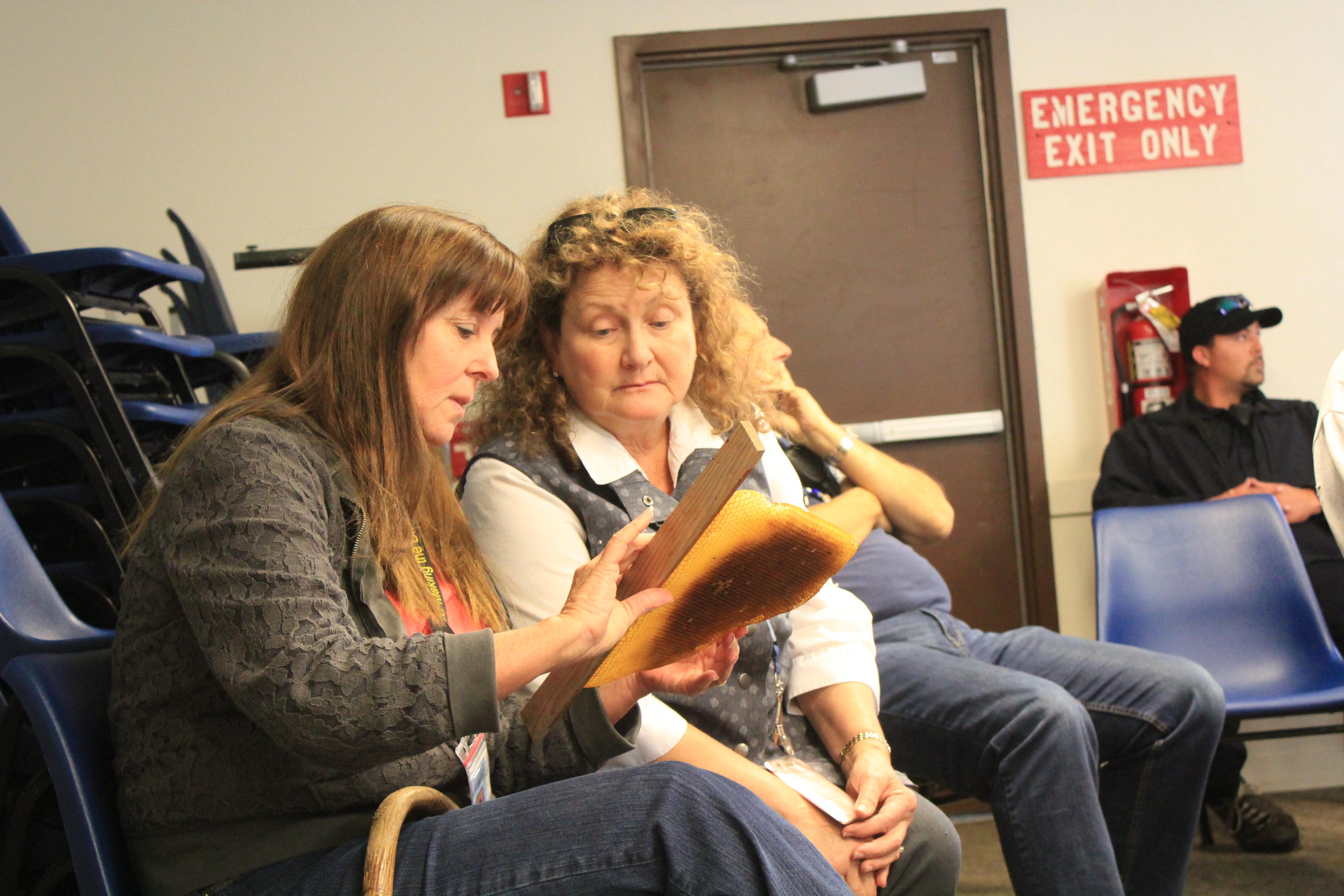
Staff get a closer look at honey comb. Photo by Emily Passarelli.
Shawn Piliponis coordinated with the Sustainability in Prisons Project (SPP)-Evergreen staff Kelli Bush, Emily Passarelli, and Sadie Gilliom to arrange and sponsor the beekeeping class for LCC inmates and staff. The class was taught by Rebekah Golden and Gabriel Quitslund from Bee Thinking in Portland, Oregon. Rebekah has worked with bees for eight years in university research labs, her own apiary, Bee Thinking’s apiaries, and other community organizations. Gabriel is a sales manager for Bee Thinking who has a vast knowledge of bees and issues related to beehives such as disease, colony collapse, and pests.
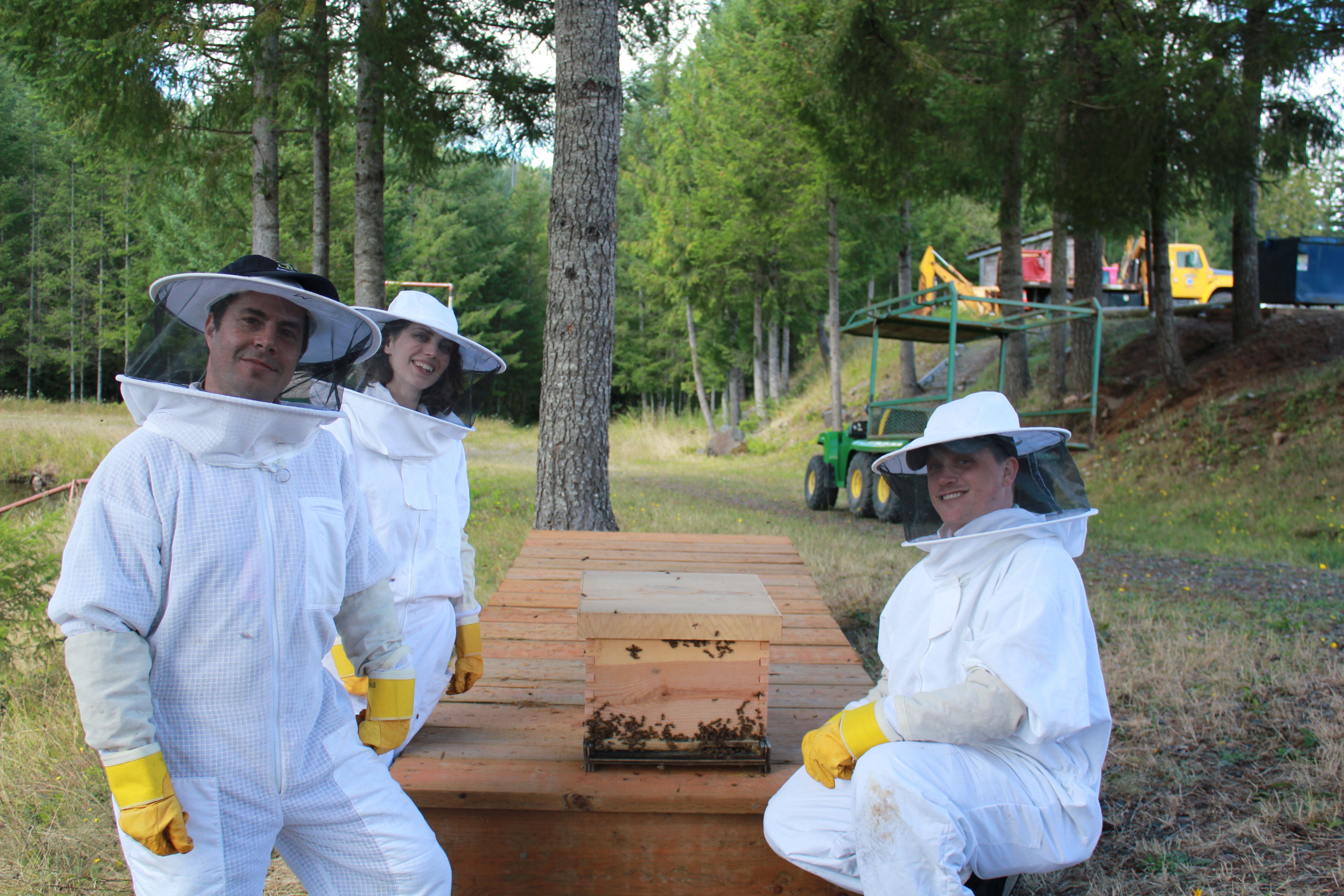
Bee Thinking’s Rebekah Golden and Gabe Quitslund help CC2 Shawn Piliponis set up Larch’s new beehive. Photo by Emily Passarelli.
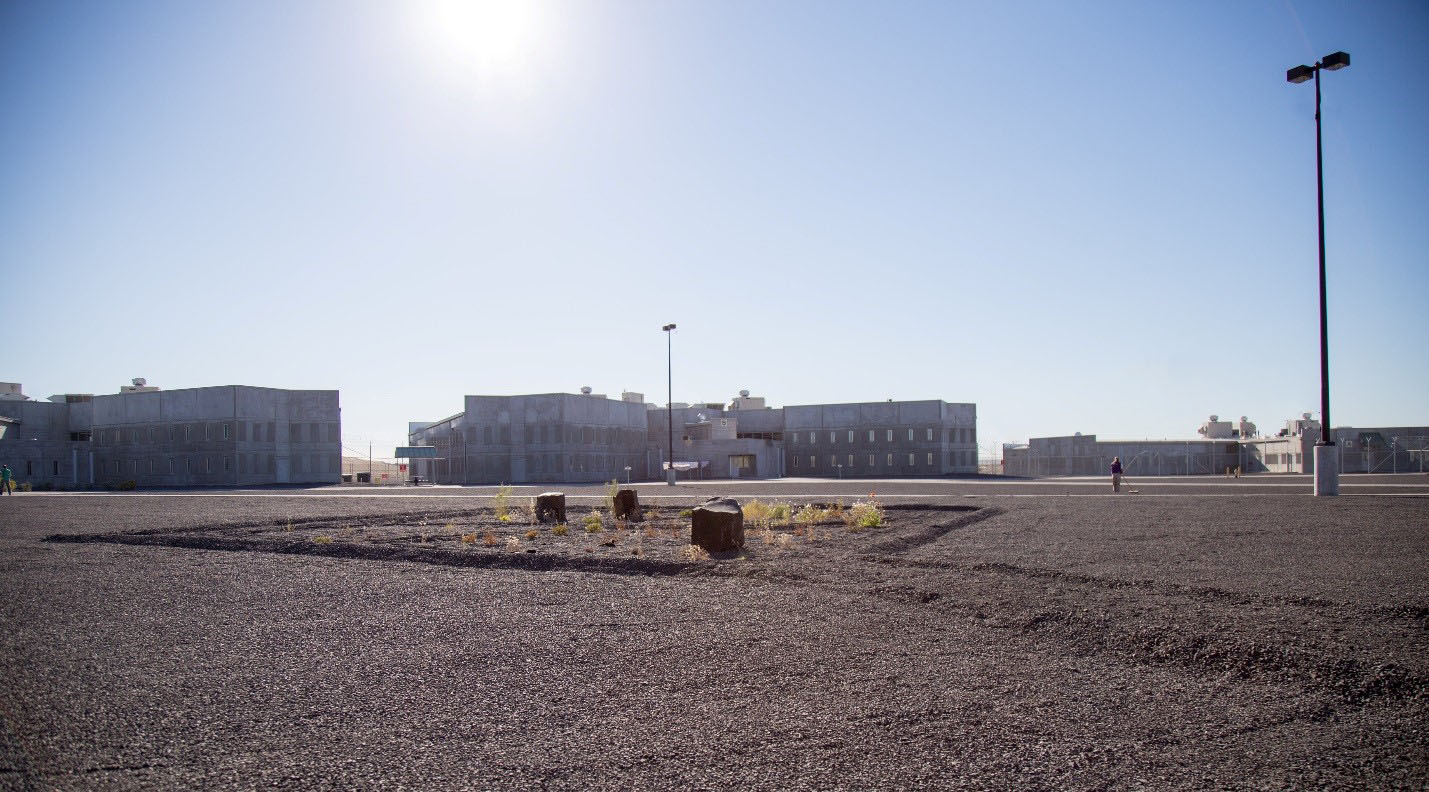 CRCC during the summer. The picture is looking at some of the units and the courtyard with a rock garden in the center. The gardens at CRCC all feature native plants and rock designs. Photo by Ricky Osborne.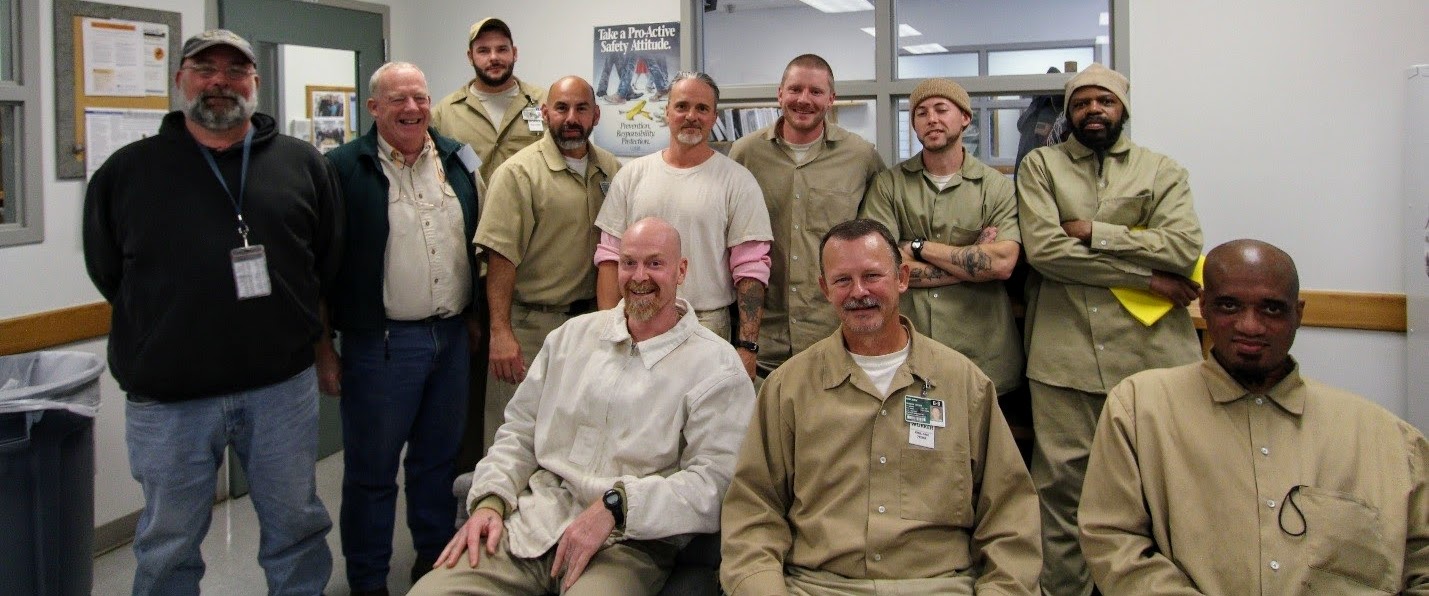

 Graduation brings an end to student-staff employment. Each coordinator trains their successor, which is as much about introducing them to the culture and ways of thinking as it is about program policy and protocols. Each turnover is bittersweet. We have to say good-bye to someone we have relied on and invested in, and it is painful to see them go.! At the same time, we get to welcome someone new, and their fresh perspectives helps SPP to continually improve; we can’t get stale! Also, there is the satisfaction of seeing SPP alumni go on to new and valuable endeavors, and we take pride in supporting their ongoing careers and aspirations.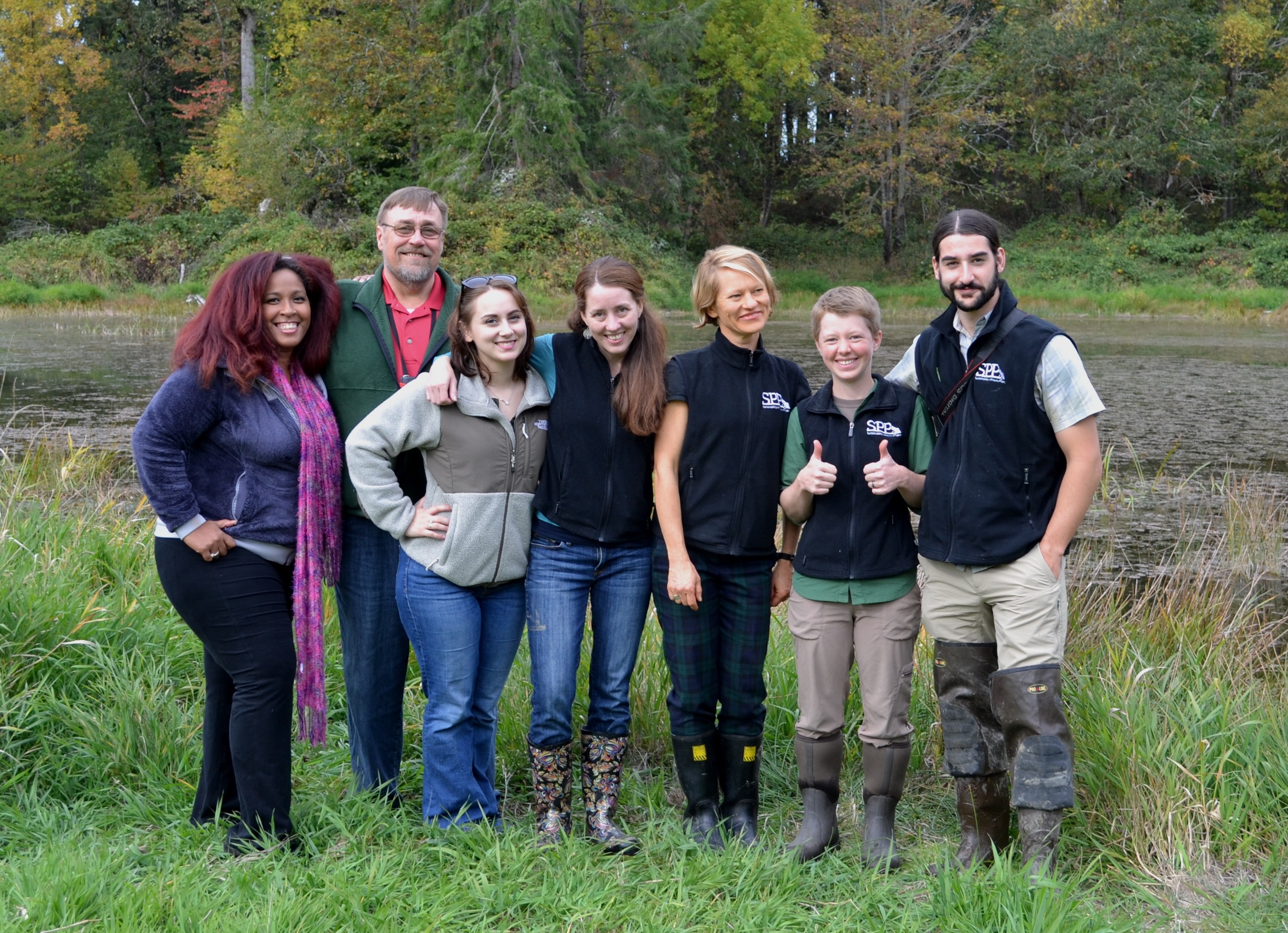



Once a year, SPP reports on all things sustainable happening in Washington State Prisons.